The first image in Rabah Ameur-Zaïmeche’s debut feature already contains the principles that have come to define his cinema. His camera slowly surveys the landscape from the roof of a typical French public housing building, lingering over apartment blocks and trees as the French-Algerian rapper N.A.P.’s “Au revoir à jamais” plays on the soundtrack. Ameur-Zaïmeche takes his time introducing this world, allowing the neighborhood to take shape as a lived environment rather than a backdrop or social problem, shaped as much by everyday movement as it is by architecture. Screening as part of the Museum of Modern Art’s “Immigrant Nation, People in Transit” film series, Wesh, Wesh, What's Happening? (2001) follows Kamel (played by Ameur-Zaïmeche himself), an Algerian immigrant in his mid-30s who has returned to France after serving a five-year prison sentence in Algeria that had barred him from French territory for two years. He finds himself suspended between places: unable to secure legal papers and thus find stable work, l reliant on the solidarity of the community he grew up with.
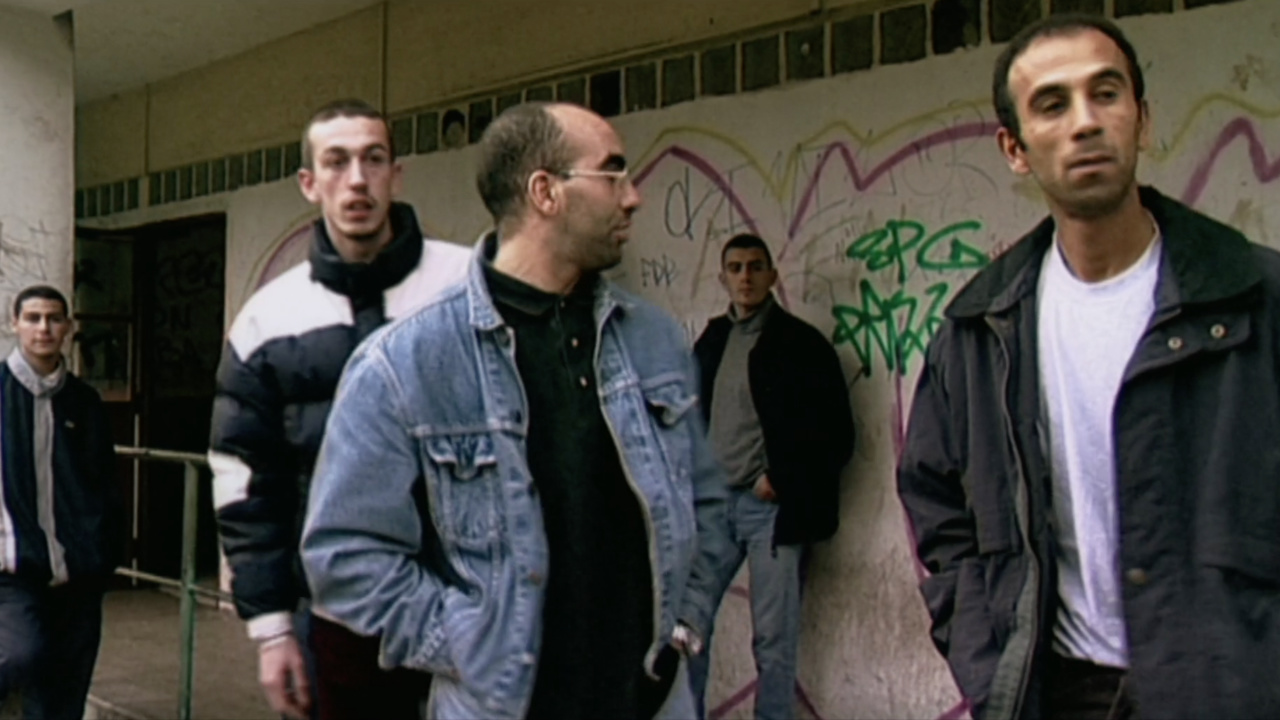
The elevated perspective of that opening scene never becomes one of surveillance. Before long, the camera lowers and joins the ground, moving among bodies gathered on football pitches, sidewalks, and street corners. Shot with an unassuming digital handheld camera, the film resists the sensationalism that has come to define so many cinematic representations of the banlieues. A great deal happens in the film, and almost nothing happens at all. Young men wait, drift, joke, play, and watch the world around them—an answer, perhaps, to the greeting repeated throughout the film: “Wesh, wesh, what's happening?” Not much, at least in the conventional dramaturgical sense; rather than organizing his narrative around spectacular confrontations, Ameur-Zaïmeche finds political force in the rhythms of everyday life, allowing Kamel's story to become a quiet yet powerful reflection on injustice, police violence, and masculinity, without reducing his character to a social case study.
Ameur-Zaïmeche’s commitment to observation never becomes didactic: information arrives gradually, almost incidentally, through conversations and fleeting encounters. Drawing as much from documentary as he does from the visual language of music videos, Ameur-Zaïmeche blurs the boundary between observation and fiction. His debut is remarkable not simply for what it depicts, but for the way it looks: with patience, restraint, and an unwavering belief that ordinary gestures and shared spaces deserve the same cinematic attention as moments of crisis. In refusing spectacle, he discovers another kind of dramatic intensity: one that is rooted in presence rather than escalation.
Wesh, Wesh, What’s Happening? screens this evening, August 12, and tomorrow, August 13, at the Museum of Modern Art as part of the series “Immigrant Nation: People in Transit.” It will be preceded by Barry Jenkins’s My Josephine.