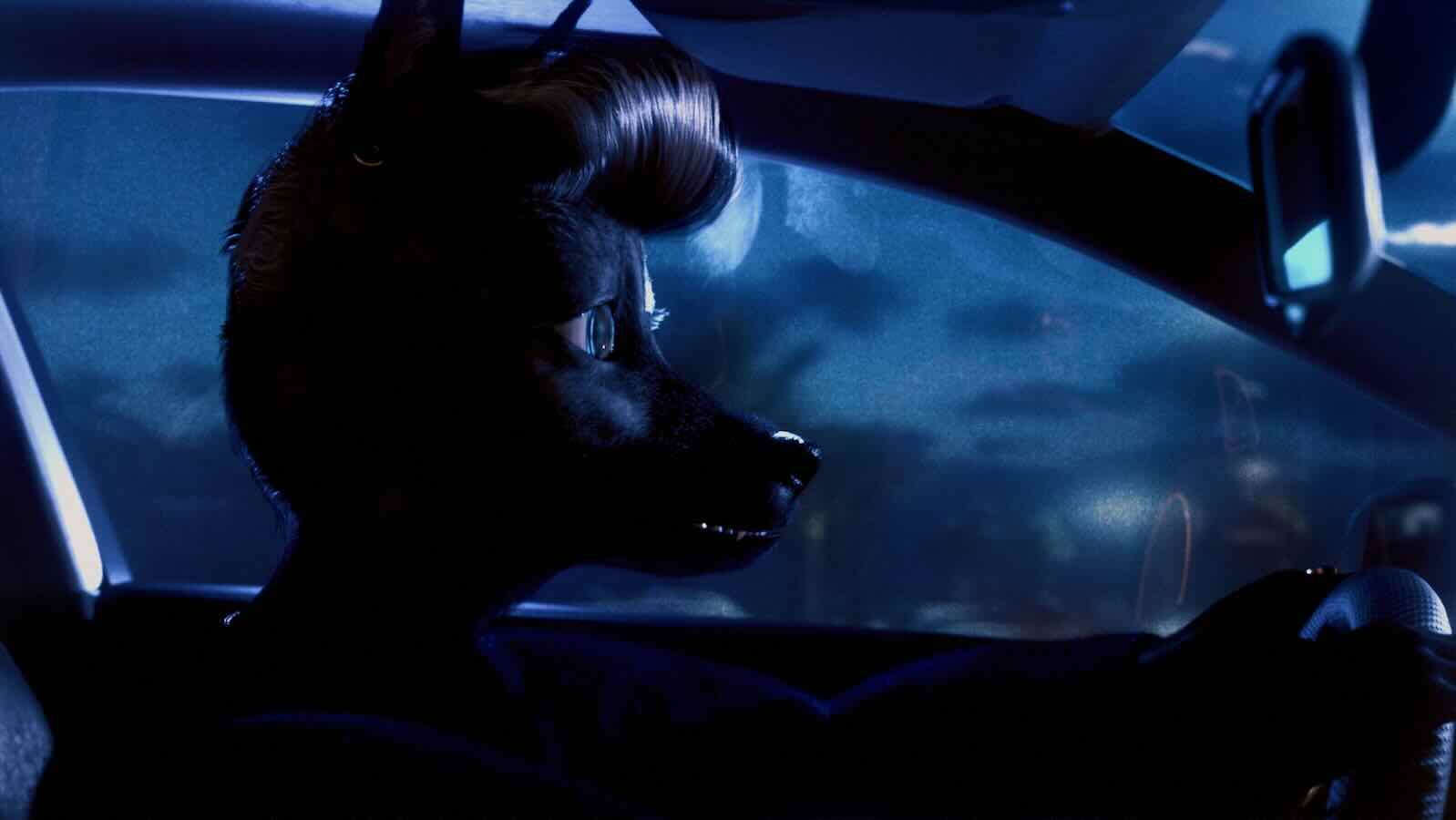
Orian Barki and Meriem Bennani’s Bouchra (2025) centers on the life of its eponymous protagonist, a 35-year-old anthropomorphic jackal and queer filmmaker living and working in New York City. While grappling with a debilitating case of writer's block during the production of her semi-autobiographical film, Bouchra (voiced by Bennani) is prompted to confront what has been left unsaid between her and her mother, Aicha, a Casablanca-based painter (voiced by the French-Moroccan artist Yto Barrada) following Bouchra’s coming out nearly a decade prior.
Throughout the film, Bouchra moves between worlds: New York City and Casablanca; her private life and her family life; the past and the present. She does so communicating in Arabic, English, and French. Bouchra yields to the meta-fictional, blurring the distinction between what is real and what is imagined. Bouchra sketches onto post-it notes stills that are not definitively established as reflections of the present, scenes from her film, or diaristic memory. Through the use of animation and human-like animal characters—a jackal, a lizard (voiced by Barki), a cow, a bear, an elephant—Barki and Bennani create space for relational dynamics to be examined beyond the identifiers that trigger implicit biases. Bouchra is not merely a film about being a queer Moroccan woman. Nor is it a story about a mother’s linear path to acceptance of her daughter’s sexuality. Rather, Bouchra reveals that which is achieved through sustained, emotionally honest exchange. Its characters are presented in their wholeness—they are not flattened into vessels for monolithic cultural critiques or reductive designations of good or bad.
The characters’ unpretentious narrative is placed in contrast with a visual invocation of fantasy—airy daytime scenes that verge on reality and nighttime sequences that are saturated in neon light. The sound design is colored by Chaabi and Raï music that enters and exits scenes seamlessly, bridging the nostalgic and the contemporary. Scenic compositions are established through a mix of 3-D scans whose striking specificity reflects great care. Bouchra wears high-top Prada sneakers and a black leather jacket (designed by costume designer Becky Akinyode); Aicha’s paintings (by Patricia Iglesias Peco) fill their family home; in Bouchra’s bedroom is a copy of WAWOG’s The New York War Crimes; Bouchra’s Moroccan lover, Lamia, wears a gold nameplate necklace that reads “ لمياء.” These subtleties reveal character rather than explain it, situating the narrative within very particular social, cultural, and temporal contexts.
Bouchra and Aicha project onto one another the parts of themselves that remain unresolved. Arriving at their family home in Casablanca, Bouchra sits on the living room floor and gifts her mother a book by the Lebanese painter and poet Etel Adnan. Bouchra asks Aicha to think of Adnan when she is stressed, but the conversation ends awkwardly when she eats a date from the platter in front of her. What Bouchra leaves unsaid is that Adnan was a queer woman. Only through the eventual confrontation of this self-censorship are Bouchra and Aicha able to address the barriers that have inhibited their self-expression and candor with one another. Barki and Bennani are rigorous in their references and it is paradoxically through this granularity that Bouchra becomes universally resonant. The film does not make broad assertions about representation and identity in isolation, but rather, through relationality, Bouchra conveys a collective sensibility that transcends the confines of place and time.
Bouchra screens tomorrow evening, June 26, and on June 27 and 28, at Metrograph as part of the series “Focus on Orian Barki & Meriem Bennani.” Directors Orian Barki and Meriem Bennani will be in attendance for Q&As at each screening.