
The globe-trotting documentaries of Michael Glawogger, Nicolas Rapold wrote in The New York Times in 2012, “can induce in viewers awe at the visuals, surprise at the intimate access to exotic lives, and perhaps a vague sense of guilt. You might wonder: Is this for real, and is it O.K. to like it?”
The Austrian filmmaker’s documentaries are heavily stylized, often semi-staged surveys of dire poverty at the far margins of the globalized world: a sweat-soaked New York street hustler shooting up and nodding off midsentence; Pashtun migrants heating their teapot with a welder’s blowtorch; a Mexican sex worker performing unsimulated oral sex. Visually stunning—the films are “so jaw-dropping it’s almost monotonous,” to borrow J. Hoberman’s assessment of House of Flying Daggers (2004)—Glawogger’s so-called “Labor Trilogy” of Megacities (1998), Workingman’s Death (2005) and Whores' Glory (2011, pictured at top) insist on the transaction between the Western gaze and the object of its curiosity, raising questions about extractive documentary practices that these days are answered with data packets depicting the subject’s-eye-view of atrocities foreign and domestic.
In 2010, Dennis Lim, now the Artistic Director of the New York Film Festival, championed Glawogger’s work at the Flaherty Seminar, an incubator of difficult conversations about documentary ethics. Subsequently, he organized a screening series that served as impetus for the Times piece quoted above. Rapold characterized that series as a “midcareer retrospective,” but Glawogger has been conspicuous in his absence from contemporary discourses his films seem designed to provoke. He died suddenly, in Liberia, in early 2014, having contracted malaria while preparing what was to be his next movie. Spectacle’s revival of the “Labor Trilogy,” reacquaints New York with a major transitional figure in nonfiction film, an analog explorer bestriding a world in the process of being made smaller by technology.
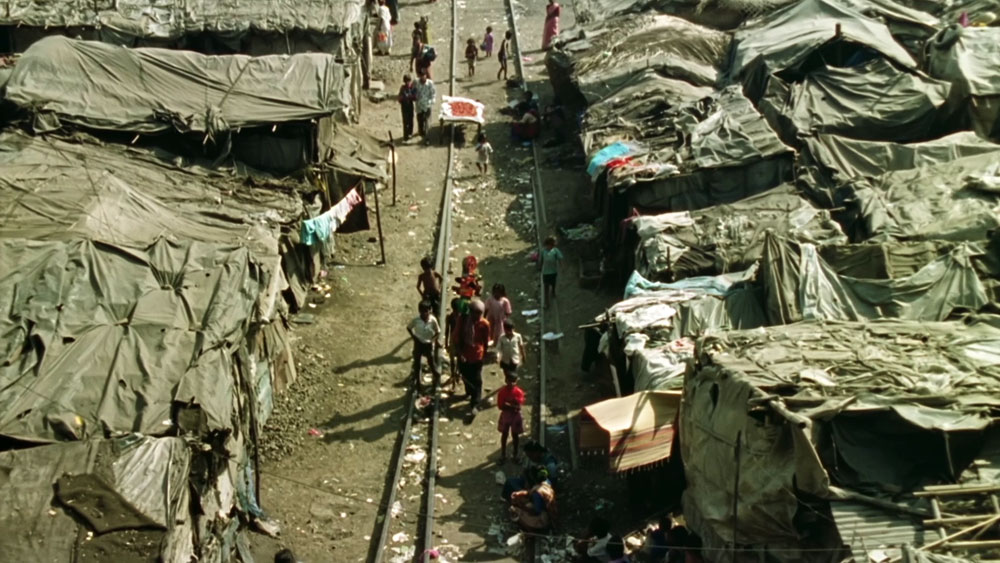
All three entries open with an epigraph; Megacities’s comes from William T. Vollman: “And perhaps in abodes of poverty, where health, learning, shelter and security are not birthrights, the soul is not a birthright either.” Subtitled “12 Stories of Survival,” the film hopscotches between the rainbow-stained dye sifters and trash pickers of Mumbai; factory workers and street urchins and drunks drying out in police custody in Moscow; scammers in early-Giuliani Times Square; street vendors and dog fights in Mexico City. Glawogger lingers on sights like the butchering of chickens in a blood-spattered Indian slaughterhouse—even workers subsisting on pennies a day can hand misery down the pecking order.
Glawogger let his subjects cadge money out of him to keep them around and interested, and would often re-stage scenes from their lives, as when Mikey, his Times Square hustler, takes a trick up to a hot-sheet motel and threatens him with a box cutter. He once explained in a Q&A at the Harvard Film Archive, “the real reality that you put on your screen is your vision of a reality. And the only thing you may never do is ask people to do something that they normally don’t do.” Cinematographer Wolfgang Thaler, also the regular cameraman for Glawogger’s sometime collaborator Ulrich Seidl, pulls off 360-degree pans and long tracking shots, and poses workers in striking tableaux against their surroundings while Glawogger asks them about their dreams. Their reflections are aphoristic and frequently profound: “What is life? Watching films, having fun with friends and sleeping next to the restaurant, getting up the next day, drinking tea and doing your work again.” These large-format portraits share a collaborative majesty with those of Glawogger’s contemporary Pedro Costa, but Glawogger and Thaler aim for a more articulated contrast in color temperature between foreground and background, achieving remarkable dynamic range with celluloid film and primarily natural light.
Few Europeans in New York City in August of 1997 made it as far as the New Lots Avenue subway station, but Glawogger did, in a Megacities chapter scored to the WFMU call-in show “Aerial View,” functioning as a New York chorus (sort of like Do the Right Thing, down to the stultifying humidity). The transnational, reconstitutive principles of sampling inflect this millennial study of everyday life under globalism: Glawogger soundtracks a cut from post-Soviet Russia to the USA with a hip-hop remix of Churchill’s “riddle wrapped in a mystery inside an enigma” quote, and as edited by Monika Willi, visual rhymes abound. Motifs such as buskers playing accordions recur across cultures, while mass-produced clothes reappear across the supply chain—Mighty Ducks gear appears as both streetwear and cast-off, and a shirt woven in an Indian sweatshop is hawked in New York—portending the even shorter life cycles of fast fashion. The film blends a granular, immersive look at menial labor à la Wang Bing with the world-mapping “network narratives” soon to come into vogue alongside imperial blowback.
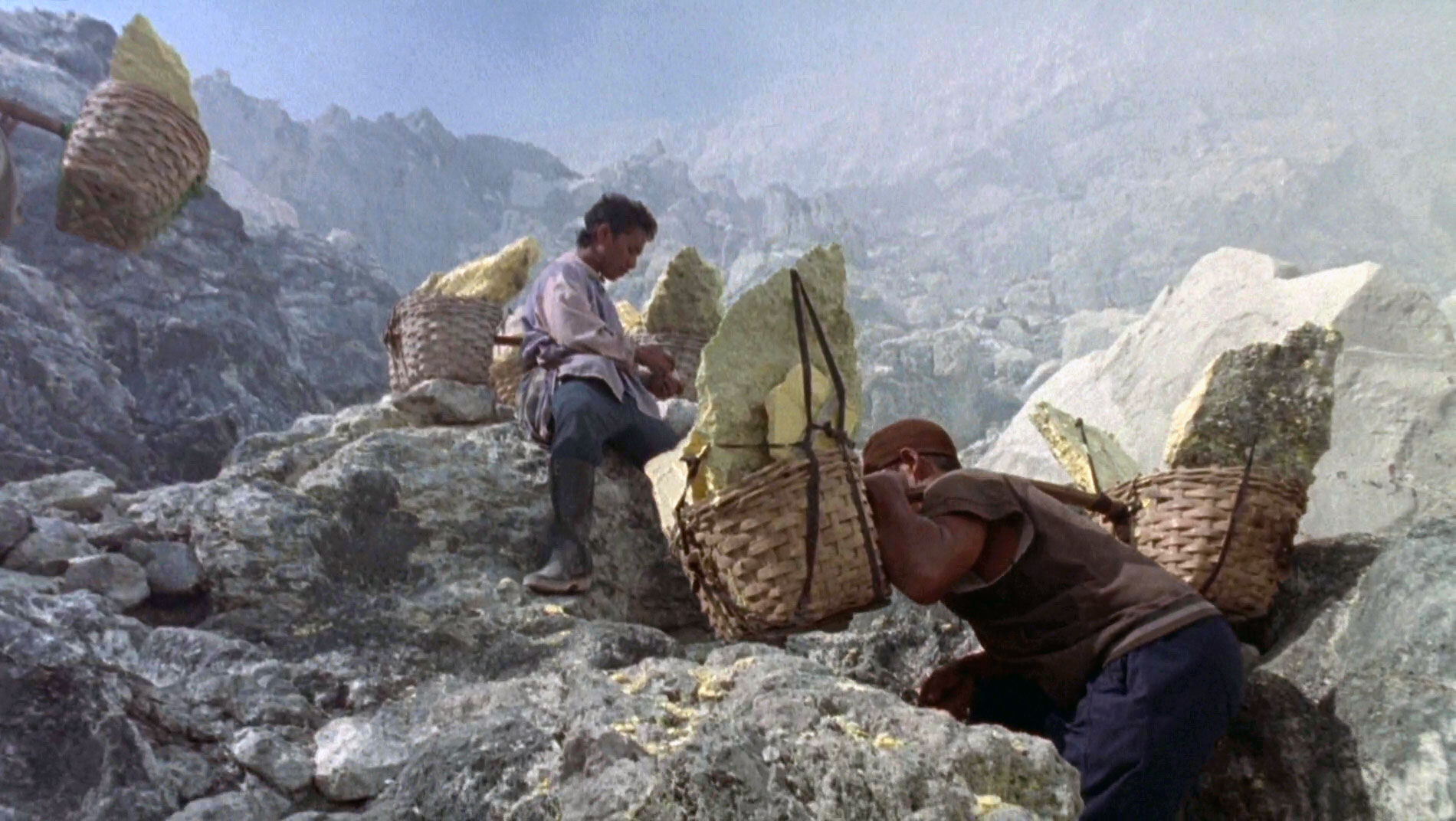
Workingman’s Death presents “Five portraits of work in the 21st century”: coal miners illegally working a closed shaft in Donbass, Ukraine; collectors gathering hundreds of pounds of sulphur and carrying it down a mountain in wooden baskets in Indonesia’s Ijen volcano complex; butchers wielding machetes at an open-air slaughterhouse in Nigeria; ship breakers in Pakistan; and steelworkers in China. (Plus an epilogue in Western Europe, at a defunct industrial works turned into a “unique leisure park” for carefree youth.)
Thaler’s compositions are as monumental as the post-human landscapes of Nikolaus Geyrhalter, another influential Austrian documentarian of the era, but they are also active sites of labor. The sights he captures are frankly incredible—the claustrophobia of the mine and the vertigo of the mountain, the billowing black smoke and open fires at the charnel house, the tumbling wreckage of the rusted-out hulls and the flying sparks at the blast furnace—and frequently incredibly dangerous, as when Thaler straps on a Steadicam rig to run alongside the sulphur collectors as they pad past the gushing steam vents. It’s in the Indonesia scenes that Glawogger comes closest to the anthropological ironies of Seidl in a scene—staged, but based on reality, Thaler told Film Comment—in which the sulfur collectors disrupt a tour group’s photo op, and sprint their way past lounging hikers (including one wearing, an Osama bin Laden T-shirt).
Huge billowing clouds of poisonous sulphur are among the many symbols of hell in the film: a black pit, goats and the gushing blood of butchered animals, fire everywhere and piles of ash. Anyone of an academic bent can connect these vignettes of cosmic individual struggle to their economic context of automation, outsourcing, and climate crisis, but there remains something of the swashbuckler in Glawogger’s travels to the poetic extremes of human experience. Like Michael Haneke (with whom, in Willi, he shared an editor), the extensive unsimulated animal slaughter in his films is cold in its remove as well pessimistic and sensational. Yet, his films are not deliberately edgy and his methods are not strictly clinical. In Workingman’s Death, sit-down interviews necessarily show his subjects at rest, as their work continues in the background without them. Leisure is a precious commodity, and for the moment, Glawogger and his subject share in it equally. Glawogger’s films were criticized in their own time as “leering” and touristic, but to put it bluntly: it is difficult to imagine Seidl or Haneke dying of malaria.
Glawogger’s approach, in its aesthetic intensity and subject buy-in, reached its apex in Whores' Glory, the capper to his midcareer retrospective and by tragic circumstance his final film. After two films about the breadth of work, he zeroed in on the oldest profession. The film is labeled “a triptych,” and introduces its three locations in split-screen, like an altarpiece, and then with glimpses into the role religion plays in its subjects’ lives. In Thailand, a young woman in front of a Buddhist altarpiece says, “I pray hard to become rich and successful”; in Bangladesh, one tells the camera, of oral sex, “Allah didn’t create my mouth for that purpose”; in Mexico, one speaks of the relationship between the Catholic God and Santa Muerte. Glawogger uses such literary flourishes to expand the scope of his films, even as he stays focused on day-to-day survival.

In Bangkok, a brothel called “The Fishtank” is legitimized by a computer payment system and the bustle of middleman around the panopticon of a two-way window, from either side of which the expatriate and local clientele, and the women, with numbers pinned to their chests, regard each other. Faridpur, Bangladesh’s “City of Joy,” is something like a warren of alleys, in which mostly upsettingly young girls, having been sold into the trade and loaded with debts to pay off, paw desperately at prospective johns. In “The Zone,” the red-light district of Reynosa, Mexico, workers linger in their small cubicle-like rooms as men drive their cars in slow circles, surveying the offerings. Since you can’t google historic exchange rates while watching the film in a theater: 1700 baht in 2011 is the equivalent of a bit more than $50; 200 pesos is $16; 200 taka is $2.75.
Workingman’s Death score, by John Zorn, varies its Chaplinesque cog-in-the-machine theme with local inflections; Whores' Glory is daringly scored to nondiegetic hipster music, including tracks by Tricky, CocoRosie featuring ANOHNI, and PJ Harvey. It’s dreamy and narcotic, often sexy and a little lethargic—barred out, which seems at first decadent, then terribly sad. Given the eloquence and visibility of today’s digitally native whores, whose documenting of their working conditions has done so much to generate understanding and solidarity, contemporary viewers of Glawogger’s trilogy will probably have the hardest time with Whores' Glory. All the sex workers in the film are seemingly cisgender, which even in a film that makes no pretensions to comprehensiveness is an omission bordering on erasure. And, I did not realize until looking it up later that Reynosa is a Mexican border-city on the Rio Grande, and part of an international metroplex with McAllen, Texas. Were there really no white johns crossing the bridge to slum it in the Zone, or were they just better at saying no to a fellow gringo with a camera?
But equally, Whores' Glory is a film of stunning intimacy, showing the Thai prostitutes visiting a host bar to flip the gender dynamic; an old bawd, terminally alcoholic but very charismatic, relating tricks of the trade like ice-cube rim jobs and describing men’s “balls swinging like church bells”; two very young girls, one cheerful and one tearful, confessing the physical toll of having intercourse several times a day.
In Megacities, men in the audience of a Mexico City burlesque show move, tracelike, to the front row, to paw at the performer with hands and mouths, but Whores' Glory withholds the sexual act itself until its penultimate scene. The men in the film are largely kept at a distance from Glawogger’s subjects, and in their own interviews they analyze the different, more dull and companionable love they feel for their wives; enthuse with boyish, idiotic avidity over their love of sex; or boast unnervingly about “pounding ass” or giving it good to these “bitches.” Their blinkered perspectives stand in ironic juxtaposition with the access Glawogger offers to his subjects’ interiority, famously the one thing a john’s money can’t buy. Glawogger cannot grant his subjects power—though he did pay them for their time—but he can, and does, engender an appreciation for their wisdom. They are women of experience, and experience is the heart of Glawogger’s cinema.
“Michael Glawogger’s ‘Globalization’ Trilogy” runs throughout the month at Spectacle.