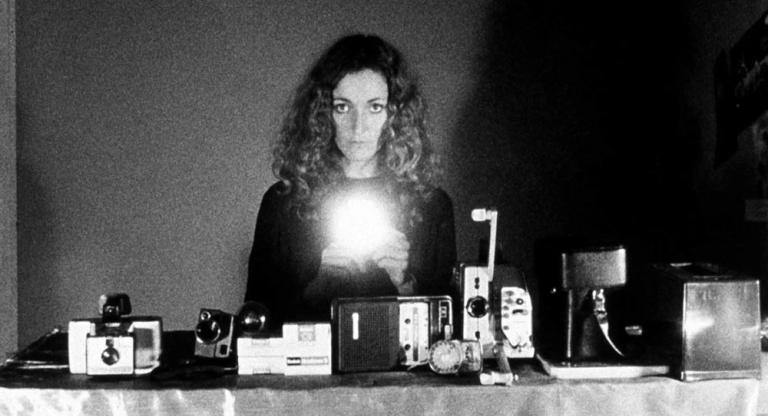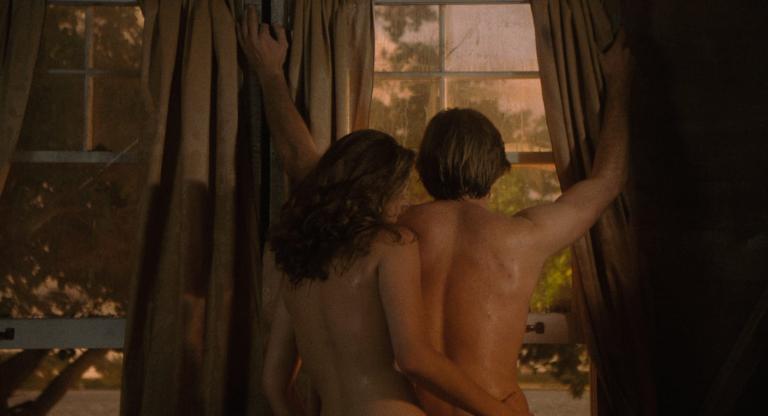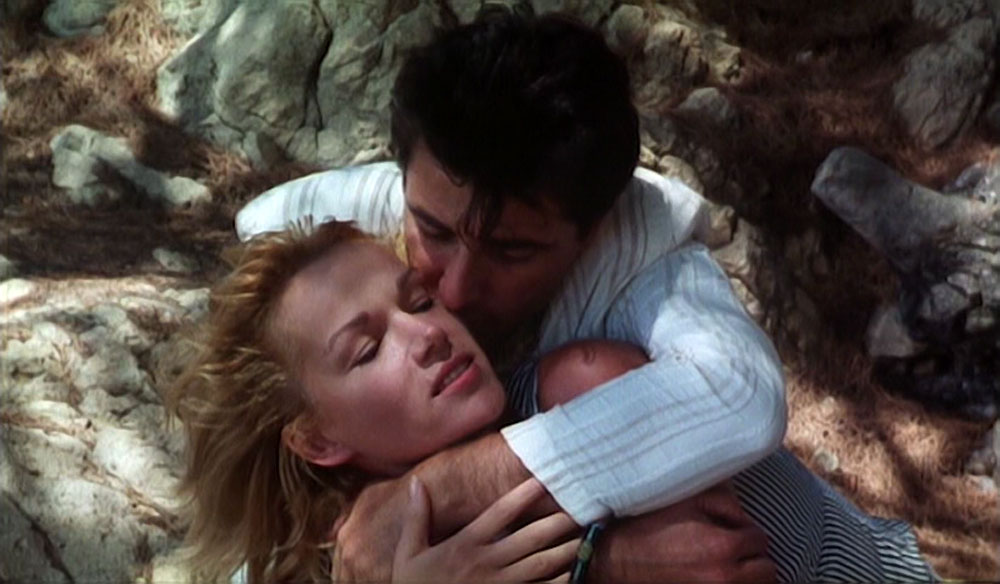
Haydée Caillot occupies an obscure corner of a familiar strain of French cinema. A peripheral figure in Compagnie Éric Rohmer, she moved fluidly between acting and filmmaking, appearing in A Tale of Winter (1992) and Four Adventures of Reinette and Mirabelle (1987) while writing, directing, and starring in her own work. Her small body of films, some even produced by the Compagnie, belongs to that same rambly-talky tradition about matters of the heart, but has a feminine sensibility that’s particularly attentive to the humiliations and freedoms of singledom. Visually, Caillot’s world is one of sunlit details—seashells gather in catchall trays, tarot cards promise some clue to the future, and red turns up everywhere.
If L’anniversaire de Paula (1993) and Les Volets Bleus (1987) are indicative of what Caillot is like as a person, it’s clear that she is drawn to writing stubborn women who have accumulated enough life experience to have little patience for pretense: women who argue with waiters and find absolute vulgarity in planning. In both of these short films, the protagonist impulsively decamps to the seaside in pursuit of love. In L’anniversaire de Paula, a divorcée (Dorothée Blanck) arrives in the northern port city of Dunkirk hoping to celebrate her 50th birthday, which falls, cruelly and inconveniently, on the last day of the year. The only promising encounter she has is with her daughter’s former college roommate, now young and married, a neat counterpoint to Paula’s own unsettled state. But Paula has no interest in being pitied, nor does Caillot want to elicit such a reaction, presenting Paula’s situation in a matter-of-fact manner: she is “neither ugly nor with a partner, simply in the way.”
Les Volets Bleus (at 42 minutes, her longest film) follows an unmoored Parisienne (Brigitte Lahaie) living out of a hotel room by choice. Her life is in limbo and she is trying to rekindle a romance with a small-town ex (Jacques Mandréa). The film pairs Rohmer-like conversational intimacy with sexual frankness as the once-couple delve into a shared past that invites a rough comparison to Catherine Breillat. Lahaie—a former adult film star who reinvented herself as a mainstream actress by starring in films by Philip Kaufman and Alain Delon, and later as a radio host—gives the film much of its charge, commanding the screen with the full sweep of her body. Un dentiste exemplaire (1998), co-directed with Stéphane Pioffet and Aurélia Alcaïs, is a spritely little ditty and a welcome change of register. In it, a young woman needs money for a holiday and her roommate suggests she pose nude for a photographer. The film proceeds with the lightness of comedic anecdote and snaps into place with a final turn of dramatic irony.
Taken together, the three films make a small, unruly world—one that Lahaie herself, in a cheeky direct-to-camera address after the credits of Les Volets bleus, calls “sensual, moving, and—impertinent.” She could not have been any more correct.
“The Films of Haydée Caillot” screen this evening, September 16, at Nightclub 101 as part of the series “99 minutes (or less).”