If you were a New York cinephile in the 1970s and 1980s, many of your waking hours were programmed by the odd couple team of Jackie Raynal, a French expat who ran the bohemian Bleecker Street Cinema downtown, and her mustachioed husband Sid Geffen, an affable but shady real estate speculator turned repertory theater owner who operated the more conventionally upscale and uptown Carnegie Hall Cinema. Raynal was the more adventurous programmer of the pair. In 1977, she invited friend and critic Serge Daney to present a Cahiers du cinéma week, introducing New Yorkers to Jean-Luc Godard’s Numéro Deux (1975) and Chantal Akerman’s News From Home (1976). In 1979, she asked Jonathan Rosenbaum to program a “Rivette in Context” series, which paired films by the then-underappreciated French director with movies by Alfred Hitchcock, Fritz Lang, Jacques Tourneur, and more. She also carved out space at the Bleecker to open the 78-seat James Agee Room, a 16mm-only theater that allowed her to introduce young underground filmmakers like Jim Jarmusch and Amos Poe.
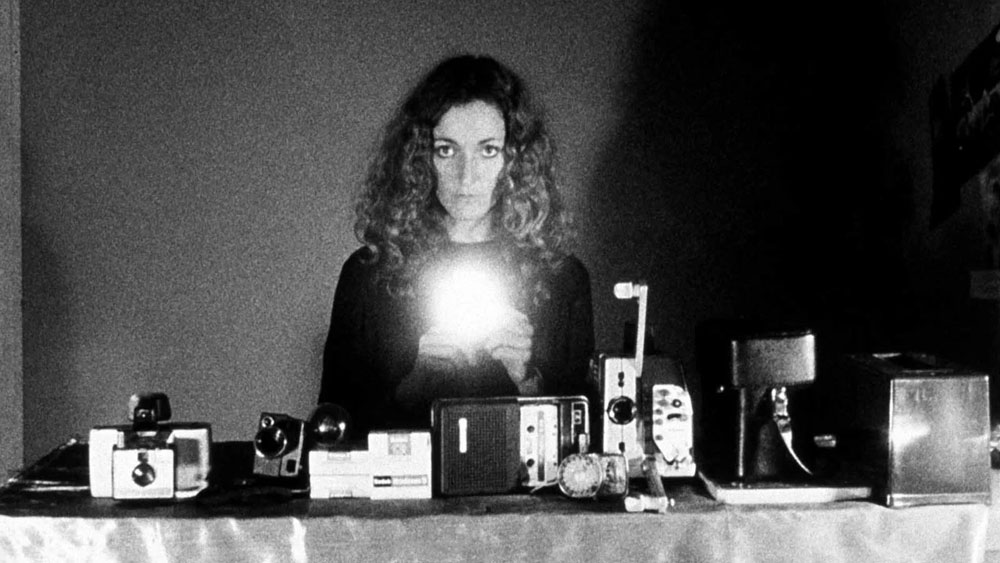
Raynal’s groundbreaking film programming was just one facet of her artistic life. After spending countless hours at the Cinémathèque Française, where she formed her artistic sensibilities and made important connections—she edited films for Éric Rohmer, and then became a key member of the Zanzibar Group, a collective of artists, writers, and students invited by the artistically-inclined oil heiress Sylvina Boissonnas to make underground films with complete creative freedom—Raynal directed, wrote, and starred in Deux Fois (1968), a singular, formally radical, and entrancing hour-long avant-garde film that simultaneously deconstructs the language of cinema and the nature of male-female relationships. The aforementioned, virtually plotless film, is held together by its structural experimentation with repetition and long takes, but also by the sheer beauty of its geographical landscape and Raynal’s own spellbinding beauty and understated comedy in the lead role. Years later, Raynal starred as herself in the deadpan autobiographical short feature Hotel New York (1984). Co-written with Gary Indiana, the absurdist gem, which was elegantly photographed by Babette Mangolte, portrays Raynal’s disorienting experiences as an immigrant in New York and her marriage to Geffen (who plays himself in the film). Seen today, it also plays like a priceless documentary of the art scene at the time.
These films are part of a highly concentrated three-day series at Anthology Film Archives that gives a capsulized glimpse at her fascinating life; all of the screenings will be accompanied by Raynal in person. Her essential collaborations with Rohmer are invoked in the poignant portrait film My Last Interview with Éric Rohmer (2008). And, her own personal documentary Gougnette (also from 2008) is a revelation; it is an artful collage film about Raynal’s parents, who were Communist resistance fighters during World War II. The series is rounded out by two of the treasures from Raynal’s Bleecker Street Cinema programming: Jim Jarmusch’s debut feature Permanent Vacation (1983) and Jacques Rozier’s vibrant short Paparazzi (1964), which captures the intense efforts of photographers to catch Brigitte Bardot on camera during the filming of Godard’s Contempt (1963).
David Schwartz: The Anthology series covers so much of your life and career in just a few films. I want to start by asking about the importance of the Cinémathèque Française to you, because I feel like it had such a strong effect on your approach to film and to your career as both a filmmaker and programmer.
Jackie Raynal: I was really a cinephile because of my friends [film critics] Serge Daney and Louis Skorecki. I spent a lot of time with them at the Palais de Chaillot [the home of the Cinémathèque from 1963 to 2005] in the 1960s.
DS: And didn’t you meet the person who first hired you to work in film editing there?
JR: Yes. Women started editing because of the war. During the war there weren’t enough men around to edit. It was the only job available to women in film. The cameras were too large and heavy. [Laughs] There were a lot more female editors in France than in America at the time.
DS: That led you to work with Éric Rohmer?
JR: Very important. I started cutting with him. The first film I edited was La Boulangere de Monceau [1963] and then La Carriere de Suzanne [1963]. Then I cut a lot of films for French television and worked again with Rohmer to cut La Collectioneuse [1967].
DS: I read that you worked a lot on sound. That you would record sounds and give them to him.
JR: Yes. With Rohmer, there was only one take, so there weren’t many choices. He didn’t believe in many takes. He would rehearse a lot, but when he shot, he shot only one take.
DS: So a lot of your work had to do with building the soundtrack?
JR: Yes. All the films were post-synchronized. There was no direct sound while shooting. He would record sound afterwards.
DS: How did you make the switch from editing to making your own films?
JR: The first film I made was Merce Cunningham [1965], directed by Étienne Becker. It was a documentary and I was very excited about the way they danced. Deux Fois was sponsored by a very rich woman, Sylvina Boissonnas.
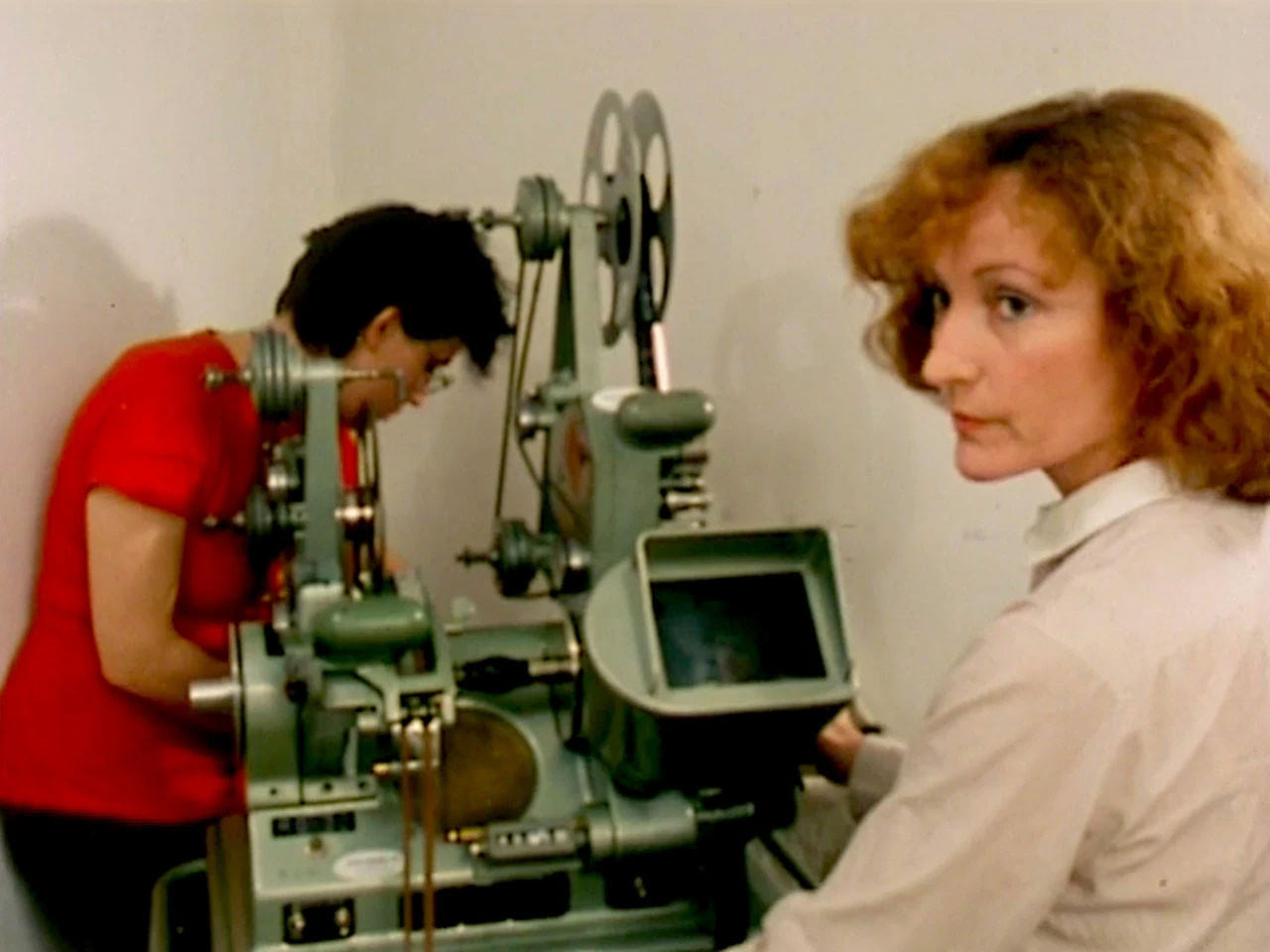
DS: What were the circumstances of that?
JR: I was doing everything with the Zanzibar Group [a group of filmmakers sponsored by Boissonnas], with Philippe Garrel, Daniel Pommereulle, Olivier Mosset, and my boyfriend Patrick Deval. I said to myself, “Why don’t I get away from them and do my own film.” I’m from the South [of France] and I always loved Barcelona. It was a challenge for me because I didn’t have any script, so it was really an avant-garde film.
DS: How was it conceived? It’s a film about the way women are perceived, and about male-female relationships.
JR: It’s a film against editing. Deux Fois means twice, and I would show scenes two times, sometimes five times. It was sometimes very spontaneous, but not always, because when you shoot in 35mm you can’t be that spontaneous.
I wrote the scenes the day before shooting. It was a love story between myself and somebody I didn’t know [Laughs] to bother my boyfriend, because my boyfriend had an affair and part of it was like, “I'm going to have an affair and I will shoot it and then he will see it.” That was the first idea.
DS: When I watched the film, I was thinking that the way that you photograph gestures feels very rooted in theater and dance.
JR: The way it was photographed was very classical. You see a lot of Barcelona, a lot of real people. It’s really between documentary and fiction. You never know where you’re going to go.
DS: I was surprised to read that there was some controversy around the film because you filmed yourself naked and that caused trouble for you in finding work.
JR: Yeah, that’s how it was at the time. But I had a cameraman who understood very much what I wanted to do. He was the cameraman for Philippe Garrel.
DS: I know you were looking at films from the New York avant-garde scene at the time, and you’ve talked about the importance of Jonas Mekas. Was that part of why you wanted to move to New York?
JR: Not so much. I didn't find any work in Paris, so after two years I left. I traveled all over the United States in 1969 and 1970. Then, when I came back to Paris, there was still no work for me. No more Éric Rohmer. I decided to go back to New York because MoMA showed Deux Fois, and they gave me the address of the French Film Office, which was not far away from MoMA. There, I met a director who hired me as a film editor for a very commercial film called Saturday Night at the Bath [1975]. It was a soft porno film. Do you know it?
DS: I don’t know that film.
JR: It was like Boys in the Band style. You could see a transvestite, you could see a lot of people at the Continental Baths. Then I worked a little bit with Jules Dassin and Melina Mercouri on a film called Rehearsal [1974]. I did the soundtrack.
DS: How did you get involved with the Bleecker Street Cinema?
JR: At one point, I was hired to do a French New Wave program by Sidney Geffen, who later went on to become my husband.
He bought the Bleecker Street because he only had the Carnegie Hall at the time, and he said, “I need another theater.” We passed by the Bleecker one day and saw it was closed. It was built by Lionel Rogosin in the 1960s. Then, in 1973, it was closed. So we bought it and I directed it.
DS: Originally, there was just one screening room and a bookstore.
JR: The bookstore was not commercial, because a lot of books were stolen, so I decided to make a small theater. There was an open screening every Monday, and that’s how I discovered Jim Jarmusch. He came with his film Permanent Vacation. I loved it, and I gave him a two-week run. It didn’t do very well, but he had a nice time with it.
DS: The James Agee Screening Room, which was equipped to show 16mm, became a showcase for low-budget indie filmmakers.
JR: The location was great, because it’s near NYU and the New School. There were a lot of young people. At the time, SoHo was a place where rents were not too expensive, so there were a lot of artists. We had a lot of people coming in, like Susan Sontag and Amos Poe. Amos was very popular; his films did well.
DS: There was that great series you did with Serge Daney that included Godard’s Numéro Deux. You gave free tickets to people who came to see it, and a lot of people used the ticket to come see it again.
JR: We gave people who didn’t like the film a ticket to come back for anything they wanted, and a bunch of them came back to see Numéro Deux again.
DS: When I started going to movies seriously, I went to the Bleecker Street and Carnegie Hall cinemas all the time.
JR: You were young!
DS: It was the year I went to college at Columbia. I would just go to repertory theaters all the time, so I was at your theater a lot.
JR: It was unique. We would show Raúl Ruiz films and Jacques Rivette films. People told me I was crazy, that I was not going to make any money. But it was very well attended. We showed Rivette’s four-hour movie L’Amour Fou [1969] and it got a full-page review in The Village Voice.
DS: You’ve described film programming as a form of editing, like the way Henri Langlois used to create interesting combinations of films.
JR: Well, I was a child of Henri Langlois.
Jackie Raynal will appear in person at Anthology Film Archives from September 15 to 17, for the series Jackie Raynal Presents.