The Southern Gothic is such an expansive branch of its mother genre that it feels at times completely disconnected from it. The old dark castle is swapped out for the country farmhouse and tales of aristocratic creatures of the night for those of the ordinary suffering of the destitute. Don Siegel’s The Beguiled (1971), based on Thomas P. Cullinan’s 1966 novel of the same name, locks the Southern firmly into the gothic, rendering thematic parent and child all but indistinguishable.
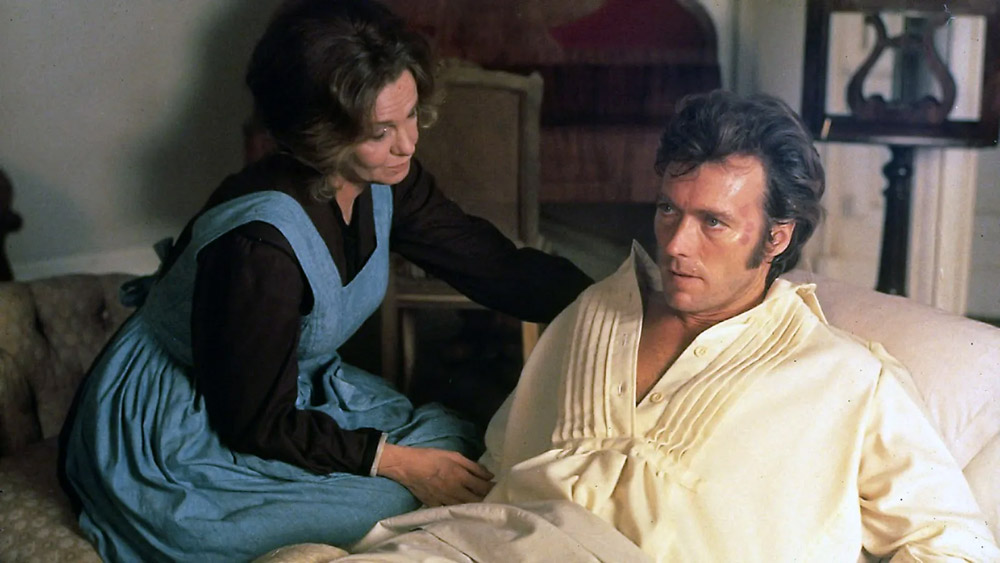
Siegel’s film, set in the back half of the American Civil War, stars Clint Eastwood as John “McB” McBurney, a Union soldier who is taken in by the residents of a Confederate girls’ school—headmistress Martha (Geraldine Page), teacher Edwina (Elizabeth Hartman), enslaved servant Hallie (Mae Mercer), and a half-dozen adolescent students—after a mortal injury. Immediately, a set of deeply entrenched sexual paradigms are established. McB represents a sexual menace—among his first onscreen acts is kissing a 12-year-old girl on the mouth—that is, according to his caretakers, characteristic of the Union army. “If the Yankees win, they’ll rape every one of us,” Abigail (Melody Thomas Scott) worries; later, passing Confederate soldiers warn Martha not to “advertise” the girls in her charge with a “Farnsworth Seminary for Young Ladies” sign, lest roving Yankee rapists see it.
Yet alongside this ambient threat of male sexual violence is a measure of female erotic agency and aggression born from the women and girls’ isolation. They set upon McB; Doris (Darleen Carr) suggests taking off his pants because “Yanks have tails” and as his stay goes on, he enthusiastically receives the attention of nearly the entire household.
With Hallie, his dynamic is different. She is uninterested in McB sexually, though she admits he “doesn’t look half bad, for a white man.” She is skeptical of his promise that, in exchange for helping him leave before her enslavers turn him over to the Confederate army, he will do his best to locate her lover Ben. Hallie explains that Ben escaped the school years earlier after Martha’s brother Miles (now missing, presumed dead) tried to sell him. A flashback suggests that Hallie fatally defended herself against an attempted rape by Miles.
This sexual transgression, commonplace in both antebellum history and its fictional representations, is not Miles’s only one: insinuating dialogue and fleeting flashbacks soon reveal that Martha and Miles were engaged in an incestuous union prior to his “disappearance.” This relationship, emphasized with chiaroscuro shots of a grand oil-painted portrait of the pair, reflects the peculiar gothicism of the genteel antebellum household; steeled against the supposed perversity of the abolitionist troops and racialized others, the family folds in on itself, turning abjectly inward.
The Beguiled screens this evening, June 27, at the Museum of Modern Art as part of the series “Universal Westerns.”