On his website, the artist Bruce Wood writes that he began to make films because, as a student of painting, he was frustrated that the images did not move. His search for the moving image brought him to the School at the Art Institute of Chicago to study with Stan Brakhage after undergraduate work at the Massachusetts College of Art and Design. Over about five years in the mid-1970s, he produced a series of black-and-white short films that bear little resemblance to most of the work he has since produced as a painter (or his narrative filmmaking foray, 2005’s The Door).
Wood’s films from the ‘70s elaborate a surprising diversity of effects within their narrow formal limits and have earned frequent comparisons to both the work of Andrew Noren, who shares a similar interest in the minimal exploration of the possibilities of texture in black-and-white filmmaking, and the painter Franz Kline for their shared narrow use of line. There is a felt consciousness of the eye’s search for the identifiable object in watching Noren’s films—trees, leaves, hair tucked behind an ear, water, always, and always moving—and an ease of letting go of that identification into abstraction.
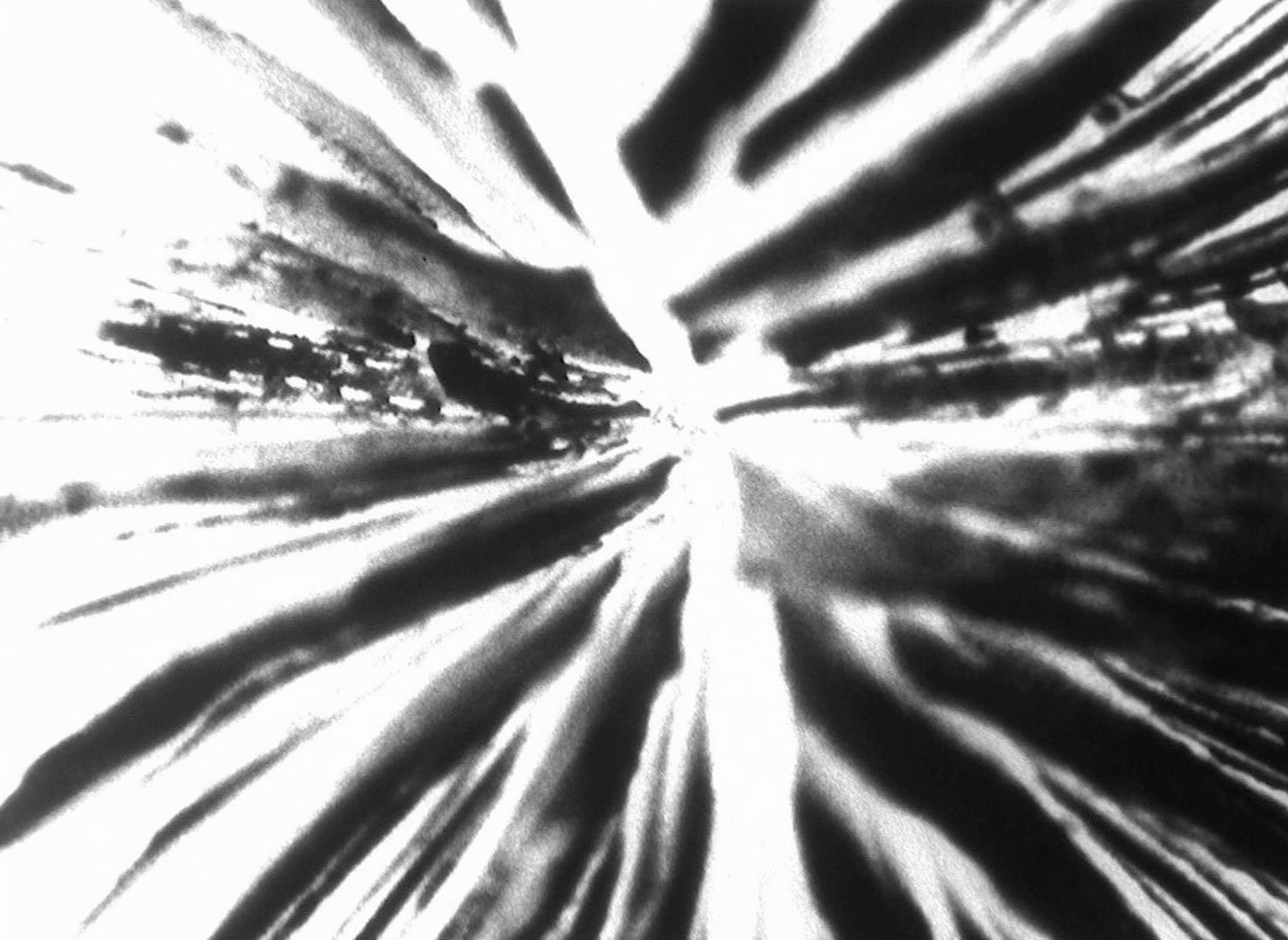
Wood’s technique and ambition develop across the films featured in Spectacle’s program. Textures grow precise, more delicate: columns of smoke spin into themselves before dispersing, made substantial in high contrast; silvery, agitated liquid surfaces are seen from the perspective of one submerged. Molten Shadow (1976, pictured above), the penultimate entry in the second program, charts complex relationships between form, speed, and motion—baccillary marks take on a written letter’s intentional curve when rushed across the field of vision, alongside the finer lines of hair, smoke, threads of dye slowly diffusing through clear water. The Bridge of Heaven (1977), the final and longest film in the second program, makes more overt use of camera effects, its shapes closer to discrete subjects, their textural shifts intentional, contained.
Taken together, the films seem driven by a mandate of experimental practice that’s less about developing a language of filmmaking for the benefit of the filmmaker than outwardly directed suggestions of possibilities for what the medium can do. Unlike Noren’s work, or some of Brakhage’s that may have directly inspired him, it’s difficult to imagine Wood’s filmmaking practice in overt conversation with the mundane experience of seeing the world immediately around him. He’s not asking the camera to exercise a transformative effect on the world, but instead using it to create a closed universe unto itself, manifestly full of potential to unfold and expand beyond the frame.
“Painting Shadow Calligraphy: The Short Films of Bruce Wood” runs July 18-19 at Spectacle. Bruce Wood will be in attendance.