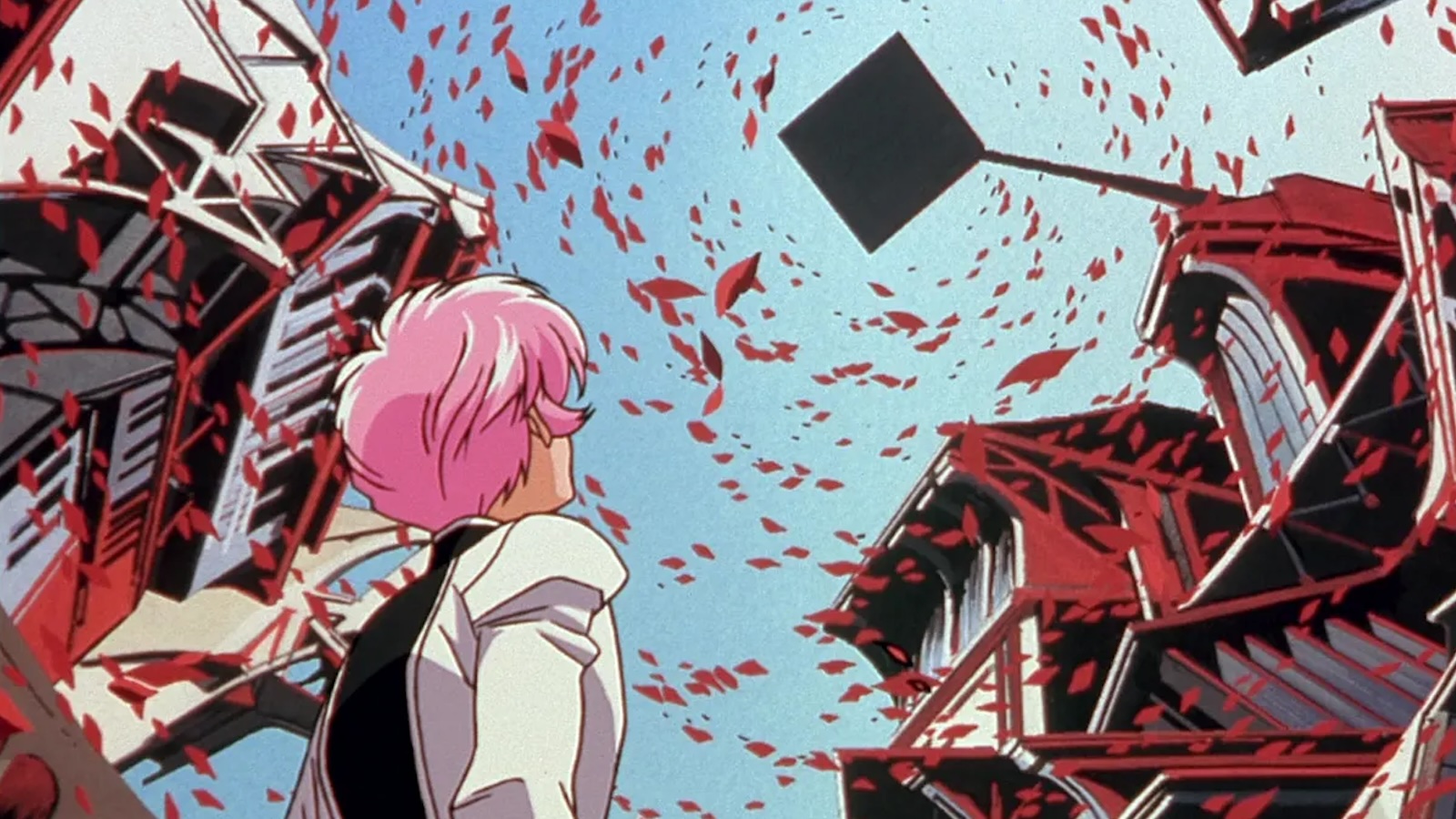
Created by the Be-Papas, an artist collective founded by director Kunihiko Ikuhara after his departure from the Sailor Moon franchise, Revolutionary Girl Utena: The Adolescence of Utena (1999) follows Utena Tenjou as she arrives at the otherworldly Ohtori Academy and finds herself competing in a mysterious dueling tournament. The duelists are fighting to be betrothed to Anthy Himemiya, the mysterious Rose Bride, and gain the “power to revolutionize the world.” Set within a beautifully animated, surreal environment of constantly shifting industrial-gothic architecture, endless staircases, vast rose gardens, and regal interiors, rigid heteronormativity is both enforced and spectacularly dismantled.
Utena’s gender presentation defies easy categorization. She moves with confidence between masculine uniforms in public and more feminine attire during private moments with Anthy, embracing a gender fluidity that exists entirely on her own terms. Other dualists challenge the gender binary in their own ways, craving liberation from everything that restrains them. None of the students at the Academy are straight, excluding select male duelists who seek to possess Anthy as their property, highlighting the lack of autonomy women experience within arranged marriage. Sexual violence and trauma extend beyond Anthy’s experiences: Touga, Utena’s ex-boyfriend, was sold to a pedophile by his parents as a child, making it clear that abuse cuts across gender lines. The tournament itself is a hollow search for masculine power played to fill the void in leadership left by the school’s absent headmaster. Despite participating in the game, Utena rejects this paradigm. She does not want to possess Anthy, but rather to stand beside her in romantic companionship: a distinction that other duelists fundamentally fail to understand.
When Utena wins the tournament, she rejects the power offered to her and instead chooses to traverse beyond “The End of the World,” transforming herself into a car in order to carry herself and Anthy away from the Academy’s restrictive world with the support of other gender non-conforming duelists. It is a powerful expression of the transgender experience, as Utena changes her constrictive human form into something representative of self-determination and liberation. Her and Anthy’s decision to leave affirms that true revolution lies not in seizing authority, but in abandoning oppressive structures entirely in order to construct a new reality. The film’s recurring mantra that “high goals attract good company” reminds us that this shared desire for freedom transcends any single identity, uniting our protagonists in their pursuit of gender euphoria and collective freedom.
Adolescence of Utena screens this afternoon, June 25, and throughout next week, at Metrograph.