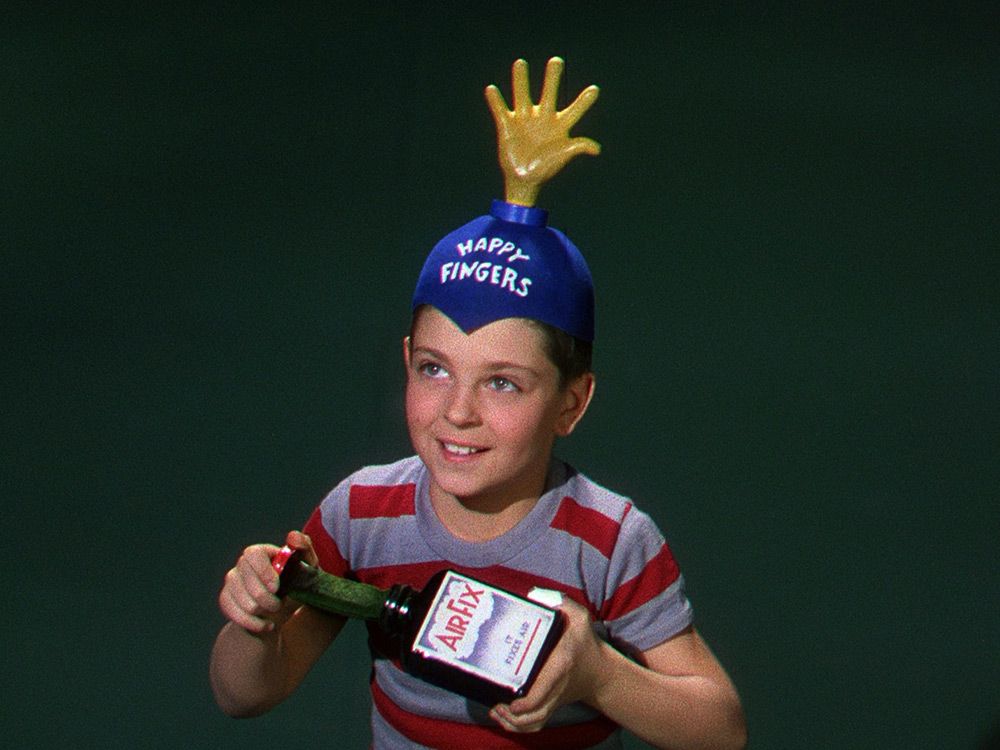
“People should believe in kids. They should even believe their lies,” admits plumber August Zabladowski to Bart Collins (Tommy Rettig), the child protagonist of The 5,000 Fingers of Dr. T (1953). If the Dr. Seuss penned surrealist feature had a distilled philosophy, this would be it: children perceive the world around them with startling acuity, their imaginative powers reveal important truths, and their dreams should be listened to.
For all its larger-than-life whimsy, the conceit of Dr. T is relatively simple. Bart finds practicing the piano tedious and considers his lessons with Dr. Terwilliker (Hans Conried) oppressive. Terwiliker’s approach seems less about edifying students than deifying his own vainglorious neuroses at an ensemble concert of his many pupils. Adopting a more encouraging approach, Bart’s widowed mother Heloise (Mary Healy) views piano lessons as an opportunity to provide structure for her son. In Bart’s view, Dr. Terwilliker has her hypnotized. He finds a sympathetic ear in Zabladowski, who visits regularly to service a broken sink, and—if Bart could choose—would be a perfect new dad. Dozing off on the piano bench, Bart is plunged into a topsy-turvy totalitarian dreamworld ruled by Terwilliker where a fascist police force clad in turquoise tights throws all non-piano playing instrumentalists into jail cells. Here, Heloise is held captive under Dr. Terwilliker’s spell and Zabladowski works as a cog in the bizarro piano-worshipping machine, unsure of what his labor is truly supporting.
The buzz enjoyed by Gerald McBoing-Boing (1950), Dr. Seuss’s Oscar-winning animated short about a boy who speaks in automotive noises, allowed for the greenlighting of such an outlandish live-action feature. Acquired by Stanley Kramer’s production unit within Columbia Pictures, production on Dr. T was less of a success story. The shoot exacerbated tensions between Kramer and Columbia president Harry Cohn, ultimately ending in the early termination of a 20-film contract a year later. The experience turned Dr. Seuss off Hollywood for the remainder of his life.
In spite of fraught filming and poor audience tests, followed by re-shoots and edits that still couldn’t save Dr. T from a damning premiere, the film escaped obscurity and eventually became a cult classic. Owing much of its narrative gimmick to The Wizard of Oz (1939), Dr T. is much more like Ken Russell’s Tommy (1975) for kids. It also features musical romps through trippy set pieces, in addition to costuming congruous with the curved structures, distorted scales, and selectively deployed bright colors typical of Dr. Seuss’ illustration style. Unlike Tommy, however, there’s a sobriety to Dr. T. Released during the height of McCarthyism, the film’s themes of collective action, nuclear anxiety, and resisting fear-based political systems resonate with the paradigms of its post-war landscape.
All of this heavier meaning-making never escapes the optimistic framework of a children’s film.
Two frenzied scenes define Dr. T. One is a centerpiece dance sequence that runs over six minutes. An orchestra of imprisoned non-pianists create a relentless cacophony of sound in what amounts to a prime showcase of Seussian aesthetics and an image of possibility: of other instruments to play and other paths forward for Bart. The film’s finale recalls the strange yet hopeful chaos of this subterranean sonic bacchanal. At a 500-person piano designed by Terwilliker, the maestro announces his students will monolithically play “the most beautiful piece of music ever written.” After sabotaging the performance and dispatching their villainous instructor, Bart again implores the sea of celebrating children to “play the most beautiful piece ever written.” In different rhythms, 5,000 fingers slap, slam, and tickle the keys. Some even step, stomp, and dance on top of the instrument before it explodes. Resisting conformity has never been this fun.
The 5,000 Fingers of Dr. T screens tonight, March 4, at Nitehawk Prospect Park as part of the series “Soderbergh Selects.”