The ball is round. The game lasts 90 minutes. That’s a fact. Everything else is pure theory.
So said Sepp Herberger, West Germany’s World Cup-winning manager of 1954, as quoted in the opening of Run Lola Run (1998), a film which then proceeds to play out the same dramatic scenario three times, with variations in choice, chance and outcome, from the same initial premise, like three games played according to the same rules.
Baseball is pastoral, football is martial, basketball is entrepreneurial, and soccer is structural. Zidane: A 21st Century Portrait (2006), currently installed at the Guggenheim, is, like Corneliu Porumboiu’s The Second Game (2014), a soccer film that unfolds in real time, more or less from the opening kickoff to the final whistle, and more or less bounded by the lines of the pitch.
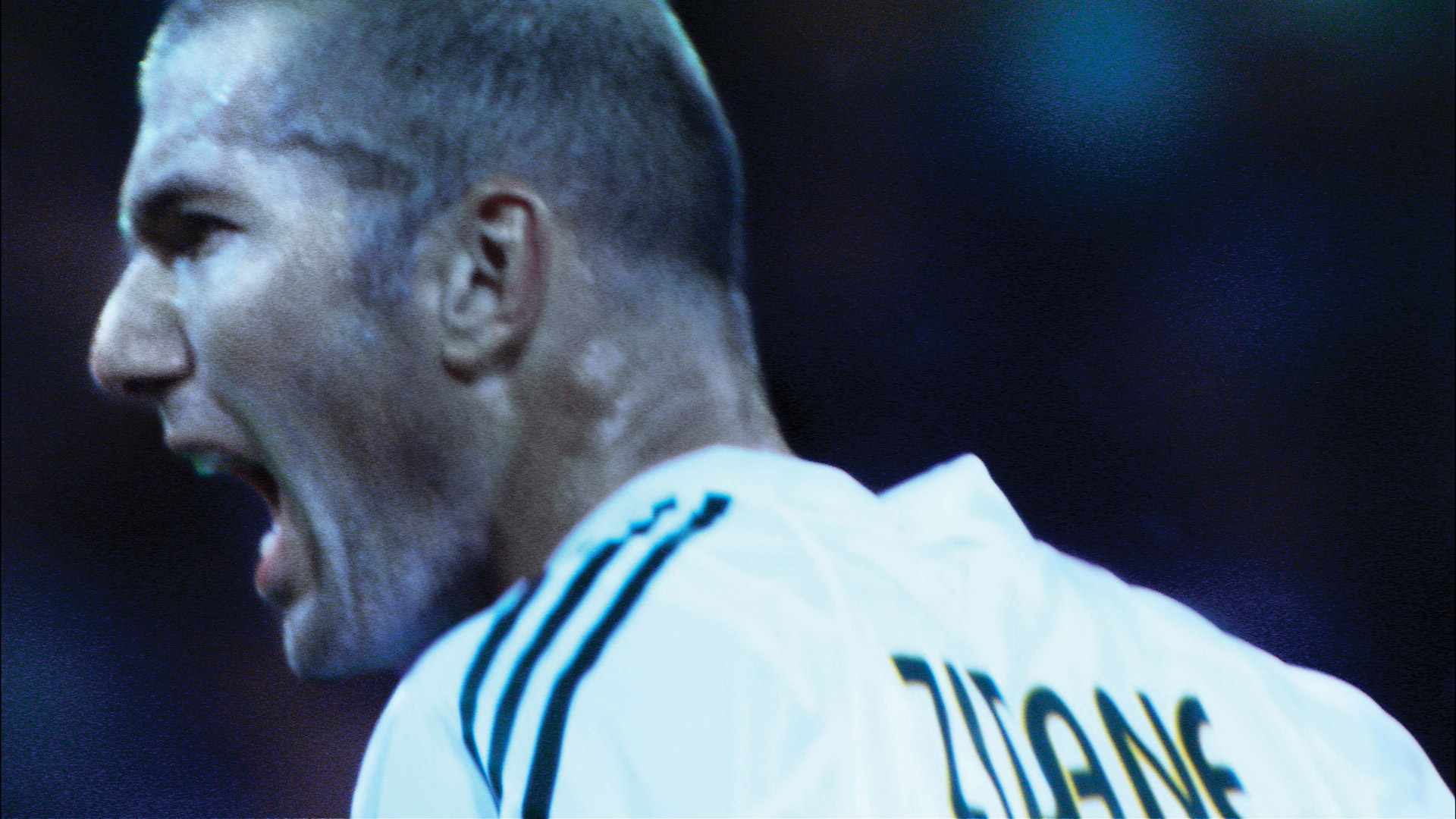
On the night of April 23, 2005, Real Madrid and Villarreal played a La Liga match at Santiago Bernabéu Stadium, and video artists Douglas Gordon and Philippe Parreno filmed it, with 17 simultaneous cameras (12 35mm, two Super 16mm, and three digital, including two with prototype zooms previously used only by the U.S. military), all trained for the entire 90 minutes on Real Madrid’s French midfielder Zinedine Zidane, by then a World Cup and Ballon d’Or winner in the penultimate season of his career.
The film is in part a time capsule—there’s Zidane’s teammate David Beckham with his landfill indie–era fauxhawk, and Villarreal’s Diego Forlán, five years before his miraculous performances at the 2010 World Cup—and in part a physical spectacle. Rather than following the ball, the vantage sticks with a single player who is alternately at the center and the fringes of the action, making his surging runs forward during Real attack, but also adjusting his socks during lulls, stopping and starting, accelerating and decelerating, hurrying up and waiting.
Even during the height of his fame, Zidane cut an intimidating figure, seeming at once totemic and withholding, as well as dazzlingly confident on the ball. The son of Algerian immigrants, he was subject to racist abuse especially early in his career, and directed his anger into channels carved uncommonly deep. He is a captivating subject, all the more so for his unconsciousness of the cameras. Illuminated against the night by the stadium floodlights, the sweat glistens on his bullet-shaped bald head; his movements are efficient and his gaze is watchful. Rarely forthcoming in interviews, Zidane represented the mystery of the elite athlete to an extreme degree, that of an initiate into knowledge that is embodied and instinctual rather than articulated and codified, and that resists all introspection. Like a Method actor, he is “living the part.”
Gordon and Parreno did interview the player before the match, and his thoughts, koans about the nature of an elite athlete’s concentration (“When you are immersed in the match, you don’t really hear the crowd. At the same time you can almost choose what you want to hear”), are displayed on the screen as subtitles, but only during the first half, when Zidane sees less of the ball. His occasional muttered conversations with teammates are inaudible in a very sculpted sound mix; the droning score by Scottish prog band Mogwai swells or, eerily, drops out entirely, replaced with sounds of exertion and shouts of “Aquí,” or the ambient roar of the crowd. (Kevin Shields, of My Bloody Valentine, is credited as the film’s “noise consultant.”) Zidane does laugh, genuinely and for a long time, at a private joke with his teammate Roberto Carlos—and then, in the film’s startling climax, in the game’s 90th minute, he rushes into a scrum and does something we can’t quite see, for which he and Villarreal’s Quique Álvarez receive red cards. (At the time of the film’s release, immediately concurrent with the 2006 World Cup, this ejection was taken as eerie foreshadowing of Zidane’s frankly Sophoclean final match, the final of the tournament, when he was sent off in extra time for inexplicably headbutting Italy’s Marco Materazzi. Twenty years on, during a time in which soccer games are bogged down with video reviews in which officials ponderously relitigate split-second judgement calls from multiple camera angles replayed in agonizingly slow motion in the impossible search of total sporting objectivity, the end of the film is ironic in a different way, as an on-field act that escapes the gaze of Gordon and Parreno’s 17-camera panopticon.)
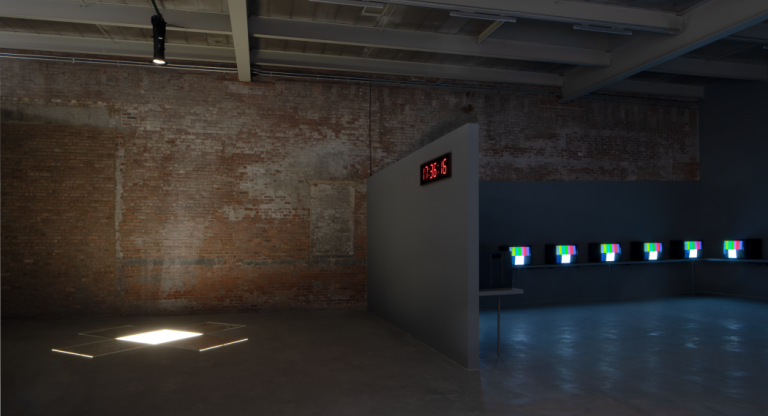
The day before the game, cinematographer Darius Khondji (in between Sydney Pollack’s The Interpreter and Wong Kar-wai’s My Blueberry Nights) took his crew to Madrid’s Museo Nacional del Prado to view the collection of works by Francisco de Goya and Diego Velázquez, particularly the way the painters posed the human form against fathomless black backgrounds. (These blacks would prove a recurrent motif in Khondji’s collaborations with Parreno.) The camera crews of a televised sporting event are positioned to provide “coverage,” in both the commercial and the cinematic sense; operators will be arranged so as to follow the ball, a person of interest, or a particular quadrant of the field of play from a wide or tight angle. It appears, from the single continuous camera feed presented side-by-side with the edited film at the Guggenheim, that the operators were given far more freedom to roam. Gordon and Parreno watched the game on monitors from a truck, like the director of a TV broadcast, and cued operators to move in or out or focus on specific body parts. The raw footage at the Guggenheim moves from Zidane’s feet to his face to a head-to-toe view or a wide shot of the entire Bernabéu, zooming and reframing on the fly, blurring the image with extreme focus pulls, and sometimes scanning the crowd or advertising hoardings for a quirky face or telling billboard (very little of which made it into the final cut).
More of the camera operators were drawn from the world of film than from televised sports, and they sometimes have trouble following the action, especially when shooting such tight close-ups with such unforgivingly long telephoto lenses. Zidane is often shown in from the waist up or in extreme close-up, and Gordon and Parreno cut on movement even when the ball is at his feet, which would not please Fred Astaire. With the cameras placed all around the pitch, the film constantly flaunts the 180-degree rule, which is honored even more rigorously in sports broadcasting than in classical continuity editing; the perspective is impressionistic. Discussing the film at Art Basel 2006, Gordon described the film as depicting “a man just doing his job.” That the film is a rather abstract and balletic movement study is reinforced by the Guggenheim’s two-channel presentation, first when the single-camera feed covers the same action from another vantage, and later when it falls out of sync with the edited film.
By the standards of cinema, Zidane is an astringent movie: pure sensory immersion without any narrative scaffolding built out by the filmmakers, simply a durational conceit and unchoreographed activity. “Rumor has it that the work had people yawning at Art Basel,” Bidoun reported in 2006, “but given that Gordon’s self-proclaimed inspiration is Albert Camus, maybe the genius is in the banal details.” And yet narrative interest is not exactly in short supply. The film is playing at the Guggenheim for the duration of the 2026 World Cup; the day I watched the full 90 minutes of Zidane, I also watched the full 90 minutes of USA vs. Paraguay. Zidane has setbacks (Juan Román Riquelme gives Villarreal a first-half lead after the referee awards a dubious penalty), comebacks (Zidane is involved in the buildup for Real’s two second-half goals), and a shocking final twist; it’s also full of stars, as befitting the peak of Real’s galactico era. (Conversely, to be a sports fan is also to accept a certain quantum of “banal details”—so far this World Cup, I’ve also watched the first half of Saudi Arabia vs. Uruguay.)
What is it, then, that makes Zidane a highbrow museum piece, rather than a populist spectacle? It’s not the focus on a single individual: TV sports have attempted numerous experiments with unconventional views. In 2012, viewers of an Australian A-League match between the Newcastle Jets and Melbourne Victory were presented with a “Heskey Cam,” trained for the entire 90 minutes on the aging striker Emile Heskey. (Heskey, a much-maligned figure in his native England, scored twice.) Nor is it the ambient music: Mogwai’s instrumental crescendos are similar to the score composed by Explosions in the Sky for Peter Berg’s Friday Night Lights (2004). Nor is it the real-time film’s implicit artifactual value, which deepens as our distance from Zidane’s playing career grows longer: Zidane’s first match for the French national team, in 1994—during the last months of the dying Mitterrand’s presidency and at the very start of a World Cup cycle that would climax with the multiracial France team’s home triumph in 1998—is available in its entirety on YouTube and takes on similar resonances as it becomes history rather than news.
With Gordon’s emphasis on work, the film purports to isolate an individual’s labor from its industrial context, to locate Zidane’s agency within the intermingled flows of storytelling, entertainment, and capital that characterize the business of sports. But, crucially, it doesn’t: several key points in the game, including the foul leading to Villarreal’s penalty and Real Madrid’s goals, are replayed for us multiple times through footage from the game’s television broadcast, relaying conventional exposition in a familiar visual grammar.
I’ve long suspected that much of the purported inaccessibility of experimental film is due to framing; one can chill out to Takashi Makino shorts as easily as to an Abstract Liquid Background 4K video. The difference between this soccer match and any other soccer match you might watch during this World Cup, then, must simply be that this soccer match is playing at the Guggenheim—except that every Friday during the World Cup, the Guggenheim will be rebranding its restaurant, the Wright, as “Frank’s Pub,” and airing matches.
Zidane: A 21st Century Portrait is on view through July 19 at the Guggenheim.