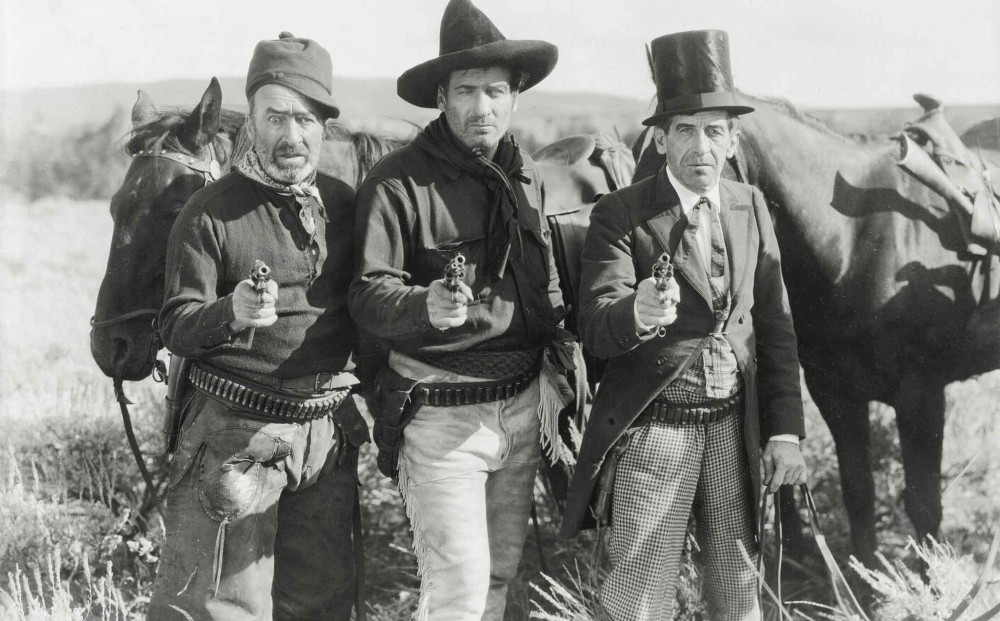
In John Ford’s 3 Bad Men (1926), the rugged, brooding fugitive “Bull” Stanley is on the run in Dakota with fellow outlaws Mike Costigan and “Spade” Allen. They are wanted from Mexico to Canada for horse theft and robbery. But Bull’s nomadic life is now fueled less by crime than by his obsession with finding his sister, Millie, and hunting down the scoundrel who lured her from home. Charismatically played by Tom Santchi, “Bull” is just the kind of outsider on a mission who would later be played for Ford by John Wayne. The film’s other emotional core is Lee Carleton, a confident, at times flirtatious woman who wears jeans and a cowboy hat—a tomboy coquette who could have wandered in from a Howard Hawks movie. Capable of being “one of the guys,” she is mistaken early on by a man who exclaims, “By golly, he’s a woman.” Fittingly, Lee is played by the radiant Olive Borden, who was Eve to her 3 Bad Men co-star George O’Brien’s Adam in Howard Hawks’s Fig Leaves, which opened in theaters just a week before this film.
After rescuing Lee following an attack that leaves her father dead, Bull and his men gallantly make it their mission to find a husband for her, reasoning, “Three old terrapins like us aren’t fit to take care of a girl like that.” So, they head to a local saloon to size up potential grooms. If this sounds like a rom-com plot dropped into a 19th century western tale, that is just one of the film’s many registers. Working with a large budget thanks to the success of The Iron Horse (1924), 3 Bad Men represents a grand summation of the 44 westerns Ford had directed up until that point. It is a historical epic, depicting the 1877 Dakota gold rush that was sparked by President Ulysses Grant’s seizure of Sioux reservations, a revenge quest, a tale of male camaraderie, and a bustling portrait of the American melting pot (replete with dated ethnic slurs), all set against a breathtaking mountain landscape. The Museum of Modern Art’s restoration reveals the film’s sheer physical beauty, and its new orchestral score by Timothy Brock captures its grandeur and emotional range.
Ford’s artistry was his ability to blend the epic and the intimate. 3 Bad Men builds to a spectacular action scene (“We did a hell of a land rush,” Ford later boasted to Peter Bogdanovich). But what stays with us are not the film’s grand vistas, seen in long shot, rather its exquisitely captured human details in close-up; for example, the way that Lee closes her eyes, expecting and longing for a kiss as Dan O’Malley (O’Brien’s character) leans toward her in their first meeting. Or, the way the men stoically hide their love for each other during what they recognize as their final farewell.
3 Bad Men screens this evening, August 3, at the Museum of Modern Art as part of the series “Silent Movie Week 2026.”