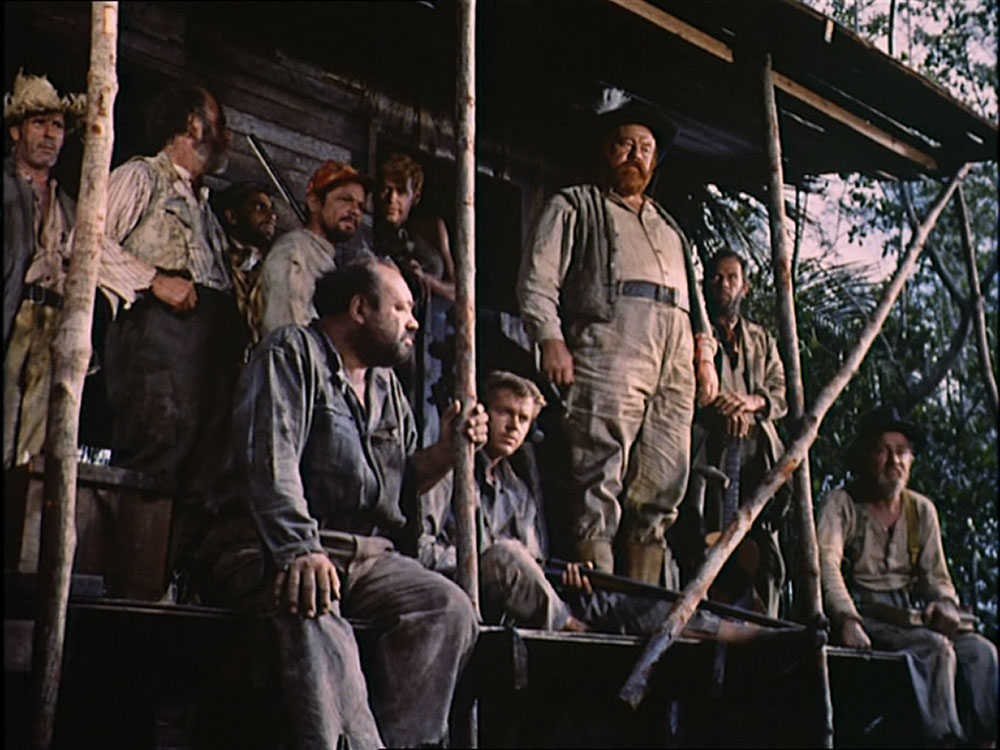
After an insult to a society lady in 1900s Miami, idealistic schoolteacher Walt Murdock (a fresh-faced Christopher Plummer) is drafted as an Audubon game warden and charged with enforcing Florida’s hunting ban on the shore birds being driven toward extinction for their beautiful plumes in Nicholas Ray’s Wind Across the Everglades (1958). Murdock’s chief adversary is Burl Ives’s Cottonmouth, a neo-romanticist swamp king with a deadly pet snake who flouts the law, as much to enrich himself as to demonstrate his primitive sovereignty over the inhospitable ‘Glades.
Shot from a script by On the Waterfront (1954) screenwriter Budd Schulberg, Everglades was filmed on location and in Technicolor. Schulberg’s faith in the civilizing influence of institutions is perhaps greater than that of the tempestuous, Thoreauvian Ray, who smothers any notion of an alliance between conservation and prosperity in ambivalence. In Cottonmouth’s gang of poachers, and the robber barons who wrench every new mile of Miami from the swamp, Ray sees the same immutable animal drive at different scales. Nature photography along this theme makes for evocative and wobbly viewing by turns: real poetry in a shore bird flock at dusk, but lurid close-ups of gators and panthers give the seedy aroma of Poverty Row. Mangled editing and clumsy dub work are generally attributed to Schulberg, who fired Ray and assumed directorial duties post-production. Both men were known to drink, but Schulberg’s niece (daughter of producer Stuart Schulberg) contends via Evan Davis that harder substances were a factor in his dismissal. The bungled finish sealed Everglades’s fate as a curio and perversely shielded its post hoc rehabilitation from liabilities—most glaring, the condescending role dealt to Seminole actor Cory Osceola, whose wages as a Friday-like figure are a torturous death by the poisonous sap of the manchineel.
But Everglades is at its most ensnaring where Ray’s influence is at its peak, in the rousing blues and folk music that seeps into a scene (Ray previously collaborated with Alan Lomax on a radio show that broadcast Burl Ives, among others); in Murdock’s whiskey-blind shrug as he slips his pro forma engagement to face death at Cottonmouth’s hands; in the halo of waves off the pair’s boat on their oneiric final journey through the ‘Glades. Schulberg may have envisioned Cottonmouth’s demise as a necessity of history’s march into progress. For Ray, progress is a more dubious concept. All he’s sure of is that life’s striving is brilliant and brief. A bit of moonshine, or snake venom, or burning sap and we’re back in the claws of beasts again.
Wind Across the Everglades screens this evening, July 5, and on July 9, at BAM on 35mm as part of the series “Spectres, Devils, and Bad Blood in Old America.”