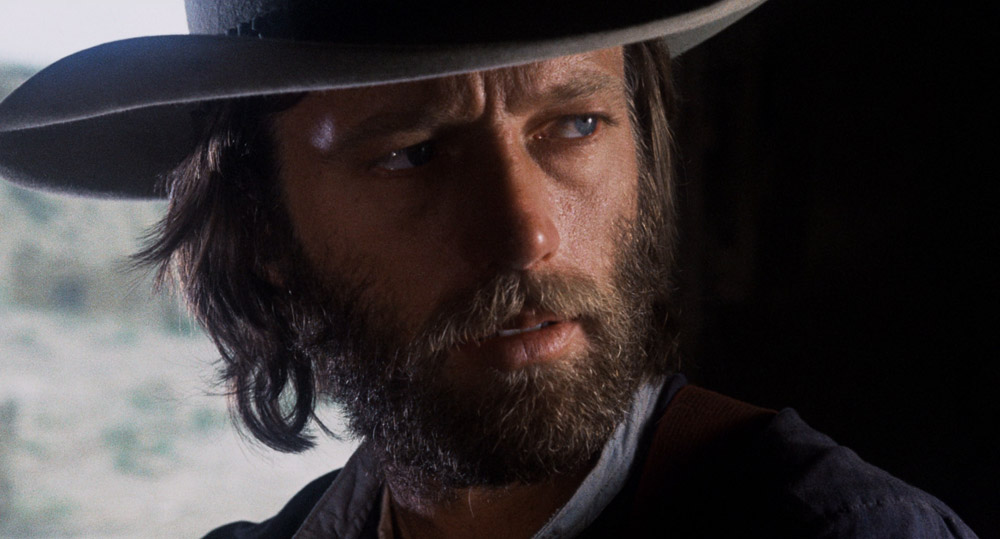
In the early-to-mid 1970s, Peter Fonda and Warren Oates starred in three films together: The Hired Hand (1971), Race with the Devil (1975) and 92 in the Shade (1975). Of these varied collaborations, only The Hired Hand was directed by Fonda. At the time of its production, Fonda was already a counterculture icon thanks to the popularity of Dennis Hopper’s Easy Rider (1969). Considering the sudden stardom of Peter, the youngest son of Hollywood legend Henry Fonda, the famed Universal producer Ned Tanen sought to bring him into the studio’s fold and capitalize on his success. Thus, The Hired Hand was a key entry in Tanen’s low-budget “Youth Division” at Universal, which supported emerging filmmakers like George Lucas and Monte Hellman.
Because of Fonda’s starring role in the drug-fueled Easy Rider, The Hired Hand has often been described as an “acid western.” From its opening sequence, in which an indiscernible bit of color slowly morphs into sunshine, reflected in a sparkling lake, it is clear that Fonda’s directorial vision is substantially inspired by the lysergic formal flourishes of the era. Despite the foregrounding of super-impositions, freeze frames, and other visual maneuvers that see bodies and images hazily bleed into one another, Fonda’s directorial debut is, at its core, a simple story about the bond between two men that possesses a quiet weariness.
Fonda and Oates star as Harry Collings and Arch Harris, respectively, two men who have been content to drift through the west together for several years. Soon, we learn that Harry once had a wife and daughter that he abruptly left behind, an absence that is beginning to gnaw at him. “Just a waste, living like this, Arch,” Harry muses, a rumination of profound melancholy that contrasts with the fantasies of riches and prosperity occasionally expressed by Arch and their young riding partner Dan Griffen (Robert Pratt). After a grisly incident in a desolate town—a harsh rejoinder to the easy-going mood of the film’s opening—Harry finally becomes determined to return home to Hannah (Verna Bloom), his long-abandoned wife. As one might expect given the ambiguous-yet-frosty circumstances of his departure, Hannah is not pleased to see Harry, nor is she eager to introduce him to their daughter. But, after some pleading, Harry and Arch settle into their new home as hired hands on Hannah’s farm, a trial period ahead of this possible remarriage.
The most potent thrust of The Hired Hand lies in its exploration of the tension between freedom and domesticity, symbolized in the aforementioned trio. For Harry, it’s the choice between family stability and the singular intimacy of the country. Because the latter is tied to Arch, their friendship often feels like a model predecessor of male homosocial relationships like the ones seen in Kelly Reichardt’s Old Joy (2006) and First Cow (2019). Yet in keeping with the spirit of the genre, The Hired Hand is also keen to note how these masculine bonds operate in tandem with the brutality of the frontier. While Fonda’s film builds to something of a conventional showdown, it is one that is contingent upon the centrality of Fonda and Oates as a screen duo, pointedly illuminating the mortal intensity of Harry’s affection for his friend. Violence is cruel, quick, and grotesquely tactile in The Hired Hand, but what lingers most are the silent moments following the bloodshed and those soft pleas, from one man to another, to hold him close as death approaches.
The Hired Hand screens this evening, July 3, at the Museum of Modern Art as part of the series “Universal Westerns.”