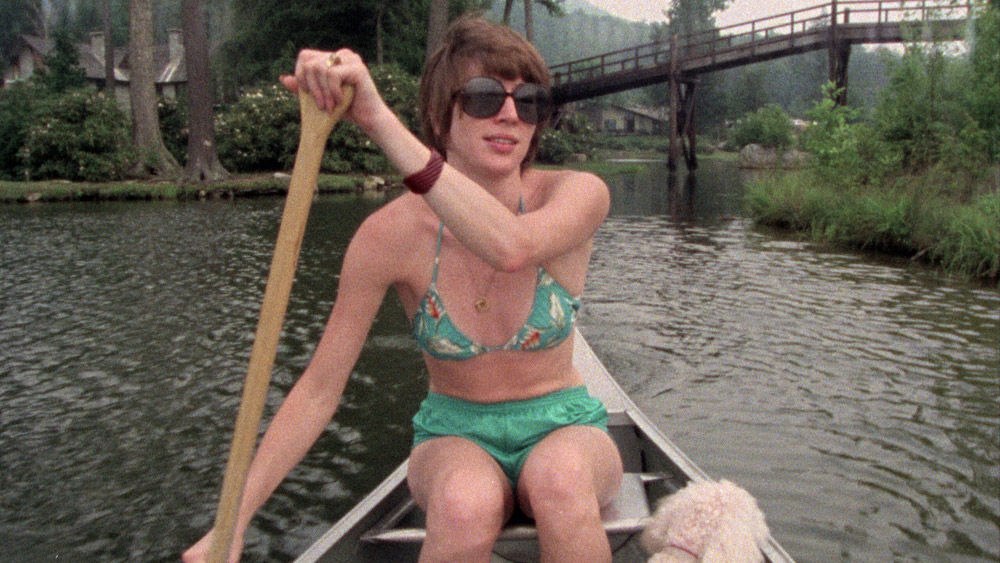
Wini, a PhD linguistics student living on undeveloped Ossabaw Island near Savannah, is sunning naked on her belly, reading a book, when her current lover, Ross McElwee, approaches, filming her and asking if she wants to hear from his research about William Tecumseh Sherman. He compares himself to the Civil War general, noting they both had red beards, and suggesting that Sherman’s string of business failures is comparable to his own roster of romantic mishaps—an analogy Wini scoffs at.
Other analogies populate Sherman’s March (whose subtitle is “A Meditation on the Possibility of Romantic Love In the South During an Era of Nuclear Weapons Proliferation”). Sherman and McElwee both had Southern roots but lived in the North. Both returned to the South with grand pursuits. Sherman led a ferocious military campaign for the Union. McElwee intended to follow in Sherman’s footsteps to make a cinéma vérité project about the modern South. But, just before starting to film, McElwee’s New York girlfriend dumped him. Sparked by his sister’s observation that “you have an instant rapport with people because you have a camera,” he decided to change the focus of his project and film his campaign to find a new girlfriend. Where Sherman’s war campaign was rigorously planned, McElwee’s quest was serendipitous. Loosely following the geography of Sherman’s route, McElwee took detours along the way, taking time to pursue his infatuations, starting with Pat, an aspiring actress who performs suggestive cellulite-reducing exercises for his camera, coyly announcing she isn’t wearing underwear.
Sherman’s March became a surprise hit when it was released in 1986. It introduced McElwee’s signature gently wry, self-deprecating yet incisive narration, which he sometimes delivers in monologues directly to the camera throughout the film. McElwee brought a uniquely literary approach to the documentary form. He told the scholar Scott McDonald that he has been guided for decades by the poet William Wordsworth’s statement, “The edge of meaning never lies far beyond the prose of ordinary experience.” What has always been most remarkable about McElwee’s filmmaking is the way he looks both inwards and outwards, merging autobiography with the observational skills of filmmakers like Ricky Leacock and D.A. Pennebaker. Wherever he turns his camera in Sherman’s March, he finds events that seem to comment on rituals of masculine and feminine mating behavior. A Burt Reynolds film shoot, a testosterone-filled men’s athletic competition, an Equal Rights Amendment protest, all add layers of subtext to the film. McElwee has always had an uncanny knack for finding details and coincidences that novelists could only dream of imagining.
If Sherman’s March were a novel, it would be a bildungsroman, capturing the folly and optimism of youth. Defying the rigid pragmatism of his father, a successful doctor, McElwee relishes in his freedom. Life feels full of possibilities. And, in this way, Sherman’s March makes for a deeply resonant bookend with McElwee’s new film, Remake (2025), which includes McElwee’s experiences with a producer determined to remake Sherman’s March as a fictional project. But while Sherman’s March looks forward, Remake is McElwee’s look back, at age 78, at a life that has been disrupted by tragedy. These two masterpieces, separated by four decades, prove that McElwee is one of our essential filmmakers. In Sherman’s March, McElwee’s friend and mentor Charleen Swansea admonishes him for his constant filming. “Turn off your camera. This isn’t art, it’s life.” Actually, in McElwee’s hands, it is both.
Sherman’s March runs July 3-9 at Film Forum. Director Ross McElwee will be in attendance for Q&As on July 8 and 9.