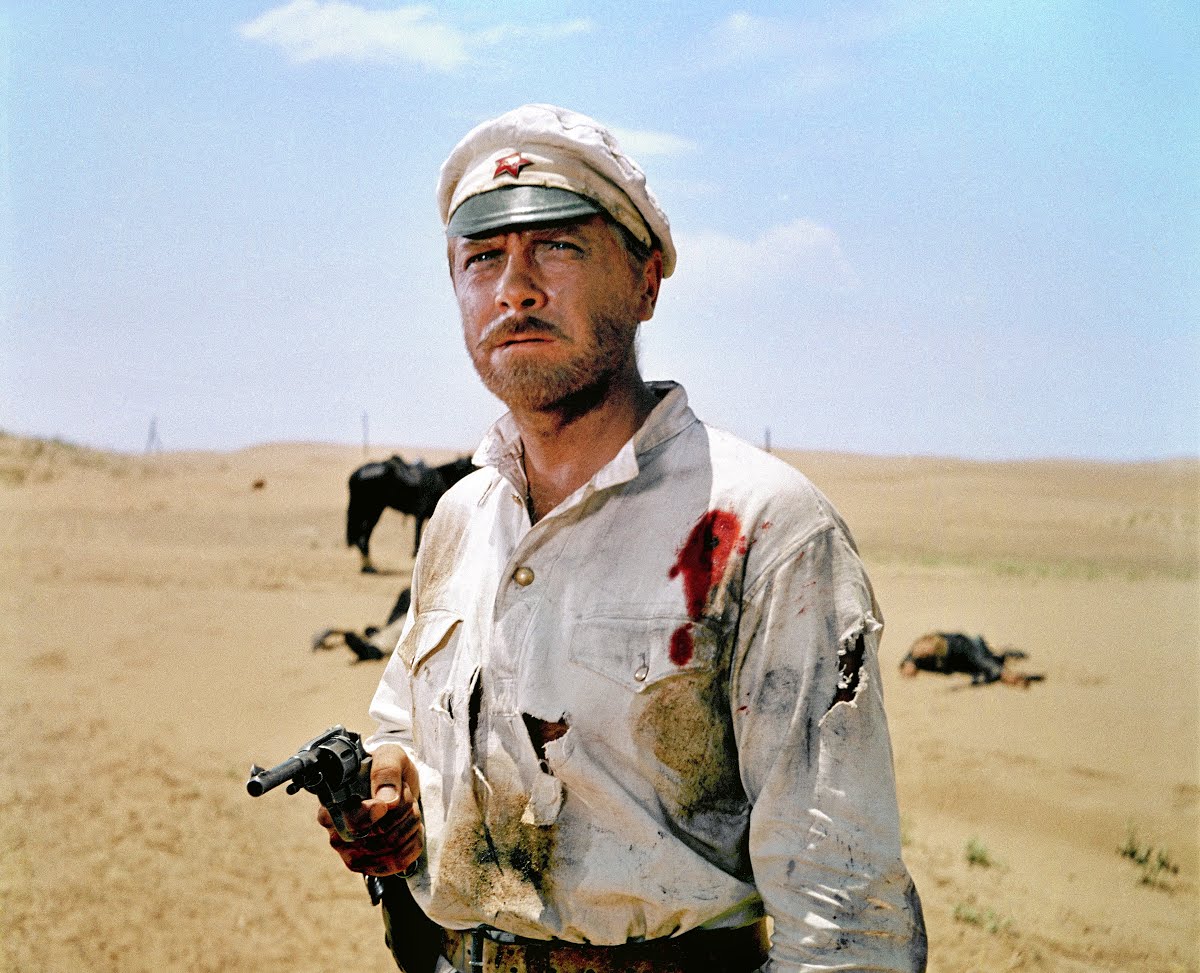
Vladimir Motyl’s White Sun of the Desert is one of the most domestically beloved Soviet films of all time, maintaining a massive cultural significance since its release in 1970. Monuments to the characters Sukhov (Anatoly Kuznetsov) and Vereshchagin (Pavel Luspekayev) can be found in various Russian cities, while, beginning in 1973 with the crew of the Soyuz-12, viewings of the film have become an ongoing tradition for all cosmonauts and back-up cosmonauts boarding a space flight. The film’s influence even reaches beyond terrestrial bounds, with the names of the villain Abdullah’s wives assigned to several of Venus’s craters. In short, kiss Motyl’s ass E.T.
A key entry in the extremely cool ostern genre (a Soviet and Eastern Bloc take on the American Western), White Sun of the Desert follows a Red Army soldier named Sukhov as he makes his way home after years of fighting in the Russian Asian Civil War through the desert of modern day Turkmenistan back to his beloved wife. Sukhov is committed to the revolution and can’t help but stop along the way to help a comrade in need. After digging Sayid (Spartak Mishulin) out of the desert sands where he was left to die by Black Abdullah (Kakhi Kaysadze), the leader of a group of Basmachi guerillas, he encounters a group of fellow soldiers escorting the cruel leader’s liberated harem of wives. The group of women are left in Sukhov’s charge, facilitating a delightfully comic culture clash wherein the soldier attempts to impress upon his wards the new freedom the global revolution has afforded all working people of the world, including women. Abdullah, however, wants his wives back and returns for a showdown with Sukhov and the gruff, world weary former customs official Vereshchagin on the shore of the Caspian Sea.
White Sun of the Desert is filled with the action set pieces and melancholic atmosphere of a great euro-western. Isaac Schwartz’s score recalls the sweetness of Ennio Morricone at his most reflective and the enormous smooth sand dunes that fill the frame create a simplified, graphic visual power. The film is larger than life and narratively minimal à la Leone, and, like some of the best westerns, has a fairy tale touch. Sukhov as protector of Abdullah’s liberated wives is a story that could be taken from The Arabian Nights, even though the film's ideology is purely Soviet. Sukhov longs for his homeland and the love he left behind, but his commitment to the revolution and its precepts are paramount. While he remarks that it’s time for him to return home now that the class struggle is over and “the hour of global freedom has struck” at the beginning of the film, he inevitably finds there is always more work to be done.
White Sun of the Desert screens tonight, August 21, at Anthology Film Archives as part of the series “Experimental Westerns, Part 2: Acid + International Westerns.”