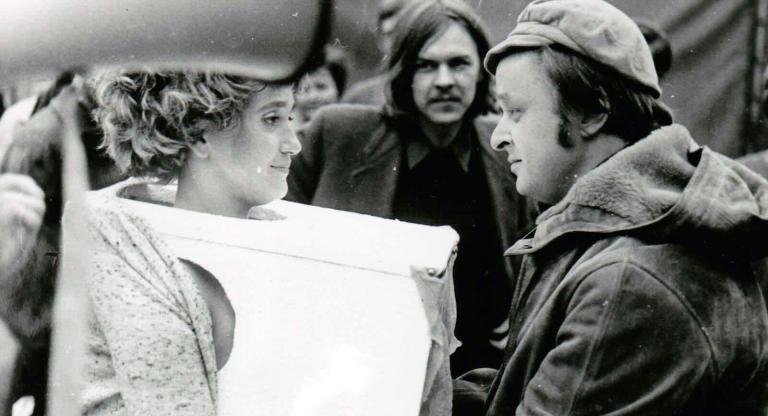
Interviewing Roberto Rossellini during a break in shooting Europa ’51, Mario Verdone asked a blunt question: “Is it true to say that in your films there is often a break between a particularly good episode […] and other parts which are inexplicably left incomplete or at least much more hastily sketched in?” A man regularly described by close collaborators as lazy, Rossellini immediately took the indictment: “That's right. As a matter of fact every film I make interests me for a particular scene […] In the other narrative episodes I feel myself hesitating, alienated, absent. I don't deny that this is a weakness on my part, but I must confess that scenes which are not of key importance weary me, and make me feel quite helpless.”
Admirably frank and basically true: Rossellini is the most rough-hewn and inconsistent of the nonetheless capital-g Great Directors. It’s also an especially funny admission to make considering the historical films that primarily occupied Rossellini for the last 15 years of his life, which with rare exceptions deliberately have no narrative highs or lows to speak of. Rossellini had often spoken of Socrates to his collaborators, and conceived of these works in the same spirit that his Socrates speaks of, with “the sole goal of creating knowledge”—in his case, via transmissions of important historical truths in danger of being forgotten. The traditional cinematic allures of spectacle, violence and attractive people were stripped away; the works’ profound strangeness is seductive in a different manner.
Socrates (1970) is the first of three films about philosophers, followed swiftly by Blaise Pascal (1972) and Cartesius (1974), all of whom could be broadly charged with the same crimes as Socrates: proposing new beliefs and therefore corrupting the youth (i.e., challenging existing power structures in the pitiless pursuit of knowledge as a non-commodifiable good). This first film begins with an image anticipating the philosopher himself, as the Spartans approach Athens and, slowly and methodically, batter down its protecting wall with the slow, annoying persistence the man himself will display in conversation; on the mountains up above, the Acropolis shines, a glowing image of almost divine knowledge and culture.
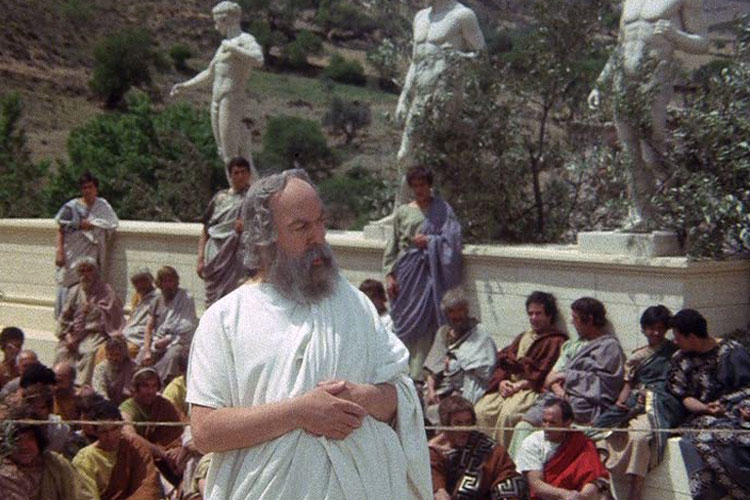
After some opening historical context, the film introduces Socrates (Jean Sylvère) looking especially scrubby, an unlikely manifestation of that building’s spirit. “I don’t look like a prince” he admits when being abused on the street. Sweaty, broad of forehead, putatively self-deprecating and consistently anti-charismatic, Socrates proceeds to enact an extended version of the classic Chic Tract classic line: “They hated him because he told the truth.” Warned repeatedly to stop talking to the youth of Athens, Socrates is finally forced to defend himself before the sporadically booing Athenian citizenry in a nearly 25-minute sequence. That he’s irritating is part of Rossellini’s intended effect as he railed against the seductions of charm in both politics and, implicitly, the cinema: Socrates lived during a period during which Rossellini diagnosed that “democracy became perverted by succumbing to the charms of rhetoric and eloquence.” He’s sentenced to death and led away, discoursing to the very end while drinking poison, a slave to both truth and his mouth.
Whether Rossellini understood that these movies were profoundly aesthetically strange or not is unclear (signs point to no) but irrelevant to their disorienting effect. The disorientingly composited-in effect of the Acropolis among the scrubby Spanish hills where Rossellini primarily shot inadvertently draws attention to its incongruity. The two French leads spoke in French, the one Italian cast member in his language and the rest of the cast in Spanish, with dubbing leveling everything to monotonous Italian. In all three philosophical films, the performers emote just a little too baldly on occasion, but the relentlessly specific lexicon of philosophy and history has its alien, oneiric nature heightened by the glaringly dubbed-in foley sounds of footsteps and crowds murmuring, and further accentuated by Mario Nascimbene’s score.
Having built his own proto-sampling device, the Mixerama, Nascimbene had first been recruited by Rossellini for the 1970 mini-series Man’s Struggle for Survival, a 12-episode history of the world. Up to that point, nearly all of his films had been scored by Roberto’s brother Renzo, but Rossellini’s French co-producers disliked his music. Nascimbene said he understood the assignment: “to inaugurate a new musical language in parallel with [Rossellini’s] new film language.” Collected on the appropriately ominously-titled compilation Psycorama, Nascimbene’s emotionally unresolved electronic drones aren’t that far off from Eliane Radigue and other patient pursuers of sustained electronic unease.
Two of the three films end with the protagonist’s death, and the music’s tone of unease, often at odds with the abstruse philosophical disputes it soundtracks, creates a memento mori undercurrent. The results scan as Lynchian to me—not for any direct anticipation of his work, but in the combination of profoundly unnatural acting and musical unease yielding a synthesis whose emotional effect can’t be precisely articulated. For all their intellectual abstraction and would-be didactic nature, I find these Rossellini movies to be strangely emotional, suffused with a desire for knowledge not entirely compromised, but definitely made more fraught, by the additional knowledge of the finiteness of time we have to pursue it.
Socrates screens this afternoon, October 9, and on October 16, at Metrograph as part of the series “Classical Cinema.”