Tsai Ming-Liang’s What Time Is It There? (2001) opens with a long take emblematic of the approach that made the Taiwanese-Malaysian filmmaker one of the key progenitors of slow cinema, the international film movement praised for its attunement to duration and the mundane nuances of everyday life. In this medium shot, a man, played by frequent Tsai collaborator Miao Tien, sits down in his dining room for lunch. He lights a cigarette; at one point, he gets up and beckons for his son, Hsiao-Kang (Lee Kang-Sheng). Despite these brief gestures and actions, the shot mostly just observes a contemplative Miao in a moment of repose. However, far from an exercise in duration for its own sake, the significance of this quotidian frame becomes clearer when Tsai abruptly cuts to the back of a car, where we find Hsiao-Kang holding an urn. Through the simple linkage forged between these two shots—and the fact that Hsiao-Kang softly addresses the urn as his father—the viewer comes to understand that Miao’s character has suddenly passed, an absence that haunts the narrative.
To call What Time Is It There?—one of the artistic peaks of Tsai’s spectacularly productive run throughout the 1990s and 2000s—a film “about grief” would be accurate yet deeply misleading. Tsai has no interest in thematizing or drawing conclusions about the tragic loss felt by his characters. Instead, in keeping with his preference for stylistic minimalism and ambiguous psychological motivation, he observes their behavior. No matter how bizarre or inexplicable the actions of the film’s characters are, Tsai’s camera never passes judgment, prodding the viewer to find emotional resonances within these confounding expressions of personal sorrow and confusion.
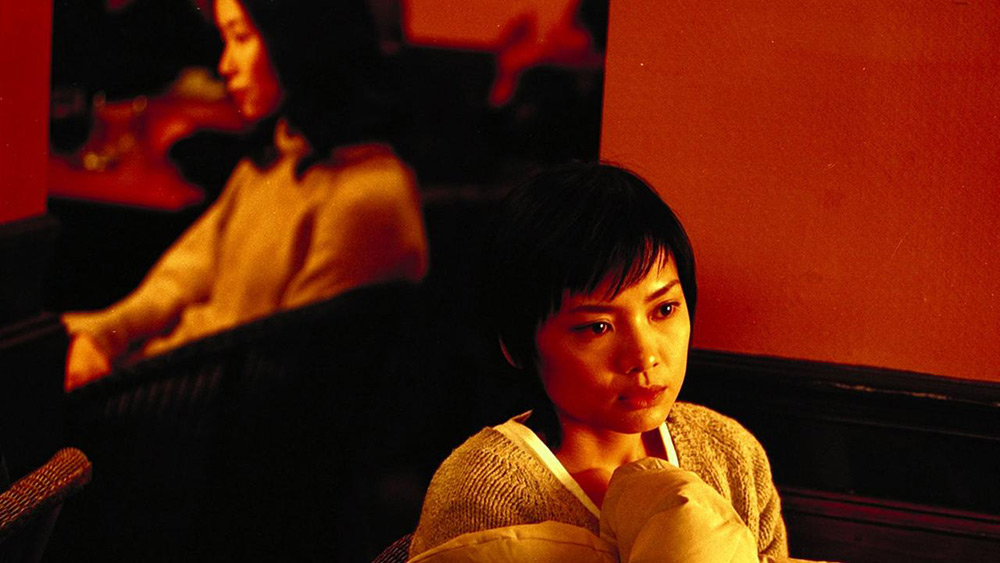
Like most of Tsai’s films, the plot here is more aptly described as a scenario. While selling watches on the streets of Taipei, Hsiao-Kang meets a young woman (Chen Shiang-Chyi) who asks to buy his personal watch ahead of a trip to Paris. For superstitious reasons, he is resistant but eventually acquiesces. The remainder of the film cuts between Hsiao-Kang, his mother (Lu Yi-Ching), and the young woman as they navigate their daily lives. Hsiao-Kang sleeplessly wanders around his apartment at night, often urinating in bottles, occasionally throwing on François Truffaut’s The 400 Blows (1959) to stave off his insomnia. He also, eventually, begins to change every clock he can find to Paris time. His mother is constantly searching for signs of her husband’s reincarnation. Chen, alone in Paris, struggles with culture shock and the rapid temporality of life abroad.
Despite the formal austerity of his work, and the inarticulable sadness that defines his subjects, Tsai’s films are also quite funny. From slow cinema scholar Emre Cağlayan’s association of Tsai’s films with “absurdism” to Roger Ebert’s emphasis on the inseparability of comedy and tragedy in his oeuvre, numerous writers have noted this humorous sensibility, often linking his cinema to the comedies of Jacques Tati. Indeed, the influence of the French comic master’s visually dense form is readily apparent in one of What Time Is It There?’s most amusing images, where Tsai presents the spectator with an extreme long shot of a city square from above. Only after a moment or two does the viewer notice Hsiao-Kang on the left side of the frame, using an elaborate mechanism to change the time on the square’s enlarged clock. Another key sequence almost feels like a dry run for the setting, narrative, and glacial comic rhythm of Tsai’s follow-up feature, 2003’s widely acclaimed Goodbye, Dragon Inn. In What Time Is It There?, Hsiao-Kang finds himself at the Fu Ho Theater with a man who mistakenly and wordlessly initiates an attempt at cruising. The payoff of the sequence, fittingly centered around the unusual placement of a clock, pays robust dividends, both as an unexpected gag and as another heartbreaking expression of intimacy extended yet inevitably gone amok.
Humorous though they may be, Tsai’s films tend to culminate with raw, discomforting emotion from characters strained to their breaking points. Consider, for example, the final shot of Vive L’Amour (1994), an excruciatingly extended long take of actress Yang Kuei-mei wailing on a park bench, her character ignored and alone as tears stream down her face. What Time Is It There? appears primed to conclude with a structural echo of this painful portrait of sadness, right down to the park setting, yet Tsai, in a film dedicated to his father and Lee’s father alike, subverts any such tragic conclusion. Instead, in a film populated by grief-stricken, forlorn characters seeking connections to spiritual realms and far-reaching global communities, What Time Is It There?’s concluding image posits the possibility of an invisible reciprocity with the worlds beyond our reach. As the film concludes, a sense of comfort emerges for the first time, powering the feeling that the processes of mourning and steadfast belief in spiritual transition may one day bear fruit when we least expect it.
What Time Is It There? screens this evening April 3, at the Museum of the Moving Image on 35mm as part of the series “2001: The Year, Not the Movie.”