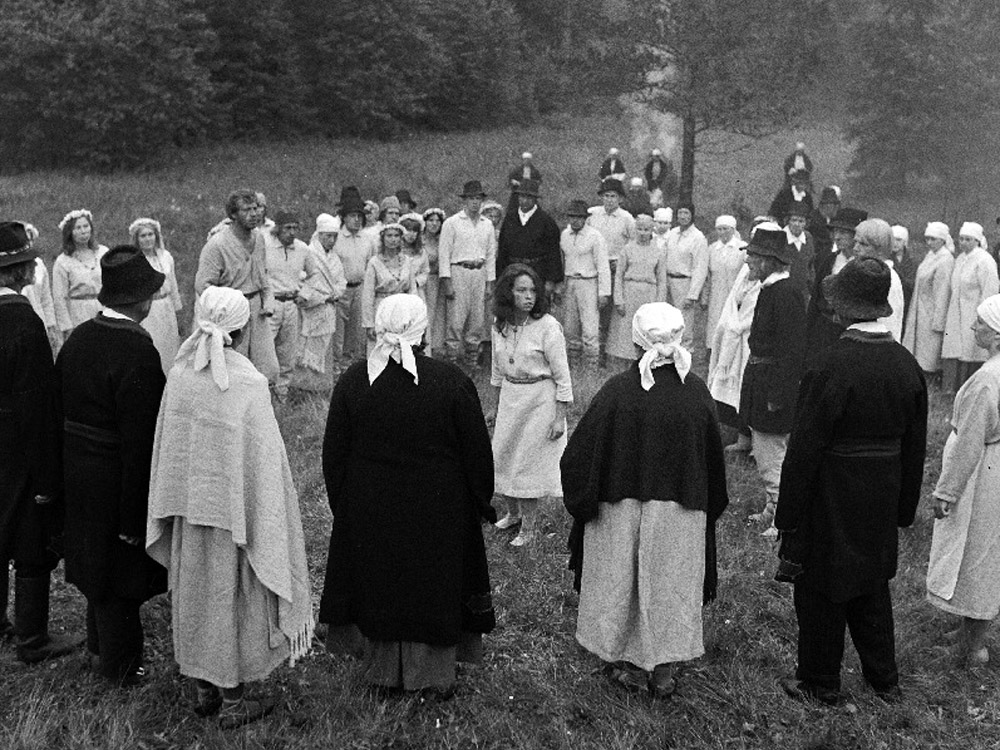
Werewolf opens on a 19th-century Midsummer festival by way of the 1960s, as men in beards and tunics and straight-haired girls in peasant dresses encircle a bonfire, the camera swirling amid the flow of their bodies in the style of Miklós Jancsó’s dizzy folk-dance dolly shots. Vivacious Tiina (Ene Rämmeld) and strapping Margus (Evald Hermaküla) pair off and chase each other into the woods, playing and giggling; when they return to the others, jealous Mari (Malle Klassen) accuses Tiina of witchcraft, and the rest of the villagers join in her refrain, driving Tiina away.
Following this opening, which feels more like a climax, Werewolf, the second of six features by the Estonian director Leida Laius, is mostly told in flashbacks, as Tiina wanders the forest and Margus and Mari stew back on the farm. The perspective of the flashbacks floats from character to character in a joint reverie, revealing how, after Tiina’s mother was executed for sorcery, Margus’s parents took her in against their better judgement and the suspicion of the community. Raven-haired Tiina and straw-blonde Mari were raised as foster sisters, but the bond between two girls and their childhood playmate Margus changed in adulthood, as Margus was drawn to Tiina and Mari grew jealous.
Based on a 1912 play, Werewolf is recognizably allegorical, and full of folk-horror touches—torches and flower garlands—that are apt for a story of an insular community’s suspicion of a sensual outsider. Shooting primarily with a long lens and untethered camera, Laius’s visual scheme catches the hippie zeitgeist with nature imagery and lysergic effects, like a frame-filling close-up of ripples in a lake, while avoiding the era’s more dated flourishes (gauzy filters, crash zooms, elaborate dissolves). Life in Werewolf is harsh and filled with toil. Margus’s family sups silently around a bare wooden table, eating meals of soup and dark bread in a deadly tableau. But their brute material pragmatism is upended by the film’s spiritual overtones, as a subjective fugue of memories, fantasies, and dreams overwhelms the narrative.
The four Laius films that played at Spectacle this month—recently restored, and previously virtually unscreened in the United States—fall evenly into two categories. Werewolf, like 1973’s Spring in the Forest—about a young woman who endures hard labor, social ostracization, a feckless husband, and the Second World War to carve out a life for herself in a remote woodsman’s hut—is a black-and-white rural period film imbued with a sense of pagan magic that comes through in shots of tree trucks soaring skyward, captured by a neck-craning camera which in its freest moments recalls another of the great dizzy-heroic Eastern Bloc camera choreographers, Mikhail Kalatozov (particularly his 1960 forestry epic The Letter Never Sent). In contrast, Laius’s ‘80s films are shot in cold-washed color that brings out every facial blemish, and are concerned with socioeconomic precarity in gritty perestroika-era settings: Stolen Meeting (1988) and her masterpiece, Smile at Last (1985), an at once wise and febrile story of a teenage girl finding her way in a largely self-governed orphanage. Her films are united in being studies of the contested independence, both personal and political, of resourceful, willful women, whether in serfdom or the dying embers of bureaucracy—a fitting theme for Laius, who overcame long odds, beginning with the death of her father in Stalin’s purges of the 1930s, to leave behind the most significant filmography authored by a Baltic woman of the Soviet era.
Werewolf screens tonight, March 30, at Spectacle as part of the series “Four Films by Leida Laius.”