The so-called “Four Heavenly Kings of Pink”—Kazuhiro Sano, Toshiki Satô, Takahisa Zeze and Hisayasu Satô—emerged in the early ‘90s, during the waning days of the pinku eiga as a popular theatrical genre in Japan. At that point, adult videos had entered the market, fulfilling the more pragmatic purposes of erotic cinema. That meant that the softcore releases of earlier pink eras no longer drew in ticket-buying crowds. So, while the “Heavenly Kings” films still meet some of the established pinky rules like the approximate 60-minute runtime and inclusion of plentiful sex and nudity, they were also free to use the format to more explicitly explore their personal and formal obsessions. For Satô, these include the deep connections between pleasure and violence, voyeurism and/or surveillance, and the camera as a central interlocutor in these relationships. Having made nearly 70 films (the most recent, Dear Kaita Ablaze, in 2023), it can safely be said that the filmmaker has plumbed the depraved depths and grazed the formal heights of his fixations.
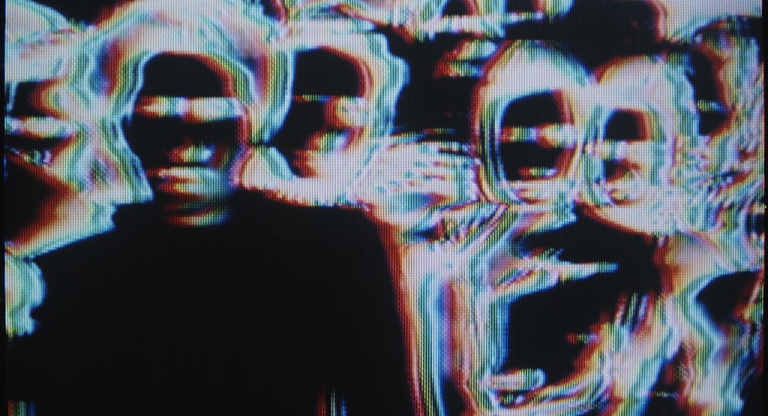
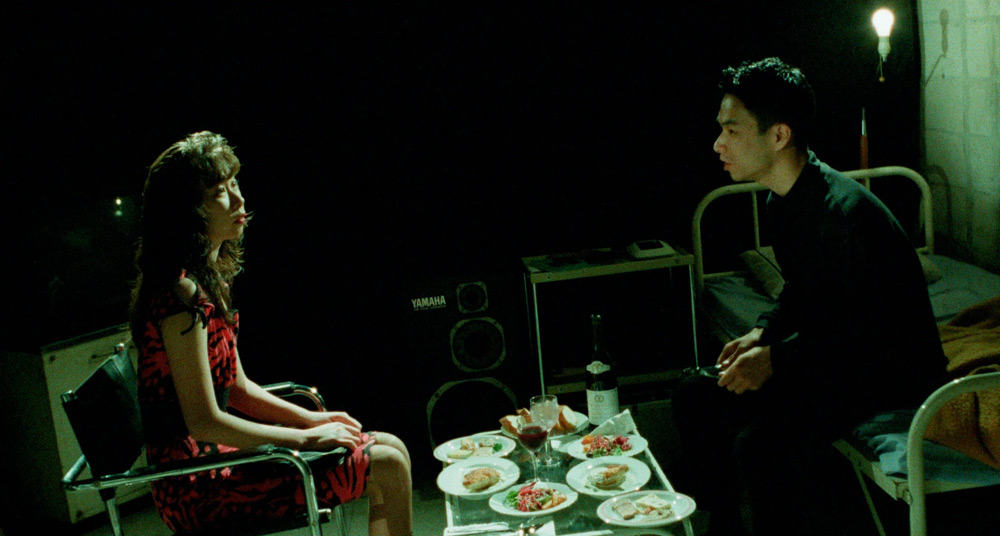
Viewers given pause by content warnings—in this case: rape, mutilation, incest, and nudity, among others—are not the intended audience of a film like Turtle Vision (1991). But, for the Satô-curious, the film is a worthy introduction. It opens from the pixelated POV of Eiji, a hired cameraman for a low-rent porn operation whose night-vision footage of lovers in the park or industrial back alleys, captured surreptitiously from inside bushes or through HVAC vents, are a hit. “It’s like I’m right there doing the peeping myself,” his boss reports. Eiji’s own cinderblock quarters are filmed from a high corner, as though by a surveillance camera, while he tapes himself with a sex worker, which we witness via the direct video feed to his TV—a double (or triple) remediation, poignantly representing his sexual self-alienation (and helping assuage censorship concerns). One night, he records a somnambular young woman in a schoolgirl’s uniform who, in the midst of a sexual encounter, suddenly slashes her client’s eyes with a box cutter. Though disturbed by what he’s witnessed, Eiji becomes immediately obsessed, filming her over several nights repeating these random acts of violence and, eventually, intervening.
This is just the beginning of Turtle Vision’s short but complex saga, which goes on to include the slasher’s sister, observing her sinister activities and the sullied city from a telescope; a suggested case of dissociative identity disorder; a sunglass-wearing “video therapist” who uses experimental films to broach “the door to the darkest depths of the heart”; and a shockingly violent memory, seen in a queasy pink hue, that haunts each of the characters drawn incidentally together by all the over-seeing eyes—of the camera, the victim(s), the peepers, the video viewers. Anticipating films like Kiyoshi Kurosawa’s Pulse by a decade, Turtle Vision explores the contagious nature of trauma, amplified by the alienations of contemporary society and home-video technology; this is achieved as much by the twisty plot and unsettling sex scenes as the film’s formal experimentations and stylistic swerves. (For more on this, read Elizabeth Purchell’s essay on Satô’s Re-Wind). In just 60-or-so potent minutes, the ramifications of one horrific attack, captured by a handheld camera, are traced in innumerable conceptual and visual directions. The result is sufficiently overwhelming and satisfying in its various revelations to distract viewers from the implications of their own positions as alienated consumers of this often delirious content.
Turtle Vision screens tonight, February 26, at the Roxy. It will be introduced by Samm Deighan.