Rooted in her experience growing up with a mother exiled from Cuba, Coco Fusco’s art has often examined the relationship between the body in performance and the greater body politic of Cuba. “Tomorrow, I Will Become an Island,” her newest exhibition and first solo show in the United States, includes sculpture, photography, performance, and moving images. In many of these works, Fusco refuses the simple narratives of Cuba produced by the American imagination—whether it be as political other or communist paradise. Given the media’s sensationalized coverage of how Fusco’s beloved island is grappling with American hostility and a related humanitarian crisis, Fusco’s work is inspiring, both in its critique of Western power and its precise understanding of Cuban art, politics, and culture.
Fusco treats politics as sculptural material. Across multiple surveillance-screens that are propped up in high corners throughout the exhibition, her film Dolores 10h to 22h (2001) stages the story of a maquiladora who is accused of stealing and locked in an office for 12 hours while her boss watches over her. Fusco performs as Dolores, who refuses to sign for her termination. And, over the course of 90 minutes, she reveals what the worker must do to survive this forced containment—acts that are alternately creative and dehumanizing. At one point, she uses a trashcan as a bathroom, at another plays with wires to provide herself with light. While the film culminates in her submission—there is no escaping her boss’s escalating violence—it also manages to indict him as a monster for carrying out and overseeing abuse. You get the feeling that power, embodied in such a figure, is no longer human, but a grotesque form all of its own.
In the “Interrogation Tactics” gallery section, Fusco studies the disquieting links between pleasure, violence, and power. Her digital print series, The Feminine Touch (2008), satirizes the racial fantasies that formed part of the interrogation practices carried out during the “War on Terror.” Her disturbing vision of a female warden torturing a male prisoner summons all sorts of contradictory feelings—about whether the viewer should laugh at the female officer’s ridiculous poses, or look away from the act of violence, which is most visible on the perturbed man’s face. On the wall opposite The Feminine Touch, the film a/k/a/ Mrs. George Gilbert (2004) opens with a grainy image of a Black woman pacing and peering through a window. Fusco’s voice then reveals that the woman, played by Teka Selman, is investigating the life of Civil Rights activist Angela Davis. “Like most of those who had seen her, I hardly knew who she was,” she says. “What I did know was that her image cast a long shadow.” This dialogue, alongside hazy shots of Teka, make it seem like the film’s narrative is fraying. Such reveries, juxtaposed against an overwhelming mass of archival state surveillance records of the FBI’s pursuit, capture, and acquittal of Davis, produce a dual narrative about “official” histories versus those produced by Black scholars.
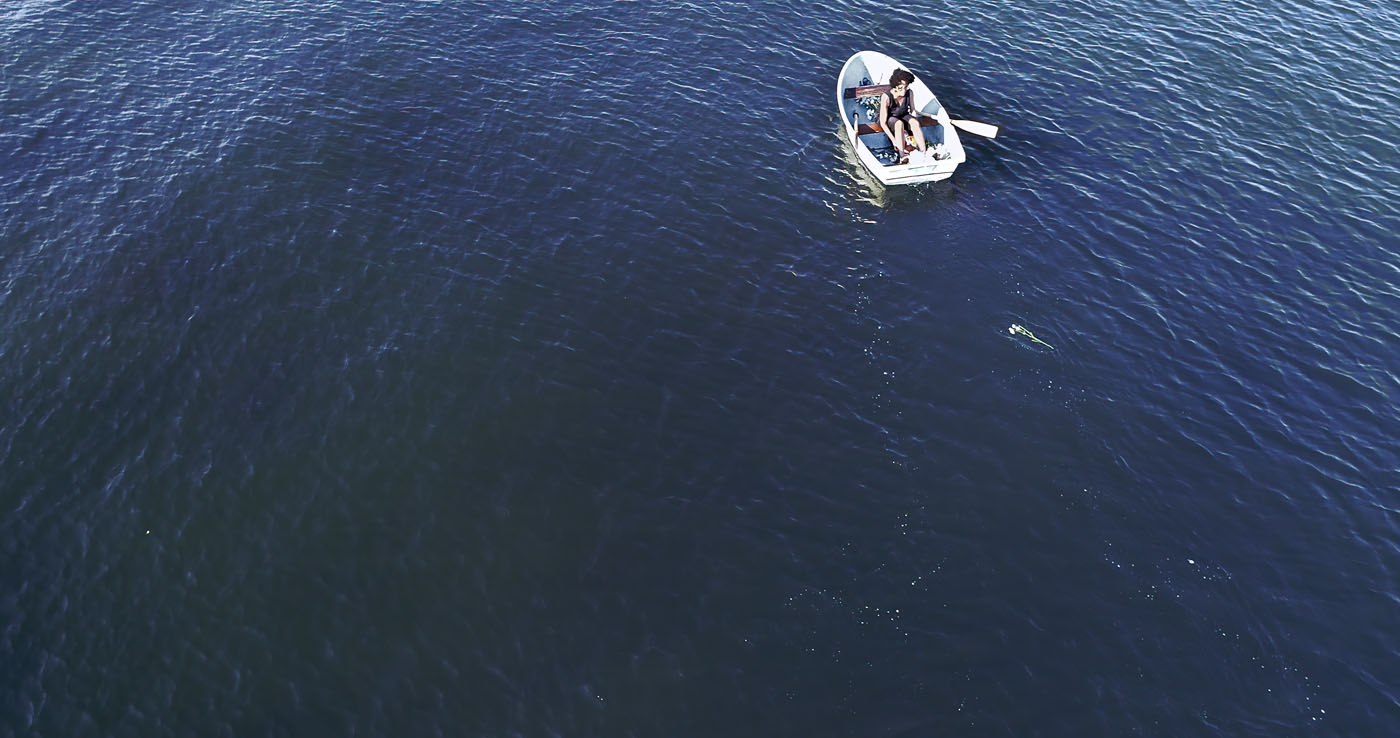
Situated in a dark gallery near the end of the exhibition, in a section that brings together a selection of videos in which Fusco explores the relationship between artistic expression and the biopolitical management of lives, lies Your Eyes Will Be An Empty Word (2021, pictured at top). Fusco films herself paddling along the shore of Hart Island in the Bronx, throwing flowers into the water as she utters the names of New Yorkers who lost their lives to Covid-19. To Live in June with your Tongue Hanging Out (2018) reflects on another form of erasure. Here, focusing on Cuba’s censorship of the late poet Reinaldo Arenas, whose queerness placed him at odds with the Cuban government, Fusco shows how Arenas’s friends have kept his political poetry alive. Both films stress the exhibition's thesis: that artists, whose persistent challenges to repression expose larger struggles between authoritarian states and social movements, will always protest state violence and record histories that official authorities attempt to cast into oblivion.
Coco Fusco: Tomorrow, I Will Become an Island is on view at El Museo del Barrio through March 1.