Note: this screening has been cancelled due to inclement weather.
“The American filmmakers played an important role for me because when I was working for the Dalmas news agency [in the early 1960s], my editor, Claude Otzenberger, made me read Richard Leacock’s interviews and go and see the films of D.A. Pennebaker and others who were trying to extend journalism into cinema,” Raymond Depardon told Artforum some years ago. “For a long time, my experience in film was like that, an extension of my journalistic photography.”
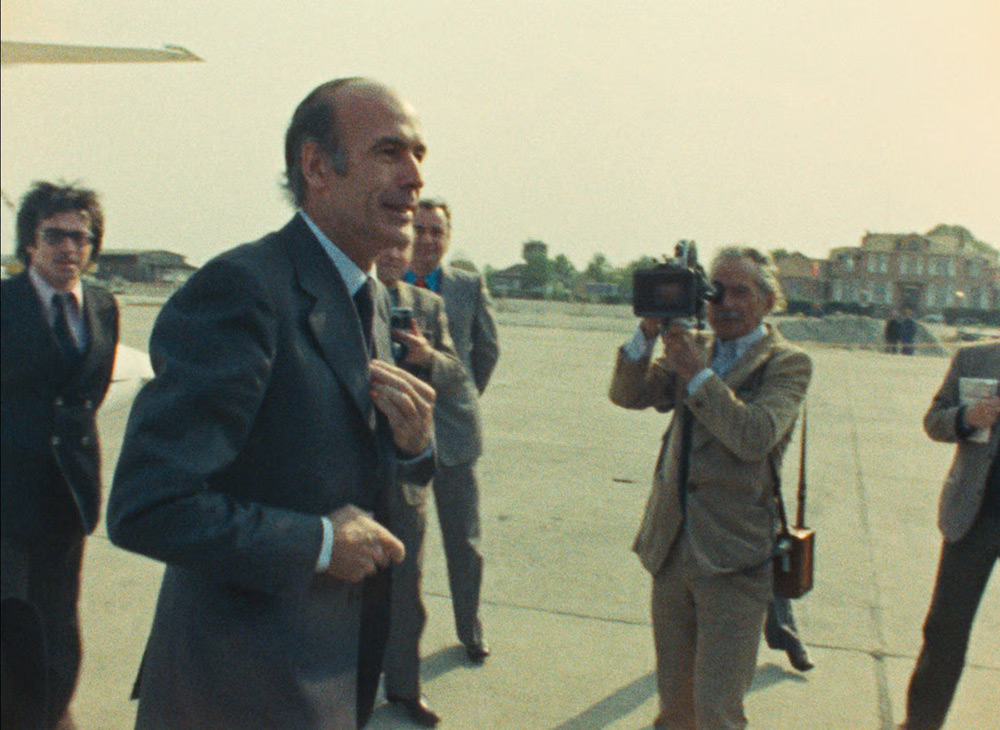
Depardon’s later masterworks, such as Caught in the Acts (1994), apply a more conceptual structure to Wiseman-esque institutional portraits, but his early films show the formative influence of direct cinema. Given the subject matter, there is a particularly strong link between Robert Drew’s Primary (1960) and A Day in the Country, a look at Valéry Giscard d’Estaing’s 1974 campaign for President of France (which he would ultimately win by the narrowest of margins). The stylistic debts are obvious: no voiceover or title cards, just a fly-on-the-wall camera—or rather, a fly in the air, buzzing alongside all the other cameras jostling against the crowds as Giscard disembarks from plane or helicopter in this village or the next, or shakes the grasping hands reaching out to him through through the window of his car, chanting crowds pressed close against the glass.
The film was suppressed by Giscard until 2002, though it’s not obvious, aside from one shot where his exquisitely, tensely poised combover goes rogue, what was so controversial about the film. There are no hot-mic blunders, just an alternately bemused and peevish aloofness at the constant gladhandling that goes into campaigning; what passes for cynical electioneering is quaint by today’s standards, namely a strategy meeting ahead of the head-to-head second round against François Mitterand, in which Giscard advocates for saying as little as possible of substance, making no new promises or attacks, maintaining a (combover-like) equilibrium as he passively soaks up the first-round votes of the Gaullists and allows the intraparty squabbles between the socialists and communists play out on their own.
Having beaten the Gaullist Jacques Chaban-Delmas in the first round, and ultimately to lose to the socialist Mitterand in a 1981 rematch, the center-right Giscard was a transitional figure in the Fifth Republic, which up to 1974 had been dominated by De Gaulle (who died in 1970) and his prime minister and successor Pompidou (whose unexpected death in office that April occasioned the election and documentary, which all came together within the space of several weeks).
The film is most notable as a transitional document in and of itself, showing the trappings of the modern media circus beginning to transform the traditional practices and attitudes of French politics. An elegant, stentorian patrician whose career had been spent largely in the background, Giscard, like his close contemporary George H.W. Bush, is an odd fit for a modern campaign. It’s so disorienting to see his face, of all faces, on the t-shirts of screaming young people, to hear his platitudinous and pedantic rhetoric over the chants. (In The Years, Annie Ernaux frames Giscard as an avatar of anodyne neoliberalism, and recalls that she “had turned off the TV on election night when Giscard uttered his ‘I send my cordial congratulations to my unlucky competitor,’ like so many farts from a mouth tight-pursed as a hen’s rear end.”)
Giscard still drives his own car much of the time, craned over the wheel and inching through traffic on his way to a climactic rally (he skips the pop music acts). He watches alone as the early returns from the second round come in, his black-and-white television set propped up on a 19th century end-table in a room not built to accommodate consumer electronics. Depardon attends to the coming wave of transformative technologies, following the wires that run off a thicket of logo’ed microphones to the line of reel-to-reel tape recorders in front of different outlets’ correspondents in the press area, and milling around on the studio floor before the televised debate between Giscard and Mitterand. Depardon doesn’t show us the debate itself—his audience would have been quite familiar with it—but rather watches as producers point out, to a plainly unfamiliar Giscard, the matching three-minute clocks, just offscreen, that will ensure equal time.
The 1974 debate between Giscard and Mitterand was, in fact, France’s first televised presidential debate, which makes another parallel between A Day in the Country and Drew’s Primary, as the latter is a document of the same election cycle that yielded the TV debates between Nixon and Kennedy. The Nixon-Kennedy debates are often credited as inaugurating the modern era of American politics, in which the public is mystified by narratives crafted and disseminated through widely reproduced mass media. The all-access behind-the-scenes documentaries of Drew and Depardon stand with one foot astride that new zeitgeist and one foot squarely within it, peering beyond the surface of the news images even as they create more of them.
A Day in the Country was due to screen this evening, February 23, at Film at Lincoln Center as part of the series “Raymond Depardon: Humanity in Focus.” The screening has been cancelled due to inclement weather.