When David Gatten learned that The Great Art of Knowing (2004) had helped inspire Kevin Walker and Jack Auen’s Chronovisor (2026), he was caught off guard. “It’s one of those instances when one never knows what one’s work does once it goes out into the world,” he tells me over a landline from Salina, Colorado. “That my movie would bounce around in the world and play a role, even a small one, in helping to inspire a feature film that I was not aware of is a wonderful thing.” The connection, though, is unusually precise. Gatten has spent decades making handmade 16mm films out of all forms of printed matter; likewise, Chronovisor devotes long stretches of its runtime to staring at words on yellowed, browning pages.
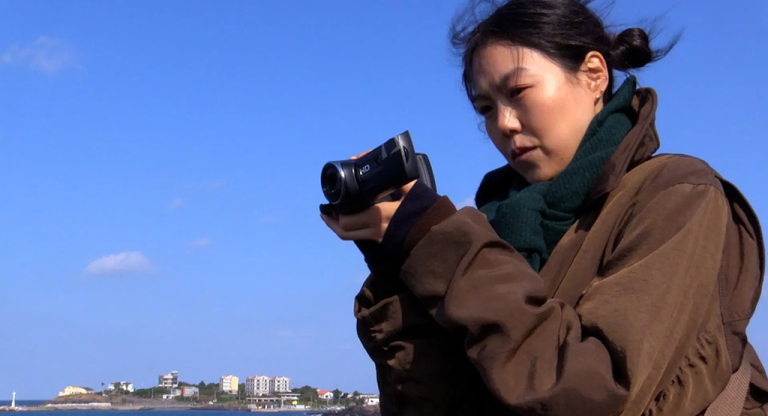
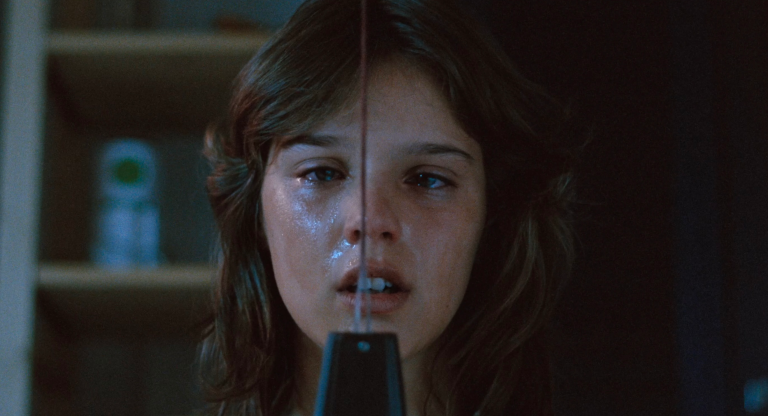
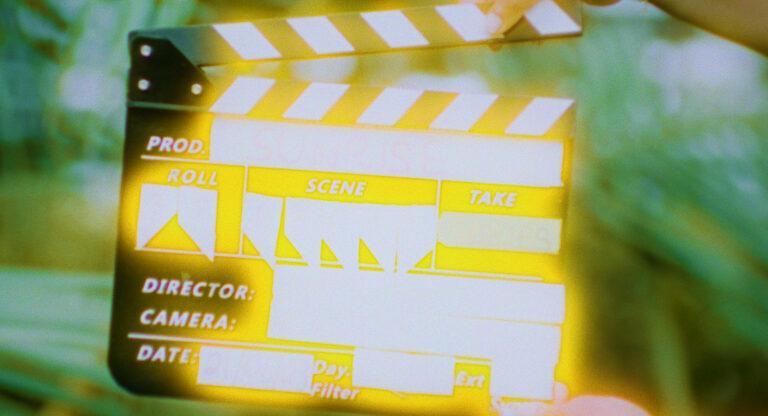
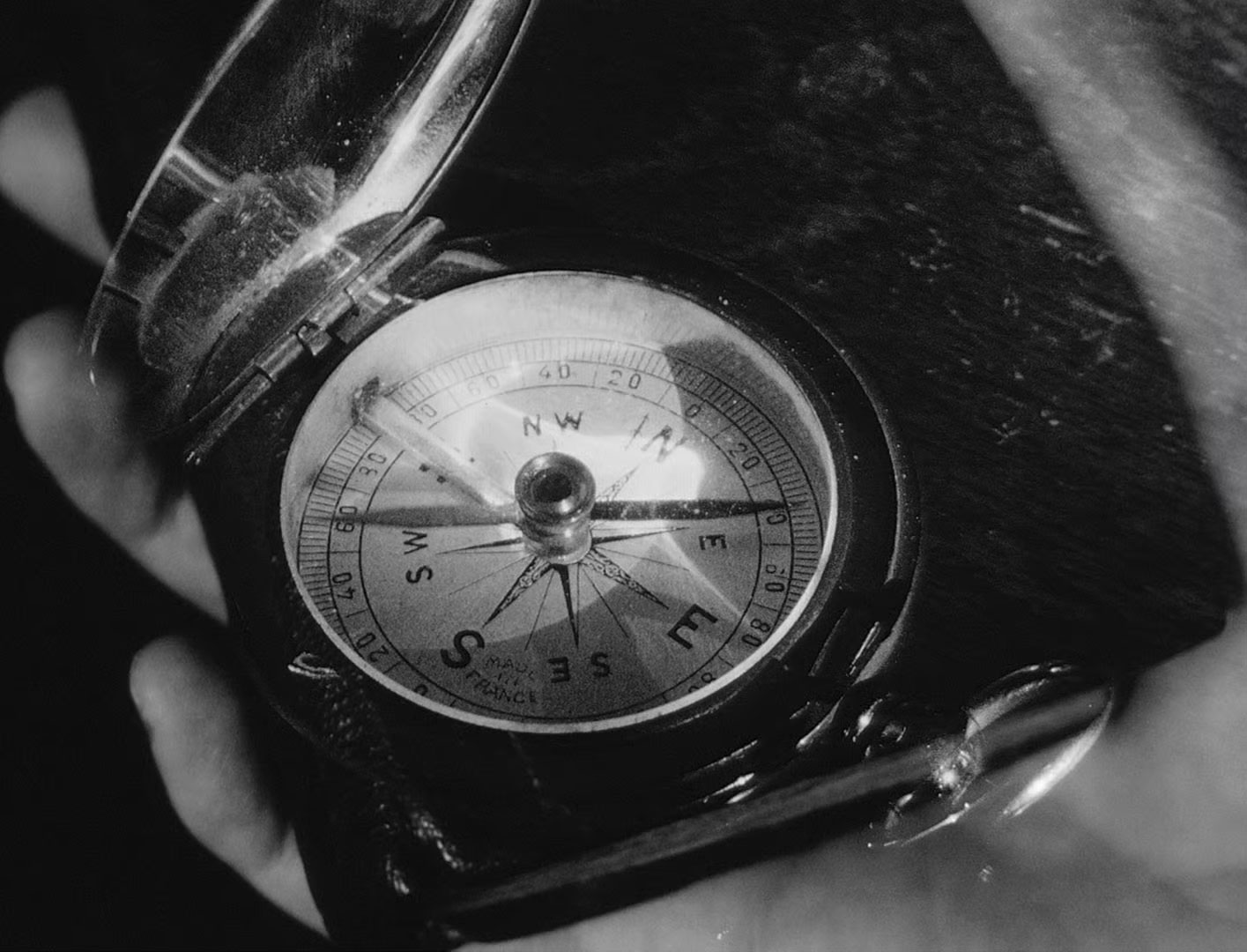
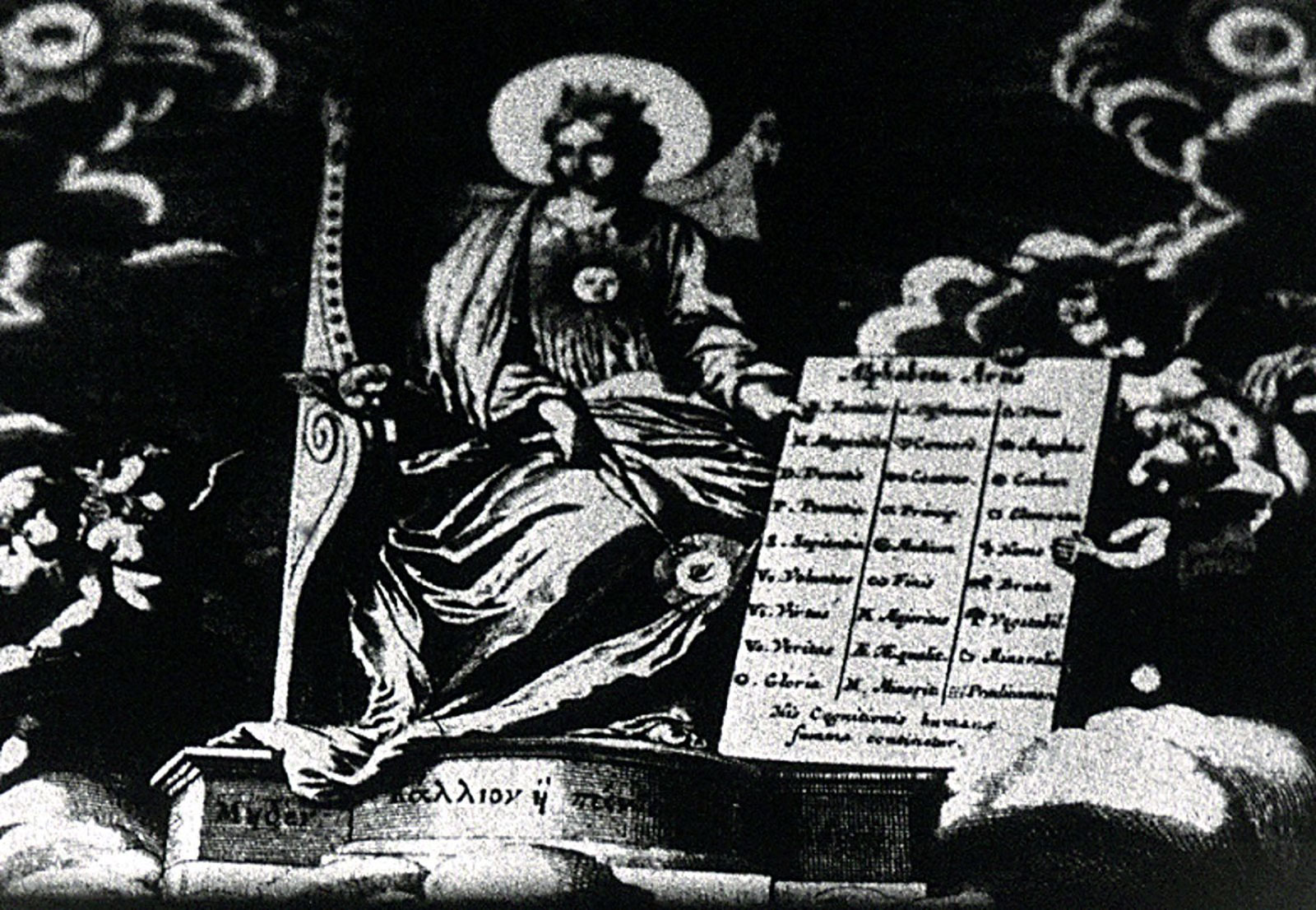
The similarities extend beyond the filmmakers’ shared fixation on books. The Great Art of Knowing takes up an encyclopedia that aspires to contain all human knowledge, while Chronovisor centers on a machine supposedly capable of retrieving the past. Both suggest, or perhaps hope, that something beyond reach might be made knowable. “Systems of knowledge, particularly ones that don’t actually work, are a preoccupation across most of the films I’ve made,” Gatten notes on the same call. This preoccupation runs through The Matter Propounded: Of Its Possibility or Impossibility, Treated in Four Parts (2011), with its fortune-telling device, and What Places of Heaven (pictured at top), What Planets Directed, How Long the Effects? or, The General Accidents of the World (2013), with its turn toward astrology.
Those three “sibling” films, as Gatten calls them, form a loose sequence within the ongoing “Secret History of the Dividing Line, A True Account in Nine Parts,” a project nearly three decades in the making that draws on William Byrd II’s library and the life of his daughter Evelyn. They screen together as part of “Bibliomania: A Preface to Chronovisor,” Film at Lincoln Center’s program of films that inspired Walker and Auen. Gatten once wondered if he would ever complete the cycle; he now plans to finish it in 2028.
We spoke about those final films, his use of words as images, the role of memory in his work, and more.
Paul Attard: In The Great Art of Knowing, the written word moves between legibility and abstraction. At what point does writing cease to be something we read and become something we look at?
David Gatten: The pleasure we take in reading—or “The Pleasure of the Text”, as Roland Barthes would have it—always has a flip side: the anxiety of not being able to read. Legibility and its absence operate at several levels in my films. A text may be in a language I can’t read or, in the case of Leonardo da Vinci, written backwards. That makes it even harder to read and illegible for the most part, until I start using what has been translated from his Codex on the Flight of Birds [1505-06]. There is great enjoyment in being able to read, and also great relief in realizing, “I can’t read this.” Instead of the printed word, the image can take on some of the values of speech: cadence, rhythm, decay.
The other thing that operates in my films, or in any films in which there are large blocks of text, is that there’s this question of, “Am I going to have enough time to read all of these words?” When it can’t be read, we fall back on the text as an image. And text as an image, whether one can read it or not, is very different than an image of a tree, or something without words. A tree doesn’t announce any particular duration. When text appears on screen, the shot is usually over once the viewer has had time to read it. That makes it different from images without language.
I watched the trailer for Chronovisor, and it uses on-screen text in a similar way to The Great Art of Knowing. A primary document appears on screen, sometimes in another language, and then text comes up super-imposed on top of it. When I saw some of the images, I noticed a formal affinity in terms of process and the idea of reading. I can't read something, and then I can. It's illegible, and it suddenly becomes legible through that gesture of superimposition.
PA: Chronovisor imagines the past being retrieved as an audiovisual signal, but your films seem suspicious of ever recovering history in full. What can cinema recover from the past, and what must remain inaccessible?
DG: We do the best we can. We use the tools, processes, and materials of cinema to explore. The films act, in some ways, as an embodiment of the past articulated through the research process, but for me, making a film is always a process of exploration. I never know what I’ll find when I start.
This might not be surprising, but I have a lot of books. [Laughs] Especially in my 20s and 30s, I always felt that I would finally find the book that answered my questions—not an uncommon desire at that age. At a certain point, probably during the seven-year process of making The Great Art of Knowing, I realized I must let go of finding everything in any one place. I now think there’s a slow accumulation of understanding, and The Great Art of Knowing rests on the understanding that one can’t know everything, but that doesn’t prevent one from continuing to look. When something happened 300 years ago, and only fragmentary primary documents remain, there has to be an acceptance of the limits. But I never know what the limits are when I start.
PA: Across the three films presented at Film at Lincoln Center, text can function as historical evidence, intimate communication, or an instruction to the viewer. As you work, how do you determine what kind of object a text will become on film?
DG: I almost never know beforehand what category something will fall into. I don’t really think about those categories. It happens through the discovery of editing. Even when there are grand conceptual structures or edifices, I never know exactly what will happen with a panel of text or a fleeting phrase until the editing process. I may have some ideas about what I want to register on the film strip, but the world always resists one’s visions. I can either bang my head against the wall and keep re-shooting it, or I can enter into a conversation with what the film gives back to me. The latter is much more rewarding.
My editing process is unusual, at least at this point in the 21st century: I shoot reversal film and don’t make work prints, so I only have the original camera footage, which is very delicate. I project it twice, make notes, remove shots I know I won’t use, project it a third time, attempting to memorize the footage. I cut it into A-B-C, sometimes D, rolls using a cement splicer and gang synchronizer. I’m working from memory and don’t use a viewer. It could be years since I last saw the footage at 24 frames per second, but I’m still working from memory of its time signature, counting frames, and imagining what the material will look like once printed. There is no second cut. First cut is final cut. I don’t know what it will look like until the print comes back from the lab, so I have to rely on my understanding of how the materials combine.
PA: Sounds like another form of exploration.
DG: It is. It’s an engagement in a kind of faith. I might make only four or five cuts a day. They’re cement splices, so I have to be certain that each cut is right. In between, I make another cup of tea, brush the scraped emulsion off the editing bench, look out the window. I almost always have a Bolex set up looking at something. I’ll look through the viewfinder and probably won’t shoot, but sometimes I do. The process is slow so that my life moves more gently.
PA: At the School of the Art Institute of Chicago, you studied with Shellie Fleming and Zack Stiglicz, whose work remains deeply underseen. I can see traces of both in your films, and now perhaps in Chronovisor too. What did you learn about filming from each of them?
DG: I applied to the Art Institute hoping to study with Shellie after seeing Left-Handed Memories [1989], Private Property (Public Domain) [1991], and Devotio Moderna [1993]. I responded deeply to those films, and not only loved Shellie’s work, but loved the process through which she made them—memorizing footage, visualizing it during editing, and working without a viewer. I cannot overstate the importance of Shellie’s work or her impact on me as a teacher. She is central to how I came to understand cinema.
Zack is deeply important too. In 1991, I saw Aristophanes on Broadway and was staggered by the images he created through the optical printer and multiple-generation printing to produce high-contrast color. He made so many beautiful films, many of which haven’t been seen nearly enough, especially since his death.
So Shellie’s editing and Zack’s optical printing were foundational for me, as was Tatsu Aoki, who taught me another way of making films artisanally through contact and optical printing. Shellie had studied with Will Hindle and learned from the editing and handmade effects in films like Watersmith [1969] and Chinese Firedrill [1968], but developed her own method of rephotography without an optical printer. That lineage matters, as does understanding that one works within a tradition. A filmmaker has a responsibility to make work in relation to cinema’s history, as well as the contemporary conversation and what one can contribute to it.
PA: You once said you no longer expected to complete the 9-part Byrd cycle, having stopped feeling bound by a structure conceived decades earlier. Now the finish line is in sight. What changed?
DG: I began to understand Evelyn differently, and my interest shifted to the story, the emotion, and the tone she carries with her. I was tired of dealing with William Byrd II and the library itself; I wanted to focus on Evelyn’s emotional dynamics and interior life, imagined through the historical record I could access. I stopped in one way, but kept going in another.
The film that is unique in my filmography is The Extravagant Shadows [2012], the three-hour digital work. The characters are never named, but that’s Evelyn. I simply don’t identify her as such. That is the seventh film in the Secret History cycle. That’s not something I’ve said to more than a couple of people. I wasn’t interested in identifying it as one at the time; I wanted it to be its own thing. In fact, the two films playing at Lincoln Center with The Great Art of Knowing are both Byrd films. I’ve just never framed them that way or spoken about that publicly. I always knew The Matter Propounded was part of the Secret History cycle, and that connection became much clearer in What Places of Heaven.
At a formal level, the work [The Extravagant Shadows] is completely different. I knew it couldn’t be made on film, since it would consist of very long takes. Except for the central section, when we move into the architecture, it is one continuous take as the paint dries and cracks in real time. Plus, I wanted to explore the noisy images of a consumer-grade DSLR. The image is much flatter than 16mm, and the relationship between the books obscured by paint and the appearance of the text is different, but the underlying emotional life is the same. As the movie unfolds, it’s a different expression of Evelyn Byrd’s emotional life, transposed into another century, as she was in The Matter Propounded. It wasn’t an obvious move, but it felt honest and was where I needed to go as a filmmaker.
PA: Are you still planning to complete the final two films in the Byrd cycle in 2028?
DG: Yes, that is the plan. For many years, I was content to leave the cycle at the four “official” Secret History films. Then, in 2017, I realized that I could see a way forward, and it was more interesting than I had expected. Work began in earnest in late 2018 and intensified in 2019. The final two films will share an umbrella title and enter a new area of exploration for me. They’re centered on Evelyn, now firmly in the 20th and 21st centuries, and explore her relationship with Anne Harrison. Anne was there during the years Charles wasn’t, and their relationship became extremely close after his death. It was profoundly important to Evelyn.
So far, Evelyn has been text, then a hand in The Enjoyment of Reading [2001], followed by moving hands as she begins to be embodied in What Places of Heaven. In the new films, she gets a voice, a body, and a face. People embody Evelyn and Anne in these films. The work is new and ambitious, with sound operating in a completely different way. The person playing Evelyn is a well-known actor, and that requires a different filmmaking approach: working with SAG-AFTRA, navigating its requirements, and bringing in people to assist with the production. In the past, I’ve always worked in a completely artisanal way, with just myself and the lab.
PA: I wanted to ask about The Spirit Lamp [2025], which pairs your 16mm imagery with Chrystabell performing songs she made with David Lynch and has toured across Europe. How did you become involved in the project?
DG: The Spirit Lamp came about through one of those moments when somebody makes an exit and leaves a space behind or a door opens. When Lynch passed away in January 2025, it had a big impact on me. I became a filmmaker in part through David Lynch and Twin Peaks [1990]. I knew the music he made with Chrystabell, and because it was so meaningful to me, I wrote to Chrystabell through her website and sent something between a condolence letter, a thank-you note, and fan mail. She wrote back a couple of days later and said, “David and I were approached after the release of Cellophane Memories [2024] by the Biennial of Contemporary Art in Lisbon to make a stage show. It has three screens and a lot of images. But the person who was going to make those images isn’t here anymore. Maybe this is where you come in.”
I was stunned. She hadn’t seen my work, but she was operating on the intuition that I might be the right person. The experimental opera we imagined was too large for the Lisbon production, so we put it aside and stayed in touch. She was then asked to perform five songs at Cannes as part of its official David Lynch tribute, and a few weeks before the festival, she called and asked if I could make five films to accompany the songs. I said, “Chrystabell, you know I make 16mm films. Making even one film in three weeks isn’t really possible.” Still, I asked for 48 hours to think about it.
I couldn’t shoot anything, but I’m surrounded by tens of thousands of feet of footage in my studio. I also knew the songs front and back. So I looked through the cans, put material on the rewinds, projected some of it, and found five things that could become five films. I called her back and said, “Yes, but I’m not going to make wallpaper. This isn’t something to run in the background. It has to be edited with distinct shots and its own rhythms, and it has to be your only lighting—the cocoon in which you’re wrapped.” She said, “That’s great. There aren’t any lights at Cinéma de la plage anyway!” [Laughs]
The plan was to perform the show twice on a single day, once on the beach, just after dark, and once at Cannes’s Club Silencio at midnight. The next morning, huge amounts of flowers arrived, then chocolates—and then a producer. We realized people wanted this to happen again. So we expanded the 30-minute set into a 75-minute evening, chose more songs, and named it The Spirit Lamp after imagery in the film for “Real Love.” Chrystabell came to Boulder and we shot more material. A trailer went out to booking agents and managers in Europe, and suddenly there were shows in Paris, London, and all over. The Spirit Lamp even ended up in the same Lisbon opera house where the first unrealized collaboration had begun.
PA: You began the Secret History cycle 29 years ago. How different is the filmmaker who started it from the one who will complete it in 2028?
DG: The filmmaker I am now has been conditioned by everything that has happened over the past 20 years: meeting Erin [Espelie], leaving New York, moving here to this old gold mining cabin in Colorado, experiencing—and narrowly escaping—a major wildfire and a massive flood, then becoming a parent when Darwin came along in 2014. Being a parent changes everything. It changes how one understands the world, love, time. I’m now interested in exploring the relationship between a parent and child in a way I wasn’t before, and that enters the new work. My relationship to storytelling in cinema has undergone an enormous expansion in the last 30 years.
PA: What do you know now that you didn’t when you began? What do you still want to learn?
DG: I always knew I wanted to teach. I come from a family of teachers, and my father was a professor of herpetology at the University of North Carolina. The relationship between his research and teaching showed me a possible model. I didn’t know how filmmaking would fit, but I found a way to make teaching and filmmaking complementary practices that informed one another. That took time, but has been deeply rewarding.
What interests me now is continuing to try things I haven’t done—and might not be very good at. We will see. I’m entering another unfamiliar space. Clearly I have not made a filmmaking career based on working with actors, but actors and their performances are central to these new films. This brings a great deal of excitement and anticipation, concern and hesitation, elation—all the things that come with trying something new. Luckily, I have a lot of people around me who are very experienced in this realm, including a fantastic producer—and, of course, the extraordinary actor playing Evelyn, with whom I’ve been working on this project since 2019.
It’s also critically important to me to keep exploring the entire range of what cinema has been and continues to be. The many post-New Wave French films I’ve watched over the last 15 years, particularly those by Jacques Rivette and some of the more obscure works by Marguerite Duras, have strongly influenced how I think about storytelling. One of the things I like so much about the “Bibliomania” series is that we are seeing a huge diversity of approaches, scales, methods, intended audiences. I love all of it, and I have had long and meaningful relationships with a good half dozen of the films. I’ll see every movie.
I wish Phil Solomon was still with us—we would have had a ball seeing everything that’s being shown. Phil used to tell a story about going to the movies with Stan Brakhage. Back in the early ‘90s, they were going to the local mall nearly every day, and even went to that Stallone movie, Cliffhanger [1993]. During a helicopter shot rising up over a cliff, Stan grabbed Phil’s arm and said, “That’s what I want! That feeling! That’s exactly what I want to paint when I get home.”
PA: You don't pick your inspirations, they ultimately pick you.
DG: That's right and curiosity is the key.
“The Matter Propounded: Three Films by David Gatten” screens this evening, September 2, at Film at Lincoln Center on 16mm as part of the series “Biblomania: A Preface to Chronovisor.”