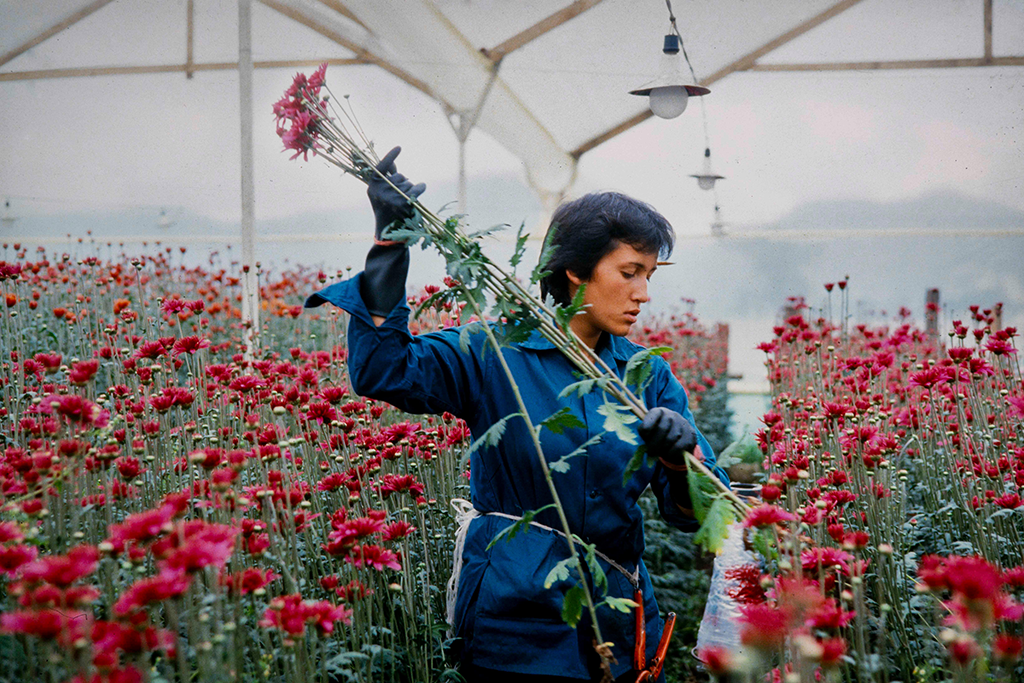
Carnations fill the screen in kaleidoscopic abundance at the beginning of Marta Rodriguez and Jorge Silva’s Colombian documentary Love, Women and Flowers (1988). Free-flowing narration accompanies these images: “Flowers, happiness, world of color, tenderness, poetry, beauty, love…utopia…woman, smile, friend, lover, sister, mother…sun, light, sensuality, ecology.” But, it’s quickly made clear that the lush abundance comes at a cost, as one worker reflects, “Every flower is beautiful, but behind each one there is a death.” Shot between 1984 and 1988, Love, Women and Flowers documents the dangerous conditions faced by Colombian flower workers in greenhouses saturated with pesticides. In close-ups, Rodriguez and Silva show women handling flowers dripping with chemicals; in interviews, the workers describe cancer, infertility and other illnesses associated with exposure. As the film’s title suggests, the filmmakers are interested in the women’s domestic and personal lives as well, allowing them to speak about marriage, family, disappointment, and their own realization about what this work is doing to their bodies.
Colombia’s modern cut-flower industry emerged in the 1960s and grew partly out of JFK’s Alliance for Progress, the Cold War development program designed to encourage capitalist growth across Latin America after the Cuban Revolution. In 1967, David Cheever, an American grad student, convincingly identified the Bogotá savanna, with its temperate climate, cheap land, and abundant low-paid female labor as especially suited to industrial floriculture. By the 1970s, Colombia had become a major supplier of flowers to the United States, starting with carnations and chrysanthemums and later expanding to roses and other flowers. Today, Colombia exports more than $2 billion in flowers worldwide, and the U.S. remains its largest market.
What makes Rodriguez and Silva’s film especially affecting is the women’s own awareness of the contradiction at the center of their work. They speak about the beauty of the flowers while describing the toll on their own beauty and health. With each new flower cut, they become prematurely aged, sickened, infertile and diminished. Colombian art and literature have long entwined flowers with pain and death, from the rain of yellow flowers that drown the town in Gabriel García Márquez’s 100 Years of Solitude, to Doris Salcedo’s A Flor de Piel, in which rose petals are stitched together into a funerary shroud as a memorial to a Colombian nurse brutally murdered by paramilitary forces.
Rodriguez and Silva were not neutral observers of the conditions documented in their film. In an interview conducted around the premiere of the film’s restoration at Cannes Classics 2023, Rodríguez cites Love, Women and Flowers as one of her most immediately effective films: screenings and pesticide-awareness workshops helped workers recognize their illnesses as shared experiences, which contributed to the beginning of a strike. According to Rodriguez, the resulting pressure forced flower companies, at least in the short term, to introduce greater protections around the workers. The film culminates with footage from an actual strike in 1988 by the union Sintraflores, but its attention ultimately turns inward as well. Rodriguez and Silva were themselves married and the film’s closing moments make clear how profoundly the project entered into their own lives.
Love, Women and Flowers screens this evening, September 3, at Maysles Documentary Center. Claudia Horn, author of Rosa Luxembourg's Herbarium, will introduce the film, and Sara Silva, the filmmaker’s daughter, will also be in attendance.