In a turn-of-the-millennium Film Comment piece on what were then Hou Hsiao-hsien's “latter-day” films, Kent Jones wrote of Goodbye, South, Goodbye (1996): “Is there another film since Warhol with a better sense of just hanging out? It's about how time feels as it's passing, about the feeling of simply existing, moving through life as most people do, no big deal, caught in a state of being itchy, nervously under the gun, pressured from outside to perform, to straighten up, to make a little money.” Made over a decade earlier, Hou's A Summer at Grandpa's (1984) similarly has characters “just hanging out” and “moving through life as most people do”—albeit without any of the aforementioned pressure. The film covers a laconic country vacation as seen through the eyes of a preadolescent boy and his little sister. They are far from the realities of labor and romance, existing instead in the ever-shortening window of total innocence.
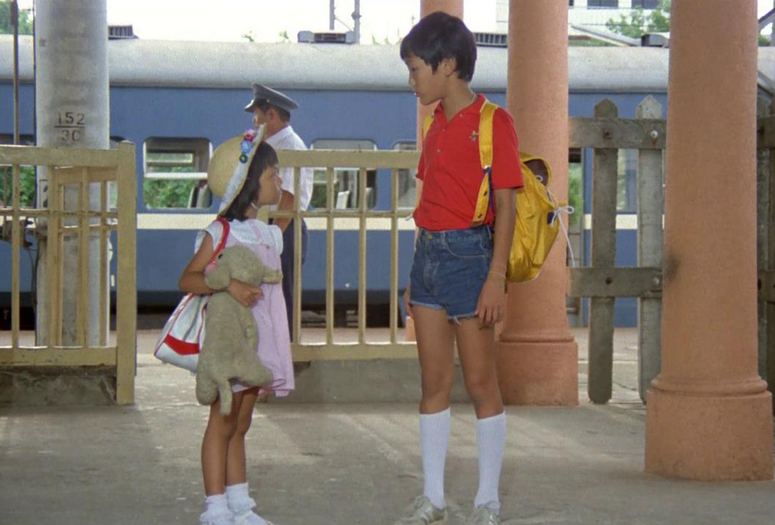
The duo are sent off to live with their titular relative in the sleepy outpost of Ludong while their mother (Nai-Chu Ting) recovers in a Taipei hospital from a serious ailment. (Bonus: their father is played by none other than fellow Taiwanese auteur Edward Yang, who the following year would cast Hou in a lead role in his seminal feature Taipei Story.) Shepherded by their uncle (more on him later), they leave the capital for the windswept languor of rural life, sleeping on the second floor of their grandfather's medical practice. Big brother Tung-tung (Chi-Kuang Wang) quickly befriends a gaggle of local boys, trading his remote-controlled toy car for a turtle and soon whiling away the heat in the local river and racing terrapins.
Death lingers in the margins. Worsening reports arrive about their mother's health back home. The kids chance upon two hoods who wind up smashing a rock on a truck driver sleeping under an overpass. Looking ahead at adulthood, their scooter-riding uncle (Chen Bo-zheng) offers some alarming possibilities as he becomes embroiled in a number of crises involving crime, fatherhood, and—in a comic turn—a bout of hemorrhoids.
As one has come to expect from a Hou film, trains are a constant presence in A Summer at Grandpa's, the rhythm of their clacking journeys contrasting with the ever-present drone of cicadas. Movement is constant in the film, from the breeze stirring the cypresses to the railway cars rattling in the distance. Time is not so much sculpted by Hou as it is traced. Every shot is a moment, every scene a memory. Even in stillness, life is always in motion.
A Summer at Grandpa’s screens this evening, March 27, at the Museum of Modern Art on 35mm as part of the series “A View from the Vaults: The 1980s.”