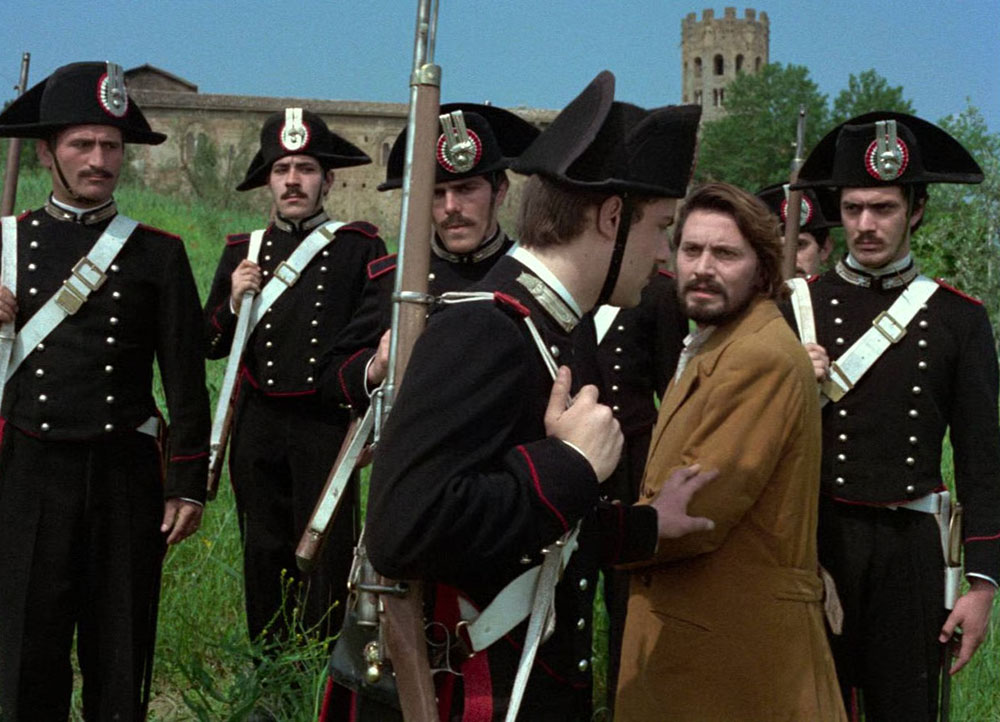
Paolo and Vittorio Taviani’s St. Michael Had a Rooster (1972), based on Leo Tolstoy’s short story Divine and Human, begins with a failed insurrection in Citta della Pieve, Italy, in 1870. After the revolutionary action is thwarted, Giulio Manieri, an Italian aristocrat turned internationalist anarchist, is jailed and struggles to keep his sanity during a 10-year confinement. Isolated, the philosophical and intellectual dimension of revolution becomes the real stuff of the film as Giulio stages political debates with himself in his cell. Years later, while being transferred to another prison, he encounters a group of young revolutionary Marxists who exhort scientific socialism, scoffing at and deriding his utopian idealism. Disenchanted, and with his hopes of joining up with likeminded comrades again dashed, Giulio lets himself drown.
The film is visually somber. It maintains a muted palette and a strange, austere melancholy throughout thanks to Padre Padrone (1977) and Our Lady of the Turks (1968) cinematographer Mario Masini. As a political and human statement, St. Michael Had a Rooster is a tragically poetic reflection on the gulf between the romance of political ideals and the efficacy of a more concrete approach. But what has always struck me most about the film is its unusual apportioning of time, the key example being when Giulio is arrested, sentenced, and sent to his impending execution. Placed in the back of a horse drawn cart, his journey, seemingly a narrative obligation meant to take him from one point to another, is the film’s most surprising sequence because of how much time it is allotted. The staging of this sequence, which is over seven minutes long, enroute to what will presumably be a larger plot point (Giulio’s death), signals an implicit revaluation of what is worth showing an audience and for how long. It hints at suppressed dramatic possibilities within, and beyond, narrative structural norms and hierarchies of action. St. Michael Had a Rooster’s structure as a whole is a testament to this idea, with a large part of the film taking place in Giulio’s cell.
Imprisonment, literal and figurative, is a theme that returns in the Tavianis’ masterwork, Padre Padrone, in which a young Sardinian sheepherder is enslaved by his father. The directors’ work would expand to include larger vistas later in films like the ambitious Kaos (1984), but the focus on anti-spectacular spaces such as closets, jail cells, and small rural dwellings characterizes their most radical work. In the context of Italian cinema, one of the world’s most visually sumptuous and expansive traditions, this rejection of space registers as a radical act, and one that we see throughout innovative and subversive Italian films of the late ‘60s and the 1970s, including Roberto Rossellini’s Cartesius (1974), Elio Petri’s Todo Modo (1976), and, maybe most pointedly, Marco Ferreri’s banal chamber piece Dillinger is Dead (1969).
Like in Arte Povera, the postwar art movement in which artists used “poor” industrial materials to create abstract works that embodied the spirit of their time and rejected the beauty historically synonymous with Italy’s fine art, the Tavianis deny the grand visuals of the historical film, and its attendant escapist pleasure, to embody the spirit of their own time. This denial is a calculated artistic break with the past and its representations. In fact, it grants us a new perspective on the past. Through its unique, human scale approach to historical drama and its daring experimentation with screen time, St. Michael Had a Rooster makes the past contemporary so that we might better understand the possibilities of our own time, as well as the desires and compromises of our own political hearts.
St. Michael Had a Rooster screens tonight, June 7, at Film at Lincoln Center as part of the series “History, Italian Style.”