Although names can provide us with the illusion of individuality, they circulate from person to person, detaching themselves from stable meaning and sometimes even repeating themselves. Crossing paths with someone who has her exact name becomes a problem for the Silvia Prieto in Martín Rejtman’s Silvia Prieto (1999)—a coincidence that unsettles her because her own life already feels directionless. The first time we hear her, in voiceover, she misleadingly seems in control of where she's headed in life: “On my twenty-seventh birthday, I decided that my life was going to change.” Yet washing all of her clothes, getting a job at a café, quitting weed, and buying a canary that refuses to sing prove mere mundane attempts to reshape her identity through habits. Becoming someone is not a game that can be accomplished in isolation, but about accommodating one’s relationships to the world around them.
Played (and narrated) by Rosario Bléfari, Silvia navigates both herself and Buenos Aires during the final year of the turbulent ‘90s. It was a neoliberal decade marked by a mirage of abundance that concealed rising unemployment and the economic collapse that arrived in 2001. The political backdrop against which the Nuevo Cine Argentino emerged found an insightful interpreter in Rejtman, whose first film, Rapado (1992), introduced a new cinematic grammar to local filmmaking. Focusing on chance, repetition, and the inertia of urban routines, Rejtman’s work turned its back on conventional dramatic arcs to propose a quietly contemporary cinema in which nothing is more absurd than the contingency of everyday life. Through deadpan exchanges, chance encounters, and the stubborn materiality of everyday objects, Rejtman’s Silvia Prieto brings to light the unspeakable and perplexing possibility in any coming of age narrative: to learn nothing and to become no one.
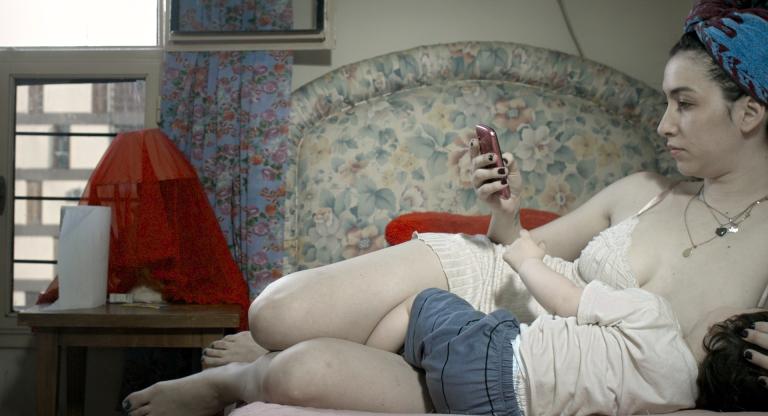
For anyone who circulated Buenos Aires’s underground culture during those years—but also long afterward, until her death in 2020—Bléfari or just “Rosario” were synonyms for the magnetic center of an entire scene that spanned music, film, and literature. Often referred to as the “mother of indie” by cultural commentators, Bléfari embodied several lives at once: she was the frontwoman for the distortion-heavy rock band Suárez, even performing while pregnant; a sharp lyricist; an experimental theater artist; an ever-young poet; the author of a meticulous accounting journal detailing her life as an artist; and Silvia Prieto herself, a character so singular she became a kind of moral beacon for aspiring Latin American pixie girls who dreamed not of changing men but of changing themselves. Both elusive and strangely precise, Bléfari’s Silvia is airy, distracted, and quietly observant. She narrates her present calmly but firmly, describing each step she takes with almost absurd precision—counting exactly how many coffees she serves or methodically chopping roasted chicken for every meal. At the same time, she moves through the city with a light, almost provisional presence while remaining unexpectedly resolute: rejecting men who hit on her, innocently lying to strangers, stealing jackets only to give them away later. Bléfari’s calm, nearly neutral delivery turns these gestures into something comic, as if Silvia were testing out possible new versions of herself with uncanny discipline, yet without fully committing to any of them.
Around Silvia gather a loose constellation of young adults. It would be generous to call them a “group of friends” since what binds them is less affection than routine and coincidence. Their relationships form with the same casual logic that governs the circulation of objects; they drift in and out of each other’s lives, much like the interchangeable yellow jacket that connects them. Their identities feel just as provisional. They carry names that cling to them like labels: Brite (Valeria Bertuccelli), whose name doubles as the brand of washing powder she sells, or Gabriel Rossi (Vicentico), a poet who claims to have begun a new life abroad yet cannot escape his high-school nickname “Bottle Lamp,” a phrase that suggests a certain uselessness. Even as these characters move through life’s supposed milestones—marriage, motherhood, settling down, prison, or brief appearances on the television dating show Lonely Hearts—nothing feels grand or sensational, nor transformative or decisive. Life’s events follow one another like objects passing from hand to hand: one by one, slippery.
By the end, the discovery that another woman (and many more) share her name never resolves into revelation. Instead, it fades into the background, becoming just another coincidence among many. Silvia does not recover her singularity, nor does she lose it entirely. She simply keeps moving—between apartments, conversations—and learns to inhabit a world where identities circulate as lightly as jackets. A peculiar freedom emerges: the possibility of living without the burden of becoming someone definite. In an interview published shortly before the film's release, Rejtman said: “People say, ‘The theme of the film is identity.’ For me, the theme of the film is language, or the literalness of things.” In that sense, Bléfari’s Silvia is perhaps not a heroine of transformation, but of suspension, drifting through the city with the calm assurance that a life does not need definition, or resolution, to keep unfolding. Just like words.
Silvia Prieto screens this evening, March 11, at BAM as part of the series “Cinema Tropical at 25.”