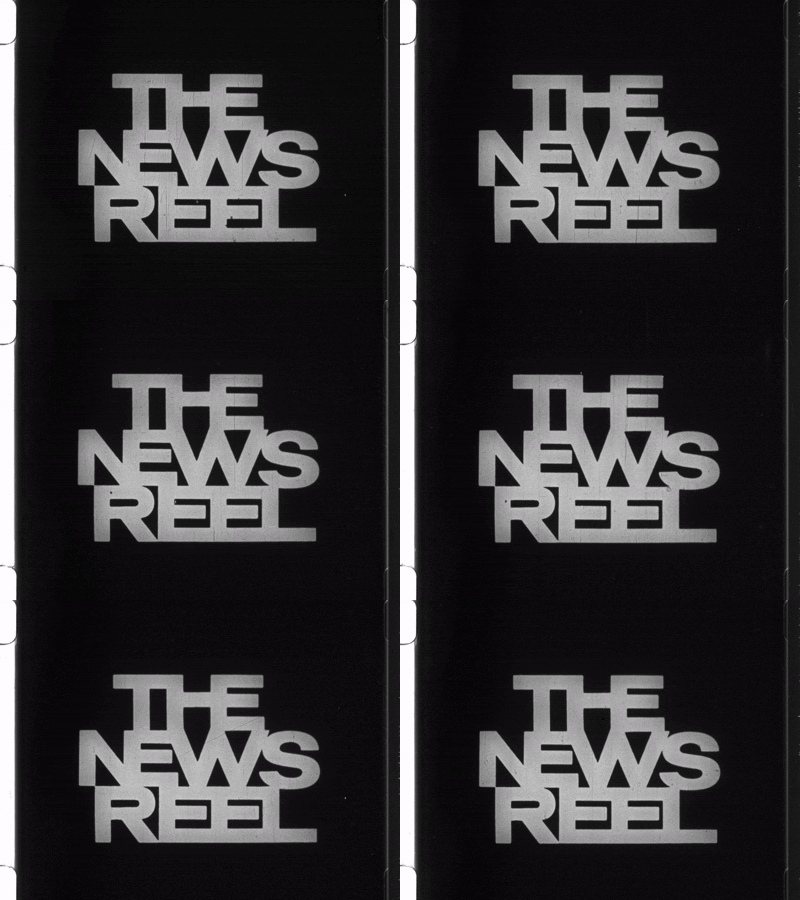
Newsreel was effectively the agitprop documentary wing of the late-1960s U.S. New Left and its films were never meant to be viewed alone at home on a laptop. Mostly bypassing commercial distribution, Newsreel showed its short, confrontational works at alternative venues, which could include everything from building walls to a truck that drove around conducting impromptu street screenings. They shot from inside the movement; in No Game (1968), which kicked off black hole cinematheque’s ongoing “Newsreel: Collective Fragments of Living Struggle” retrospective, not only does the camera appear to be a participant in the March on the Pentagon against the Vietnam War, at one point it seems to be run over by a police motorcycle! Newsreel’s logo flashes onscreen to the beat of machine-gun fire; its leaders had a flair for radical rhetoric, as when Robert Kramer explained their aspiration was to make films that “explode like grenades in people’s faces, or open minds like a good can opener.” Screenings were not intended for cerebral contemplation, but active political education and mobilization. According to New Left legend, after a 1969 college showing in Buffalo, New York, students marched on the campus ROTC building and burned it down.
The implicit question posed by black hole’s ambitious series is, what are the resonances of Newsreel’s Long 1968 here in our own moment of MAGA fascism, Gaza genocide, and mental colonization by tech-capitalist algorithm and AI slopification? For series programmer tooth, it’s quite clear that “a lot of these issues are continually recycling themselves” and that the political struggles the films address—anti-imperialism, national liberation movements, Black liberation, women's liberation, queer liberation, and more—respond to “cyclic systems of oppression that continually renew themselves if they've ever had a real contestation to their process in the first place.” They dispute that the ‘60s “movement” ever stopped; its energies were impinged upon by state counterinsurgency programs and a nonprofit-industrial complex, but resistance has always rearranged itself in new forms.
Take a film like Newsreel’s early staple, Columbia Revolt (1968), which provoked the aforementioned ROTC burning. Depicting students occupying buildings of the New York City Ivy League university in protest of its territorial expansion into Harlem and then being violently attacked by rampaging cops, it vividly captures the looks, rhetoric, and textures of 1968. But it’s never felt more relevant: switch the black-and-white 16mm for cellphone-cam color and it could easily pass for the 2024 student takeover of the renamed Hind’s Hall at Columbia, which like the student encampments there met its own brutal police repression. Likewise People’s Park (1969), chronicling the iconic battle between counterculture and university over public space in Berkeley, another Newsreel that’s both quintessentially ‘60s and shockingly contemporary, as the once potentially utopian public space is again currently blocked off with security and barbed wire to protect more university construction.
Newsreel style often toggled between two modes, what tooth calls “short ‘turn-on’ films,” with “more experimental cutting, pop music, and things like footage of riots,” and “analysis films,” with heavier, more directed narration. Sometimes the styles coexisted within a single film (Amerika and Summer ’68, both from 1969, are early Newsreel epics of sorts), other times (such as No Game) the pure montage-driven phenomenological frenzy aims to send you, the viewer, straight to the barricades. Among other highlights, People’s War (1969) is a pioneering anticolonial documentary that was shot in North Vietnam while the U.S. was committing daily war crimes against its people, and it was initially confiscated by customs when the Newsreel team returned home; Isle of Youth (1969) shows young Cubans helping to build new communist realities; and The Women’s Film (1971) captures the messy intensity of early women’s liberation, sometimes needed against the white male hegemony of Newsreel’s early “heavies.” Indeed, this ultimately resulted in protracted internal struggle that led to reorganization as Third World Newsreel, which allowed women and people of color access to the means of production and remains one of the longest-running and most important groups in the history of U.S. left film. It’s represented here by Teach Our Children (1972), co-directed by the recently-passed Christine Choy and exploring both the Attica prison rebellion that was put down by state killing and the “internal colony” thesis of African American history that emerged from early Black communist thought. You’d be hard-pressed to find a better example of New Left radical cinematic strategy than its dialectical synthesis of intellectual analysis and freewheeling montage in the vein of Cuban master Santiago Alvarez.
For tooth, showing these films now is not a sterile history lesson, and they bristle a bit over the ways the Newsreel story has been claimed by academics who publish in paywall-protected journals and try to capture its spirit of resistance within historiographical debates. “The energy of these films really is uncontainable,” they say, “and by its nature, corrodes its containers that try to get imposed on it.” All of black hole’s screenings are free, and tooth calls it a “movement-facing series, rather than something that studies the movement from outside of it,” presented in activist and organizing spaces such as Bathers Library, the alternative pedagogy/performance space in Oakland, and 34 Trinity Arts & News, the last bookstore left in San Francisco’s Financial District carrying, alongside its history, poetry, and art books, anarchist, communist, and occult literature—a modern version of the New Left bookstand seen in No Game. Some screenings may follow Newsreel’s unsanctioned guerrilla projections; follow black hole on the ‘gram to stay abreast of those. tooth doesn’t begrudge anyone who seeks online bootlegs out of necessity but notes these are all rare 16mm prints being projected, which carry a material presence lost in digital rips.
tooth rejects the “consumptive mode” of spectatorship that dominates repertory film venues, where viewers approach cinema with silent reverence: watch the film, “listen to what the filmmaker has to say, you don’t really talk to each other. It’s like receiving communion or something, and there's a lot of community around communion that I don't want to denigrate,” but Newsreel “needs to be engaged with, rather than consumed.” They’re making individual zines for each screening—impressively curated documents and essays including unearthed New Left newspapers and FBI surveillance reports—and most of all, they hope the films will serve as “conductive sparks” for political discussion and more.
Will anyone go burn an Army recruitment center down afterward? It’s 2026, none of us even want to joke about that because we all know we live under national-security hypercriminalization straight out of a Yippie fever dream. But tooth and black hole retain a commitment to revolutionary politics, with strong emphasis on Palestinian liberation, including their central role in amassing the invaluable Palestine Film Index, and one of the crown jewels of this series is Revolution Until Victory (1973), likely the first American-made Palestine solidarity film to be shot on location and go beyond broad humanitarian bromides. To this day, the film’s production remains somewhat opaque and tooth’s research promises to shed new light at an upcoming screening
For tooth, “Newsreel: Collective Fragments of Living Struggle” took a solid decade to pull off, continuously forestalled by an eviction struggle, the tragic Ghost Ship fire, the pandemic, and the more mundane travails of DIY radical culture work. “It dawned on me after a while,” the programmer reflects, that as some ideas grew more ambitious while “our situation became more precarious, that it was never going to get done unless I just started it.” Thus it’s both culmination and improvisation at the same time, but for tooth, as for Newsreel itself, the films act as “points of departure rather than points of summation, asking rather than answering questions.” For anyone even vaguely curious about radical film in cinematic terms, the series provides a vivid New Left canon. For anyone interested in radical film as practice, you couldn’t ask for a better framework.
Newsreel: Collective Fragments of Living Struggle screenings are, with some variations and additions, on Mondays at 34 Trinity, and Tuesdays at Bathers Library, through early June. This week’s screenings are Redevelopment: A Marxist Perspective tonight at 34 Trinity and a May Day (Friday, May 1) screening of May Day and Richmond Oil Strike introduced by labor historian Gifford Hartman.