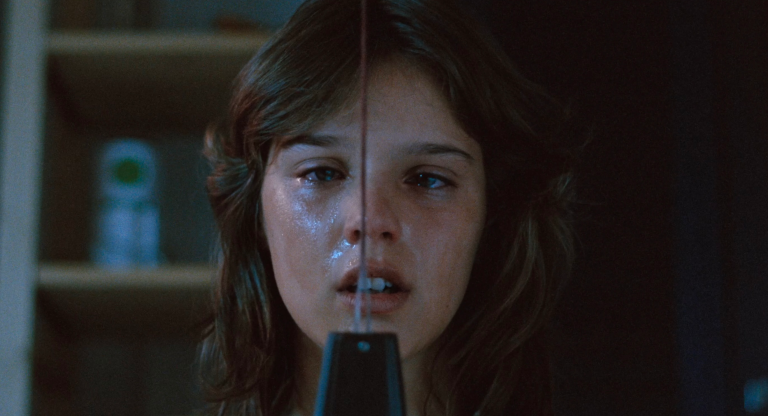
The first film retrospective dedicated to the French artist Jean-Louis Costes opens at Spectacle this evening: three programs, 10 screenings, 11 short and medium-length films made between 1990 and 2006, most of which are being shown with English subtitles for the first time.
Underground music and performance enthusiasts have surely come across Costes’s name before, whether it be because of his reputation, his performances, or his “porno-social operas.” He’s been working in the underground arts scene for over four decades, and some consider him a rock star. His music output is enormous, and it’s possible only Buckethead and Merzbow have released more albums than him. From the start, he has produced and distributed all of his work.
In the Canal+ documentary Costes, héros solitaire (1999), he says: “Even if my music is bad, it has explored continents that have never been explored. Even if it’s a Christopher Columbus of the ass, a Christopher Columbus of shit or whatever, you don't have a choice: you have to take Christopher Columbus as he is.” With this retrospective, we can name some of those continents: shame, sexual failure, the physical realities of the body. While those might seem like familiar themes for an artist, his approach remains singular and unexplored. He approaches this material through the framework of melody, romance, and slapstick. His rule is that art takes no precautions, that reality has to be represented as it is. Therefore, the acts he performs on stage and on screen are real, and the line between the author and what he shows fades. Audiences judge him, and sometimes real judges join them: a legal case over song lyrics kept him in court for 13 years.
Now, it is suddenly a good time to be curious about Costes. Quentin Rouchet's Le cœur glorieux, a 40-hour French documentary series about him, is coming out, episode by episode. YouTube deleted the channel after six episodes, but the release continues on Patreon, 11 episodes in as of this writing. With the series coming out, and Spectacle’s retrospective of his films, we chatted about his work.
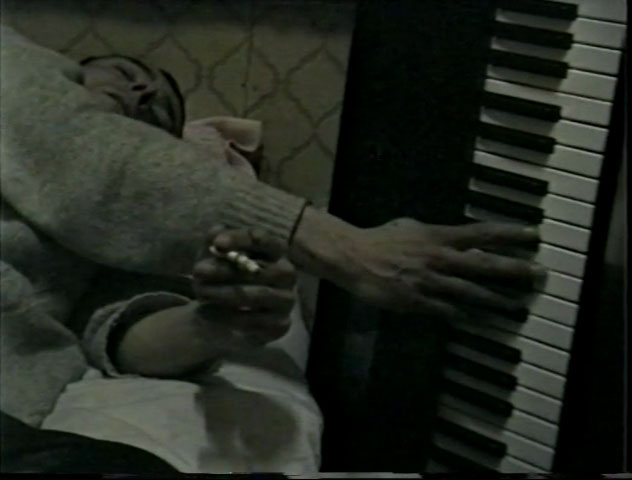
BP: In the April 2003 sex issue of the punk fanzine Apatride, someone asks you to introduce yourself and you answer: “I spend 90 percent of my time jerking off and hanging around at home without going out. The remaining percent, I film myself jerking off or scream like a faggot in heat into a microphone. I call that art.” How would you introduce yourself now to someone discovering your films for the first time?
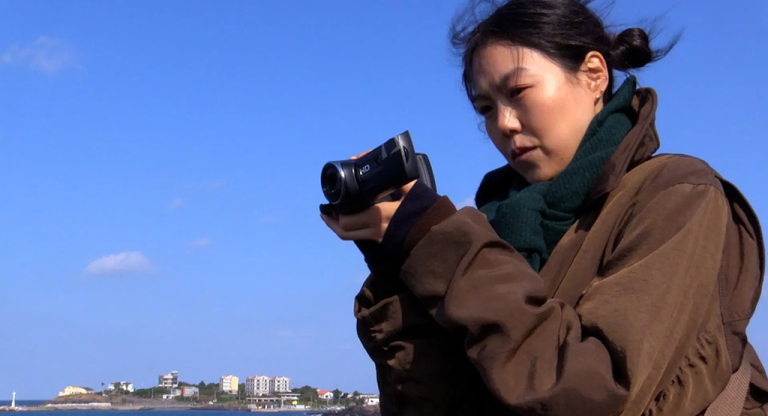
JLC: At first, I had no intention of making films. In the ‘80s, film cameras were very expensive and portable video camcorders didn't exist yet. But in the early ‘90s, cheap portable camcorders came along. I bought one, not to make films, just to film my shows. Little by little, I started making very simple short films alone at home. My interest in cinema grew, and from 1993 on I was producing more complex features with people from the music scene as my actors. The first scripted film I made was Crack Kiss, shot in New York in 1991 on the Lower East Side. I've kept making films regularly ever since.
BP: What has changed since 2003? You still scream into a microphone, and the art has done anything but mellow.
JLC: What's changed is that I live in the countryside now. It's more complicated to find actors for my films, because most of the people who could collaborate with me live in cities. Otherwise, I still scream my guts out... And, what's changed enormously since I started, is the production tools. Cheap music software multiplied the sonic possibilities and the internet lets you reach people beyond the circle of devotees.
BP: This is the first North American retrospective of your films. How is that possible?
JLC: It's the first in the world! My films have often screened at festivals, concerts, exhibitions, but there's never been a complete retrospective. French independent film festivals often thought about doing one, but they were scared certain scenes would shock people and cost them their Ministry of Culture subsidies!
BP: Then, let's start with the scenes they were scared of.
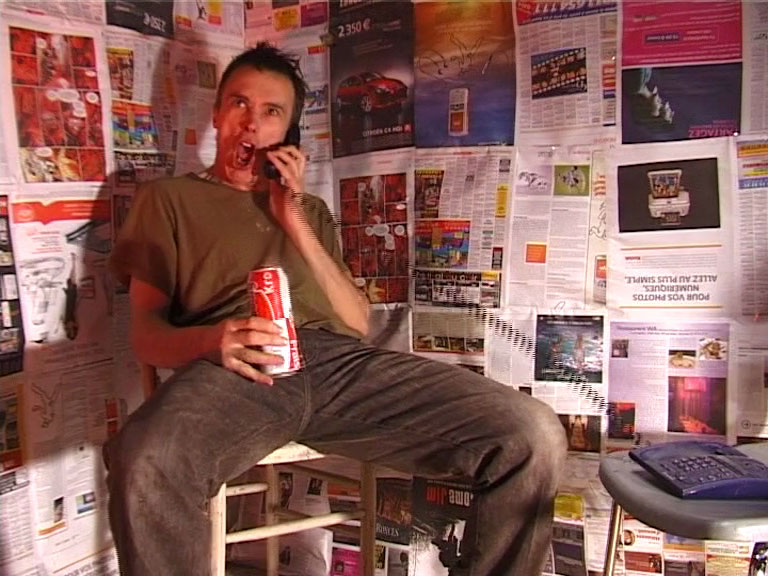
Several films happen behind closed doors, with situations that should have no witness. Deadly Gas in Tokyo [1995] shuts a man in a tiny hotel room and leaves him with failed phone calls, his own butthole, and a plastic bag over his head. At the beginning of Nooky [1990], the wife, played by Lisa Carver, leaves, and the man in the film does whatever private things he does when she's not around. Only God Sees Me [1990] is your first film, so your filmography begins with an obvious first use for a newly acquired camera: footage of yourself masturbating.
JLC: I couldn't tell you why my first film is basically all masturbation scenes. Maybe I was turned on by the idea that people were going to watch me jerk off? But, the film isn't just one jerk-off scene after another. There are strange scenes, bizarre dances, enigmatic grunting. That film really is a UFO! It was the first time I'd ever filmed anything, and I was trying out every kind of framing and lighting. Just filming myself and then seeing myself on the screen fascinated me. It wasn't really sexual, it was a spirit in a body playing with its body to make the spirit come.
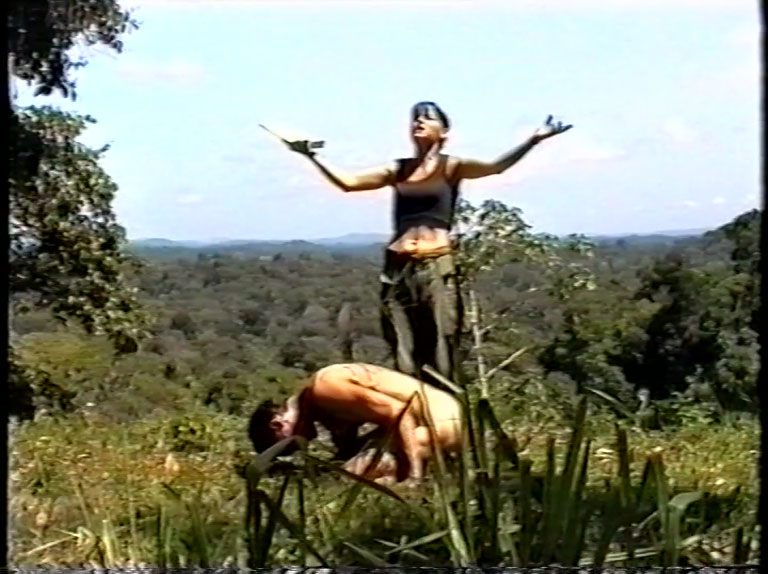
BP: In contrast, one scene in Morpho [1998], a flashback to a Paris apartment, makes the closed door absurdly literal. After a fight, a couple has make-up sex by humping opposite sides of a bathroom door.
In your movies, the door is never a neutral wall fixture. Whether an act is normal or obscene depends on what side of the door the witness is standing on—of door placement, and of where the camera puts the viewer. Film after film, you place the viewer on the private side. Why do you keep placing the camera on that side of the door?
JLC: There’s a lot of obscene, realistic private scenes in my films because they're easy to film and they work on screen. Pissing, shitting, fucking—those are important scenes in everybody's life. Leaving them out means distorting life, making it less interesting. In a lot of my films, you see public life as much as private life.
In Morpho, shot in Amazonia, the outside world is stronger than the private one. Nature is so powerful and so beautiful that a dick in the jungle does less to you than a giant tree standing up into the sky. In the beginning, I made films of a guy jerking off alone. But, bit by bit, my cramped little private world opened up and I got swallowed up by the real world. My coitus is just one coitus among billions in that swarming, lecherous forest.
BP: The midnight program at Spectacle ends in disaster. Saul and the Sorceress [1997] repeats the Morpho story in a biblical key: the husband walks out on his wife again, we see the jungle again, and he dies there again. But this time no door ever stands between them, and she finds him too late. Saul walks out of every room in his life and dies in the place with no doors.
JLC: Saul’s fate in the Bible is especially tragic: he's required to make a sacrifice for his God, but he's not allowed to sacrifice an animal taken from the enemy. He's trapped in a conflict with no way out. When I read that passage of the Bible, I immediately saw my own life in it, trapped with a woman I don't love and children who despise me: if I walk out on my family I'm doing evil and if I play my role as a father I sacrifice my art and kill myself.
BP: What lines won't you cross, even for the camera?
JLC: I've never made work in order to cross lines. Scenes come to me and I film them. I film them because I trust my inspiration, not to transgress. I can film a flower in the sun just as easily as an anus in the night. To me, it's all the same. What matters is not breaking the thread of inspiration, because if I censor myself the flow stops and I don't know what to film anymore. So, I film everything that goes through my head and only later, in the edit, pick the scenes that work.
BP: Where does safety enter the question?
JLC: The rule is simple: I can do anything with my body, but once the scene is over, I don't want any lasting damage. I won't injure my body. The blood always has to stay fake blood.
BP: How much of a film is already written when you press record? I ask because your stage performances are outrageously chaotic, but I know that very little in them is left to chance.
JLC: People who don't know my work always think I'm just winging it on stage over music that's supposedly total chaos too. Completely false. I build the music on a precise script: the melodies and noises follow one another to illustrate the actions and the feelings. I rehearse the performance to the soundtrack hundreds of times before doing it in public, so every move is controlled and locked to the sound. People seeing me for the first time think it's chaos simply because they don't know this kind of show, so they can't see the structure. But, if they come back a few times, they're quite surprised to find that today's chaos is exactly the same as yesterday's chaos!
BP: Deadly Gas in Tokyo is the aesthetic opposite—it’s austere, brooding, and almost meditative—but it’s shot with the same precision. You controlled every aspect, from the lighting to the camera placement and the performance, and you said you redid the same shot 10 times. Yet what happens inside the frame feels caught more than staged.
JLC: The film is exactly my life in Tokyo. The Japanese woman I was living with got sick of me and threw me out on the street. I ended up stuck in the cheapest hotel in Tokyo: the room was the size of the bed, plus a foot of space on the side so you could climb in. The door opened outward. It couldn't open inward. On top of that, I had no money left. I was living on freeze-dried soups, three noodles and a little spice... And, the worst part was that I was madly in love with that woman! So I filmed my life exactly as it was, stuck alone in that little cell. Everything in the film is true except the suicide.
BP: Working with actors and friends, there are a lot of moving parts and plenty that will almost inevitably go wrong. In a disorderly shoot, what can still go right?
JLC: The really complicated thing with amateur films is that the actors often quit before the shoot is over! Le fils de Caligula [1992] was supposed to be a film in ancient Roman costumes. I shot a few scenes that way, but the actors in them were unpredictable punks and they all walked off the film. I had to completely rewrite the script with other actors. Same problem on Crack Kiss. There was a script, but actors kept quitting, or saying dialogue that had nothing to do with what was written! It was very disruptive, but it also gave me superb, mysterious scenes. Above all, the final scene with the woman who lived on the street. It’s a scene that was never planned and it’s the most beautiful one in the film. Chaos can lead to order.
BP: Cinema usually runs on real stories and fake acts. You invert these expectations with fake stories and real acts, so people get confused about what is real and what is not. Is that inversion a method or an accident?
JLC: There was a period of my life when I made small docu-fictions on all kinds of subjects: demonstrations, eccentrics, a school party, concerts, dance... I filmed everything around me. But, and I can't explain it, I always twisted those reports to give them another meaning. More novelistic, more romantic. I probably find everyday life too boring, so I doctor the rushes to make it more glamorous!
BP: You are handing me the transition to Rouch...
“Costes, the Mad Master of Saint-Denis,” the title of the retrospective, brings us to Jean Rouch and his documentary The Mad Masters [1955]. You have called it an influence on your operas many times. This suggests the possession model also illuminates your films.
JLC: I'd seen plenty of films with trance scenes, but they didn't really speak to me because the spirits possessing the people in trance were local gods of faraway tribes. I couldn't feel those powers. But in Jean Rouch's The Mad Masters, the spirits possessing people are the policeman, the soldier, the priest, the president of the republic. These weren't the powers of some agrarian world anymore, they were the powers of the big modern city. It hit me immediately, since I’d “go into trance” myself over politics, society, and so on...
BP: Rouch aside, I combed hours and hours of interviews looking for directors you would claim as influences, kin, or fellow travelers. I came back almost empty-handed. The only name you seem to accept is John Waters, the Pope of Trash?
JLC: Yes, John Waters influenced me! I never saw him in a theater, only on VHS. Another strong influence: Fassbinder's early shorts and his feature In a Year of 13 Moons [1978]—that mix of violence, humor, bad taste, low budget, romanticism. But, I'm not really a cinema fan. I've watched very few films in my life. My influences come from novelists—Louis-Ferdinand Céline, for example—and from expressionist painters, which make me think of old black-and-white expressionist films. And, above all, my very first influence: Walt Disney. Everything I do is Walt-Disneyed!
BP: The rest of the retrospective’s title brings us to Saint-Denis. We have already mentioned several locations where the films in the series take place, but what about Saint-Denis?
JLC: Places like New York or Amazonia are hugely inspiring for films. Those places are the main characters of the films! Saint-Denis, just north of Paris, is a very strong city. It's the old religious capital of France. All the kings of France are buried in the Basilica of Saint-Denis. It's also a cosmopolitan city. Most people came to Saint-Denis to work in factories. That makes it a dream location. You can find actors from every culture there—actors you won't find anywhere but Saint-Denis—and fabulous sets too, from the thousand-year-old Basilica to the abandoned factories, metal structures overrun by vegetation. It's a fabulous city. Unfortunately, since the early 2000s, it's become impossible to film there as an amateur. You’ll get beaten up and your camera stolen.
BP: People have spent decades finding names for what is wrong with your films. What those labels fail to disclose are the gaps between viewers’ moral readings on certain images and the practical role those images play inside the films.
Take the misogyny in Crack Kiss. In the voiceover, the main character calls women “cunts,” “wet cows” and objects of punishment. The same voice says, “I loved you too much,” “I wanted love as a husband,” “I miss you,” “I am in withdrawal.” The character believes he has been wronged. He is toxic to the bone. And, while he processes his anger, his resentment, and his humiliation, the film never once tells us how to feel about him.
JLC: I have no particular hatred of women, but it's true that as a teenager I suffered a lot because of women. I was very shy, so the slightest mockery made me want to kill myself. Ever since, I've considered love a dangerous feeling. You lose control completely. You think you can't live without the person you love. It's as if the center of Me was Her! Every time I was in love, I was unhappy.
BP: People rarely stop at calling a film bad, they climb a ladder: I did not like it, I should not have watched it, it should not be shown, it should not have been made. When the viewer stops judging the film and starts ruling on its right to exist, does that bother you?
JLC: There will always be people who condemn, sabotage, spit, destroy. Right now, there are a lot of them! Sometimes they get my shows and screenings canceled. Online, plenty of people hiding behind their screens want to censor anything that doesn't suit them. The worst part is that big platforms like YouTube go along with it: they don’t delete films because some scene is obscene, but to satisfy self-appointed censors. If one of my videos gets a lot of complaints, it's deleted immediately. We've got state censorship, lobby censorship, and now algorithm censorship and the censorship of the bots!
BP: Your entire catalog is self-distributed. The objects are CD-Rs and DVD-Rs you burn with covers you draw yourself. Buying a film can turn into a conversation with you, complete with a recommendation. How has this affected the life of the films?
JLC: I've sold an enormous number of DVDs of my films, thousands of copies, so that's something at least. A few labels have put out I Love Snuff [1995] and Le fils de Caligula in their own countries, but the most effective distribution is piracy. There are pirate versions subtitled in 10 languages and my films turn up on obscure little websites. I don't make a cent off it, but at least the films get seen.
“Costes, the Mad Master of Saint-Denis” runs July 16-29 at Spectacle.