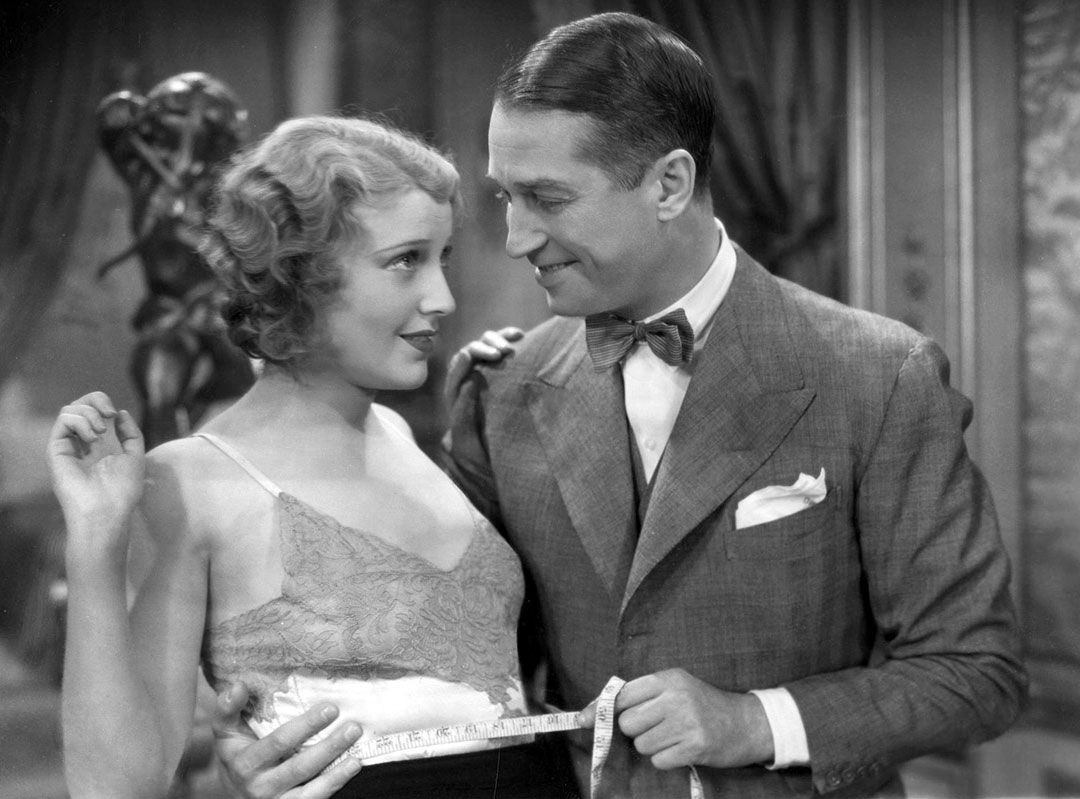
If Ernst Lubitsch was “a pioneer of the early sound musical,” as the film critic Michael Koresky notes in his essay on the director’s work at Paramount in the late 1920s and early 1930s, his contemporary Rouben Mamoulian deserves credit for crafting something nearly avant-garde with the form that Lubitsch perfected. Rarely confined to a single genre, Mamoulian followed up Dr. Jekyll and Mr. Hyde (1931) with a film that would appear to call for Lubitsch’s touch: Love Me Tonight (1932), a musical starring Maurice Chevalier and Jeanette MacDonald. The duo emerged as stars under Lubitsch’s tutelage in The Love Parade (1929) and Love Me Tonight marked their first, and only, mutual screen collaboration with another filmmaker.
Though Mamoulian began his directorial career with Applause (1929), a backstage drama set in the world of song and dance, Love Me Tonight is a musical of a very different sort. It is a splashy, fantastical production that features music and lyrics from Richard Rodgers and Lorenz Hart prior to their Broadway breakout. Mamoulian’s stylistic approach is so adventurous in the film that it borders on the experimental. In the film’s opening scene, a clock chimes as the sun rises on a new day in Paris; on a nearby street, a man starts his construction work with a pickaxe. Suddenly, as the streets are swept and babies cry out, in conjunction with the rhythmic opening of windows, these sounds accumulate to create a certain musicality. In introducing the viewer to its world, Love Me Tonight presents an ecstatic city symphony, transforming the sounds of daily life into music.
Love Me Tonight is replete with such unexpected and delightful flourishes, ranging from sequences that tinker with various speeds of motion to slight diversions into the surreal and magical, such as scenes involving talking artworks and powerful witches. These touches co-exist with the film’s more conventional narrative, which concerns the Parisian tailor Chevalier’s realization that his purportedly wealthy louse of a client (Charlie Ruggles, ever the inept nobleman) intends to evade the bills he has accumulated with Maurice and his fellow working-class compatriots. An incensed Maurice travels to the palatial estate of this noble family, where he encounters the lovely Princess Jeanette (MacDonald), a widow prone to fainting spells. Of course, in the film’s rigidly ordered class configuration, the presence of a common man at this aristocratic estate demands plenty of identity obfuscation and scheming, through which the film derives the bulk of its comedy.
Released with Hollywood’s production code already on the horizon, Love Me Tonight was compromised by its proximity to the impending censorship rules. The extant version of the film, edited for subsequent re-releases, runs 89 minutes, with the missing footage lost and relegated to screenplay excerpts on recent home media editions. Despite censors’ attempts to reduce the bawdiness of Mamoulian’s film, innuendos rule Love Me Tonight: no amount of censorship can contain Myrna Loy’s voracious appetite for the men in the film, nor can it obscure the suggestion that MacDonald’s malaise results from her unsatisfied libido. And, no matter the attempts to stifle Love Me Tonight’s playfulness, there is no quelling Mamoulian’s cleverness behind the camera. From the symphonic opening to its happily ever after, Love Me Tonight retains and sustains its joyous, formally ambitious absurdity.
Love Me Tonight screens this evening, July 14, at Nitehawk Cinema Prospect Park on 35mm as part of the series “Pre-Code Parade.”