The fall of the Iron Curtain, which made many Holocaust records and sites—including Auschwitz—newly accessible to researchers and visitors from the West, also coincided with the 50th anniversary of the outbreak of the Second World War, and occasioned an enormous upsurge in remembrance and memorialization across public life and popular culture. In contrast, Fred Uhlman’s novella Reunion, which consists in large part of a recollection of the early 1930s, was written in 1960 and published in 1971. It’s a product of a time when the meaning of the Shoah was being contested and negotiated by veterans and survivors still in the middle of their lives.
But Jerry Schatzberg’s movie adaptation of Reunion, released in 1989, moves its framing story up to the present day, and it was filmed, as the title coincidentally suggests, largely in a Germany on the cusp of reunification. Reunion’s central drama, the forging and dissolution of an adolescent friendship in the last days of the Weimar Republic, takes on a guileless, prelapsarian lyricism, while the final, abrupt twist of the narrative resolves a lifetime of trauma and fixes its meaning permanently in place. The mode is valedictory and the film an act of historicization very much of a piece with the era that would soon give us Spielberg’s Schindler’s List (1993), Tom Brokaw’s The Greatest Generation, and the creation of the International Council of the Auschwitz-Birkenau State Museum to oversee a site previously managed by the communist government of Poland.
Premiering in Cannes in 1989—alongside Shōhei Imamura’s atomic-fallout shomin-geki Black Rain—Reunion would not be released in the United States until nearly two years later; it was met with a muted response, though Schatzberg remains very proud of it. The film opens on the New Yorker Henry Strauss (Jason Robards), and the editing is initially shard-like, subjective and suggestive in the style of Alain Resnais’s films about the Second World War—a black-and-white image of an execution site, single-shot glimpses of ambiguous but anguished memories. Evidently still plagued by events on the other side of his life, the now-elderly Strauss is soon to return to West Germany, ostensibly on business, for the first time in a half-century. Working his way around Stuttgart, speaking only in English (German dialogue is unsubtitled, withholdingly), Strauss soon enough recovers family heirlooms which open the story up to its central flashback.
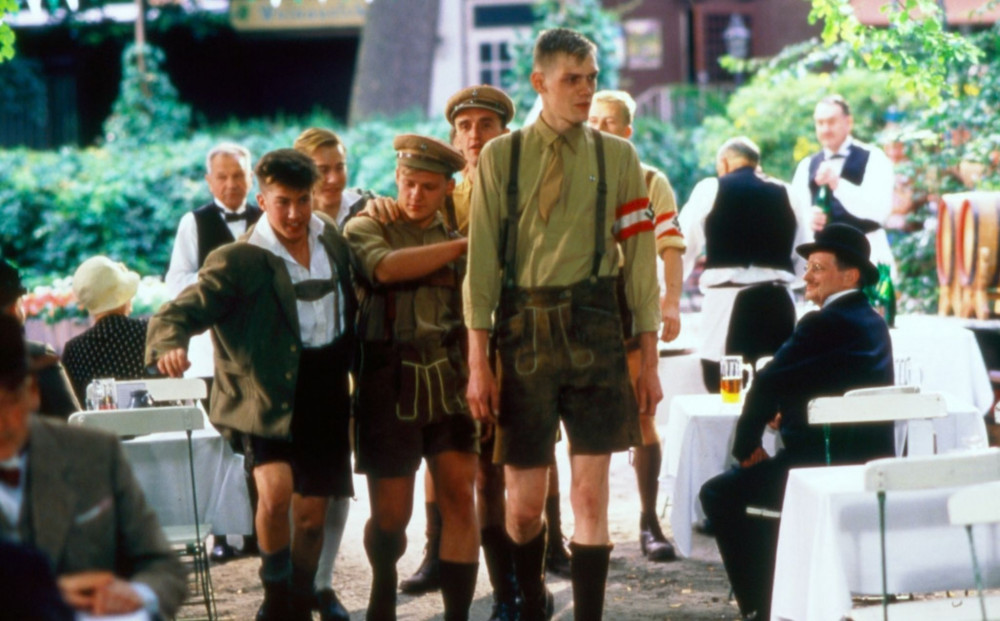
Henry Strauss was once Hans (Christien Anholt), scion of an assimilated Jewish family, who befriends his schoolmate Konradin von Lohenburg (Samuel West), son of a nobleman. Herr Strauss won the Iron Cross in the Great War and venerates Goethe; Hans admires Freud, signifying at once his secular orientation and his intellectual distance from his often brutish schoolmates. There are shades here of the prosperous but precarious Jewish Viennese family scattered across the 20th century in Tom Stoppard’s Leopoldstadt, though Reunion’s script, written by Harold Pinter and spoken by actors with class-appropriate English accents, also gives Hans and Konradin’s bond the cheery and ominously foreshadowing sentiment of a homoerotic boarding-school drama. Hans and Konradin’s friendship is a German-romantic one—they hike together in the Black Forest, and Schatzberg in one shot positions them atop a fog-shrouded cliff in a credible facsimile of a Caspar David Friedrich painting—but their beloved nation’s beer halls are soon enough overrun with the sight of Nazi armbands.
Like last fall’s Film Forum revival It Happened Here (1964), Reunion is in part a portrait of acquiescence to fascism, which in Pinter’s script arrives with the bluff matter-of-factness of everyday life. The fresh-faced Hans and Konradin are archetypes in a familiar story of innocence lost—one that takes on a real charge in the film’s final movement, when the narrative returns to the present day and Schatzberg revisits contemporary locations previously shown in period dressing, exploring sanitized new buildings which, like the medical clinic in The Secret Agent (2025), have sprung up in place of the old ones. Here, as in Kleber Mendonça Filho’s film, plot revelations are delivered with a casualness that seems to conjure the ghosts of the past rather than disperse them.
Reunion screens April 3-16 at Film Forum.