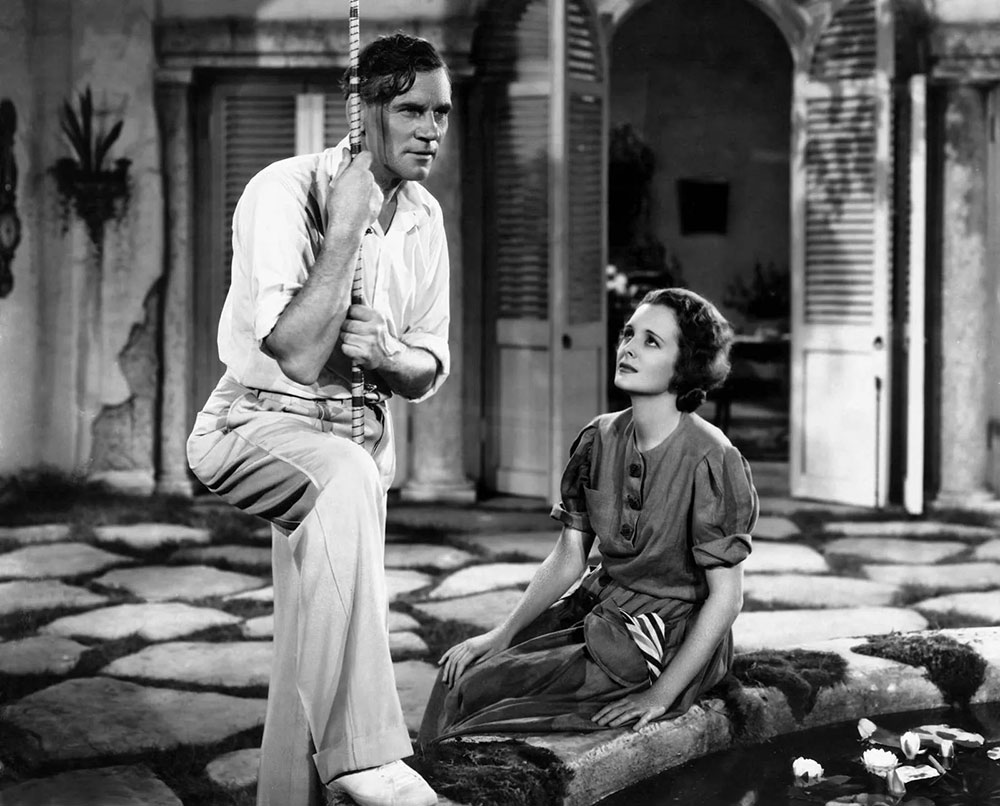
The “Auld Lang Syne”–scored opening shots of William Wyler’s Dodsworth (1936) supply a dazzling distillation of character and emotion. Auto executive Sam Dodsworth (Walter Huston) materializes at a moment of apparent triumph—the selling off of his company and the onset of a travel-packed retirement with his wife Fran (Ruth Chatterton)—but Wyler introduces him stealthily, from behind, the man’s back to the lens as he peers out at the factory that bears his name and receives the hearty congratulations of his employees. His ambivalent expression on the car ride home—the first time he shows his face—confirms a certain melancholy air. This handful of agile and probing images conveys something essential about Sam’s thoughtful, sentimental nature, and also somehow condenses, within the span of hardly a minute, the movie’s thematic spine: Sam’s fears about the transition from satisfying professional toil to extravagant marital vacationing.
It is a credit to Wyler’s ability to shift modes that, following this misty, dialogue-light salvo, much of the rest of Dodsworth can be described as a midlife sex comedy, replete with audacious innuendo and frank insights into married life. (The material comes from Sidney Howard’s play, itself adapted from the Sinclair Lewis novel.) Sam and, especially, Fran, bicker, sulk, get drunk, flirt with others, apologize and take it all back—whirling-dervish behaviors that, even in today’s American movies, are usually reserved for a younger set of characters. Where Sam looks at the couple’s upcoming European tour as a chance to decompress and learn about the world, Fran—thrilled to escape their “half-baked Middle-Western town”—desires socialization, nightlife, and the attention of men. Aboard the Queen Mary, an Englishman (David Niven) quickly charms Fran and becomes her regular dance partner—a pattern of open extramarital seduction that recurs in Paris, Vienna, and elsewhere. Sam, meanwhile, geekily chats up shipmates about lighthouses and befriends a solo expatriate (Mary Astor), inquiring after her life in Italy.
It is striking how often Sam and Fran, during this supposed trip of mutual gratification, are off doing separate things. The couple in fact most frequently interacts late in the evenings, launching into baring-it-all arguments over their growing discord and their differing notions about this new stage in their relationship. These long-take passages, with the two moving heatedly across living rooms, bedrooms, and other intimate spaces, stand as some of the most revelatory, juxtaposing the pair’s seismic quarrels with the boring business of a day’s passing. While they tear at each other’s hearts, they casually strip out of their evening wear and into pajamas. Sam fetches Fran’s cold cream, then points his toothbrush toward her to drive home a point. Whether allowing his actors such freedom to sketch these individuals or bolstering their characterizations with his own articulate camera moves, Wyler proves an ideal facilitator, translating a couple’s innermost anxieties to a realm of frantic cinematic passion.
Dodsworth screens tomorrow afternoon, July 18, at the Museum of the Moving Image on 35mm as part of the series “The Originals.”