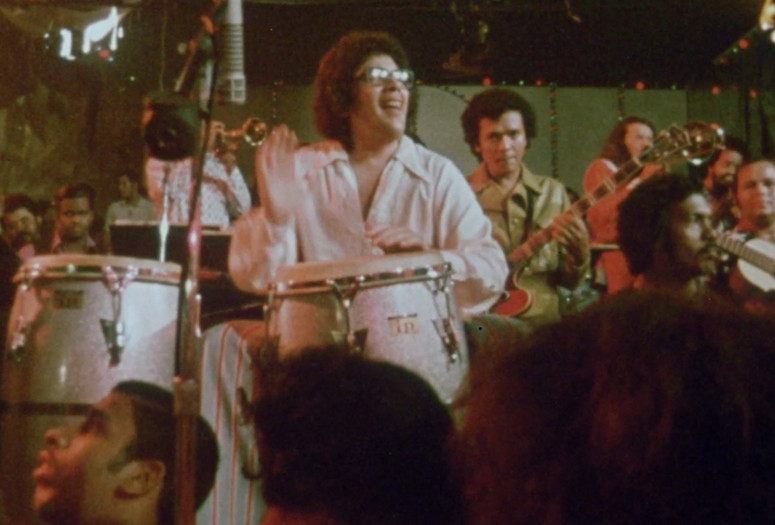
Our Latin Thing (1972) begins with a tracking shot of a boy walking in front of a Lower East Side brick wall on which appears written the film’s title, and beneath this, “(Nuestra cosa).” The musical documentary was made by the New Jersey-born director Leon Gast (best known for 1996’s Oscar-winning Muhammad Ali doc When We Were Kings), who was born in 1936 and claimed, in a late interview, that his exposure to Latin music came well before he personally knew any Latinos. He first worked in television and, as a still photographer, made album covers for the New York-based label Fania Records, whose specialties included salsa. The label united many of its talents into a group called the Fania All-Stars and, in August of 1971, commissioned Gast to record a show on 16mm at the Cheetah club in Midtown. The concert included All-Stars of Spanish Caribbean descent (largely Puerto Rican, with some Dominican and Cuban) such as Ray Barreto, Willie Colón, Héctor Lavoe, and Adalberto Santiago, and its proceedings were overseen by emcees including Symphony Sid, who at one point in Our Latin Thing is called “Radio’s leading disc jockey.”
Gast’s film largely ditches conventional exposition to immerse itself in the energy of the event. It possesses a fluidity of editing and camera movement that takes us back and forth between the club and the street. We see and hear performers play trombones and steel drums in the Cheetah, then a man slapping a wooden crate on a bright, sunny street; we move from images of people dancing gracefully on pavement to shots of the same people dancing in the club. The idea of music lying everywhere—and of its being inseparable from dance—comes across in the film with radical exuberance. Our Latin Thing not only pertains to the genre of concert films, in which the interactions between performers and public gain narrative shape, but also to the broader category of docu-fictions in which the boundaries between rehearsal, performance, and life onstage and offstage are effectively dissolved.
Two criticisms of the film seem worth making from a present-day perspective. One is about definitions: The film’s idea of “Latin” flattens Latin America in such a way that ignores most of its Hispanic territories, as well as Lusophone, Indigenous, and other Latin cultures in their entirety (including musically). The other is a content warning: among the materials interwoven with the concert is a scene of cockfighting (and conversations with cockfighters) that uncritically contains as much gliding pulsation as the rest of the film. For this viewer, the film’s depictions of music-making and animal cruelty convey the light and dark sides of male showmanship.
Our Latin Thing screens Friday, August 21, at the Museum of Modern Art as part of the series “Immigrant Nation: People in Transit.”