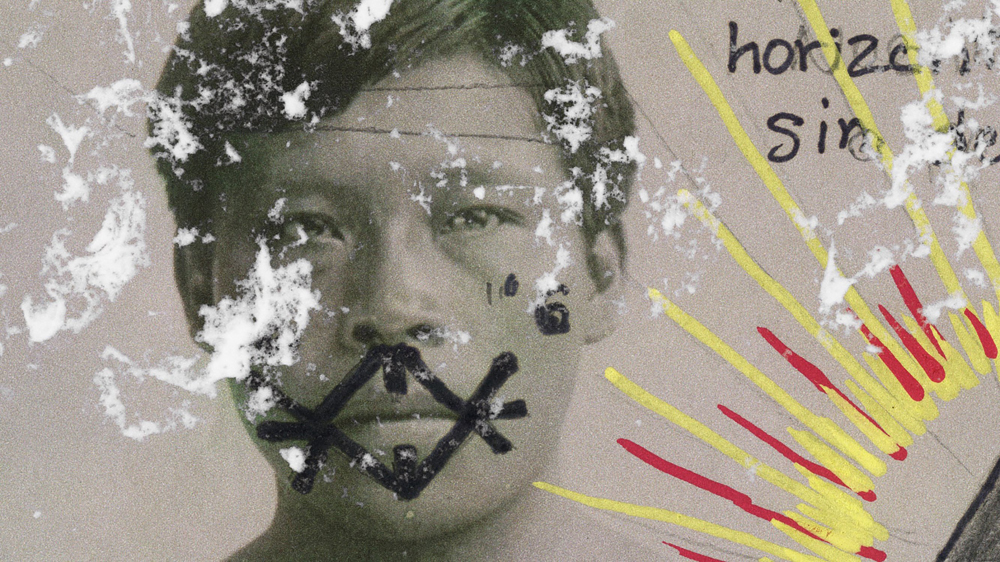
“Their presence insists that I take up this charge, which I still can’t decipher, but receive all the same.” So narrates director Tatiana Fuentes Sadowski near the beginning of The Memory of Butterflies (2025), in which a found image of two Murui Huitoto men, Omarino and Aredomi, catalyzes a journey through archival imagery of the colonial rubber trade in the Amazon, most of which was created for propaganda or “educational” purposes. The film cuts between moving images, photographs, and primary texts sourced from personal and institutional archives across Peru, Brazil, Portugal, the United Kingdom, France, and the United States; Fuentes Sadowski also intersperses her own hand-processed Super 8 in black-and-white, which is aesthetically almost indistinguishable from the archival imagery. The result is a unified visual language that collapses temporality in service of a continuous narrative.
The two young men were brought to London in 1910 by Roger Casement, the then-British Consul, who was investigating atrocities committed at rubber plantations in Peru as part of his campaign against them. He took the men to be photographed and displayed publicly around Great Britain and Ireland as “evidence,” keeping them from their lands and community against their will. In particular, Casement was investigating Julio César Arana’s Peruvian Amazon Company, known as La Casa Arana, for its imposition of slavery, torture, and genocide on the indigenous peoples of the Putumayo in order to extract as much rubber as possible. In the film, Arana’s company is emblematic of the genocidal nature of the rubber trade, just as the case of Omarino and Aredomi represents a visual regime in which images are extracted and circulated without consent, both by perpetrators and those who are supposedly bringing them to justice.
One of the driving questions of the film concerns the responsibility of the filmmaker vis à vis the archive and the people whose stories it contains. Fuentes Sadowski feels that Omarino and Aredomi, appearing in a faded photo album in Iquitos, have sent a “transmission” out to the next person who could receive it. This formulation of the archive, as a set of pending transmissions waiting for the right audience, frames the violent imagery and history that the film moves through. For the filmmaker, there is a moral duty in confronting and interpreting this glut of documented atrocity, providing specifics without sensationalization.
The film provides a critical but creative lens through which to read the images of rubber plantations; its second half deconstructs these images by returning to the Putumayo and consulting with communities there in order to add more context and detail to Omarino and Aredomi’s story. We see their portrait, along with other images of the rubber trade, annotated by community members with messages of strength and solidarity. We know that they eventually escaped captivity in Iquitos, but it is unknown if they made it back to their original communities; in voice-over, we hear participants offering speculations about their fate. With time, the stories transform the men into mythic figures, examples of refusal and return to the land. In this first feature film, as in her earlier short La Huella (2012), Fuentes Sadowski thrives in the gap between the evidentiary and the imaginary. The interweaving of her Super 8 footage, and the interventions of the Putumayo communities, constructs a visual language that, after a slightly clinical beginning, brings the viewer into this liminal space as well.
The Memory of Butterflies screens this evening, June 17, at Anthology Film Archives as part of the series “Lost & Found: Cine(ma)s Latinoamericanos Re-Unidos.” Editor EB Landesberg will be in attendance for a Q&A.