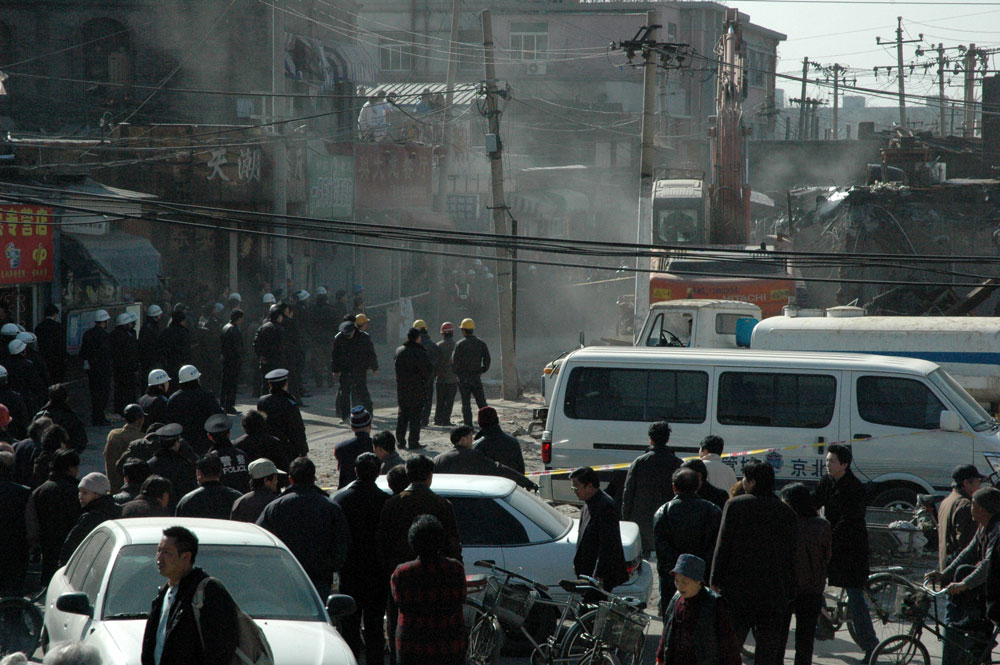
There is an inherent temporal tension involved in the visual documentation of demolition, of capturing that moment when people are seen living in buildings that will soon disappear. Ou Ning’s documentary Meishi Street (2006) captures this exact moment of life in a half-ruined, half-inhabited neighborhood that’s undergoing demolition; it had its premiere at the Museum of Modern Art in 2006 and was part of the artist’s “Da Zha Lan” project, an urban research and documentation project centered on the demolition and relocation of the eponymous Beijing neighborhood as the city prepared for the 2008 Summer Olympics. Meishi Street was made collaboratively between Ou Ning and the artist Cao Fei; the documentarian Huang Weikai contributed some camerawork; Meishi Street resident Zhang Jinli also became involved in the filmmaking process.
The latter, a restaurant owner, decidedly lived his life in protest against the neighborhood’s disappearance. Ou Ning encountered him while protesting the demolition of his restaurant and he eventually contributed roughly two-thirds of the footage featured in Meishi Street. The first thing Zhang did with the camera Ou Ning gave him was to film his exercise routine. This playful scene sees Zhang and his neighbor point the camera at one another, trying to figure out how to frame themselves while performing in front of the camera. Their camerawork is hardly polished, but its awkward movement is engrossing because it embodies the rhythm of Zhang and other neighborhood residents’ lives. Later, Zhang films himself making a protest banner. During this scene, the shadow of him holding the camera falls onto the white cloth in the sunlight and this casual moment fuses his act of protest with his filmmaking into a single frame. Throughout Meishi Street, the camera becomes an intimate entry-point into the seriousness, boldness, and validity of Zhang’s personality amid a backdrop of detritus and soon-to-be-ruins.
The red circle with the character “拆” (demolish)—a common marking on buildings slated for demolition across Chinese cities—pervades the film, as seen printed on the walls of the houses on Meishi Street; it portends the future that has since befallen said neighborhood and reflects the magnitude of China’s large-scale urbanization throughout the 2000s. Contrasting these signs in the film are the handwritten protest banners that Zhang and his neighbors craft and hang themselves. These handwritten black ink texts always appear bold and abundant, filling the paper and building surfaces on which they’re featured and standing out in muted opposition to the aforementioned red demolition signs.
Meishi Street culminates with the demolition of Zhang’s own home and restaurant. He keeps filming while confronting the officials, who come with their own cameras to record the process. Both Zhang’s and the officials’ cameras are captured from a third-person perspective by Ou Ning and his crew in such a way that when the two cameras meet, the disappearance of Meishi Street becomes a confrontation over its image. The question is no longer what the camera can preserve, but who gets to decide what this disappearance will look like.
Meishi Street screens this evening, September 19, at Anthology Film Archives as part of the series “Rubble On Screen: The Cinema of Demolition and Destruction.” It will be preceded by Gordon Matta-Clark’s Splitting.