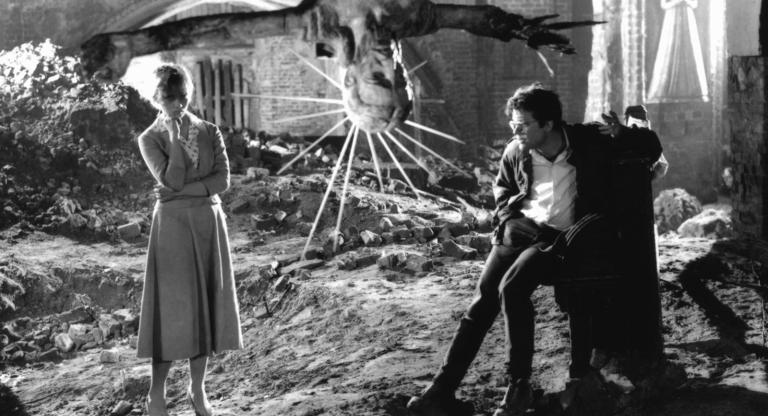
“You did the right thing, because I am Frank,” Dennis Hopper famously told David Lynch after joining the cast of Blue Velvet (1986). Hopper was then fresh out of rehab, but tapped into his history with domestic violence and various huffables to play Frank Booth, the infantile psychopath for which he’s since become best known. This PR-ready quote should only be forced to withstand so much parsing, but Hopper seemed to be thinking retrospectively as a man full of violence and ugly lust who learned to tame the beast inside and in so doing found a way back to gainful employment after a decade of exile from Hollywood. But Hopper’s 1970s weren’t entirely lost, however drug-fuelled and erratic they were. Instead, his post-60s, pre-rehab comedown was a modestly prolific period during which he delivered committed, unsettling performances in international arthouse films such as Mad Dog Morgan (1976) and The American Friend (1977); this was also the period when he returned to directing with Out of the Blue(1980).
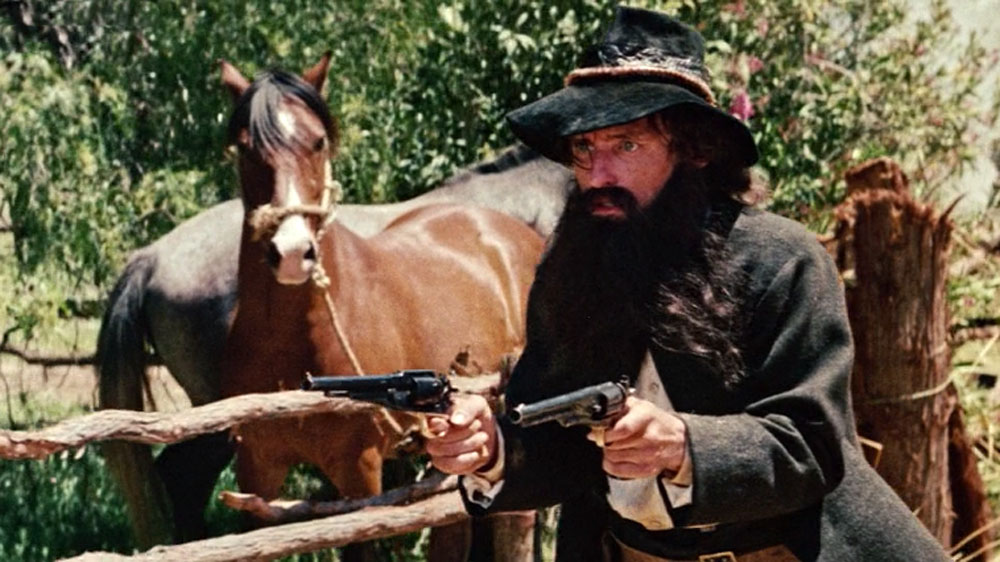
Frank Booth’s oedipal anxieties and destructive impulses cleanly aligned with Hopper’s troubled upbringing in Kansas, but Australian outlaw Daniel Morgan, as conceived by writer-director Philippe Mora in Mad Dog Morgan (1976), better reflects the full spectrum of Hopper’s persona. As a freewheeling, handsomely crafted tale of a righteous outlaw battling racist imperialists, Mora’s film has plenty of thrills to offer for anyone uninterested in Hopper as star text. But it also captures Hopper’s wounded idealism, artistic sensitivity, and self-pitying megalomania better than any of the actor’s other roles.
Uncertainty obscures the historical Morgan, a 19th century bushranger whose name and crimes are subject to dispute and the wish fulfillment of folklore. Like many outlaws whose activities grow softer the further removed they become from our current conceptualizations of atrocity, Morgan is a vessel through which we can safely exercise ambiguous feelings about our subjugation to civilized order. Mora introduces Morgan as an Irish immigrant drawn to the Victorian gold rush of the 1850s. Unsuccessful, he nurses his failures in an opium den operated by Chinese immigrants but barely escapes when white Australians torch the place. Morgan is subsequently caught stealing horses and sent to an island prison where he is tortured by guards and gang-raped by his cellmates. He’s released for “good behavior” after serving six years of his 12-year sentence and embarks on a class-conscious stickup career with an aboriginal man, Billy (David Gulpilil), at his side. The pair are hounded by phrenologists and constables who ponder whether or not Morgan has a “gorillaroid” skull that accounts for his criminality. When the law does finally corner and execute him, they mutilate his corpse as retribution for humiliating them. “His scrotum might make for an interesting tobacco pouch.”
The film was made a few years after the catastrophic failure of The Last Movie (1971), Hopper’s directorial followup to Easy Rider. All but blacklisted from Hollywood for the second or third time in his career, Hopper inhabits Morgan as a traumatized paranoiac swinging pendulously from grandiosity to wretchedness. His questionable brogue and array of comically unconvincing beards counterbalance his wild eyes and unpredictable energy. The character’s alignment with Australia’s racially marginalized recalls Hopper’s own participation in the Civil Rights movements, as well as his attempt to consider Hollywood’s disruption of Indigenous culture in The Last Movie. The onscreen Morgan’s homoerotic relationship with Billy, from whom he learns bushcraft and with whom he boyishly reads newspaper accounts of their exploits, parallels Hopper’s obsessive friendship with James Dean, from whom he learned much about acting on film as well as plenty more about performing the public role of eccentric, brilliant thespian. Hopper openly proclaimed his own artistic genius, never more loudly than in the mid-1970s when his reputation was at its nadir. He portrays Morgan as a long-suffering man of destiny whose wings were clipped by uncomprehending dolts. Mora likely never intended Mad Dog Morgan as a biography of its star, but the film nevertheless can’t escape Hopper’s gravitational pull.
Mad Dog Morgan screens this evening, August 25, at Anthology Film Archives as part of the series “Experimental Westerns, Part 2: Acid + International Westerns.”