In a fundraising advertisement featured in the Los Angeles Sentinel, director Robert L. Goodwin said: “Movies are a weapon. The image of black folks was created by movies and, by and large, people the world over know us primarily from the image in which Hollywood has created us. Black Chariot puts the weapon in our hands. My movie will help to rectify the disparaging image Hollywood has cast us in and it will also yield a healthy profit in the process.”
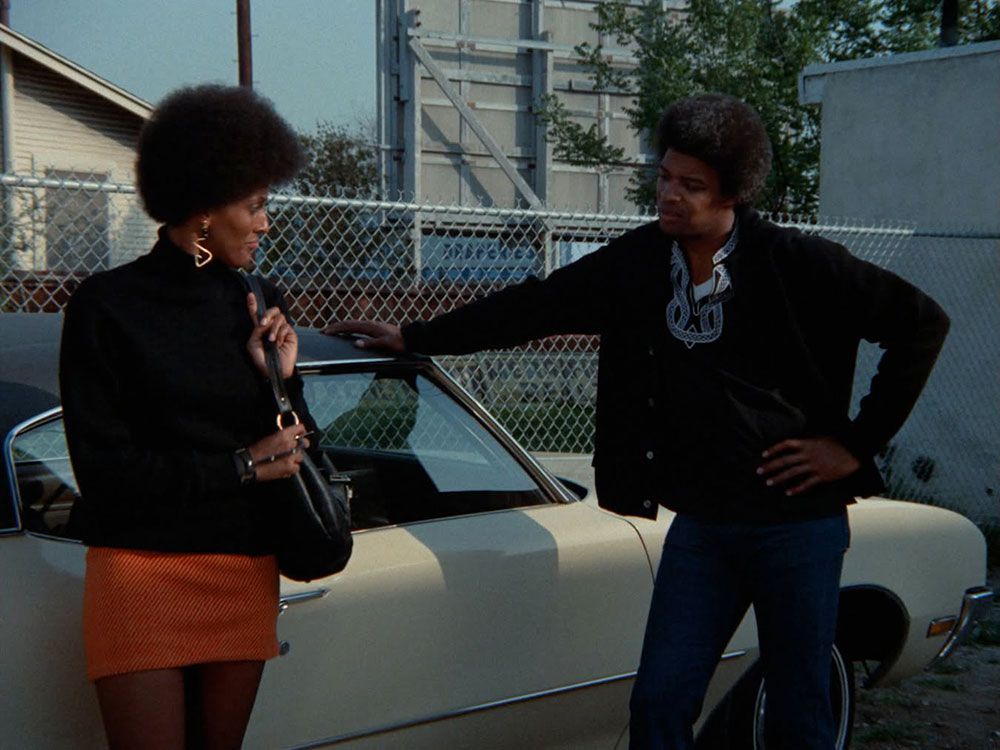
Written, directed, and produced by Robert L. Goodwin, Black Chariot (1971) stars Bernie Casey, Barbara O. (credited as Barbara O. Jones in her screen debut), Richard Elkins, Euge Dynarski, Monica Sanders, and Paulene Myers. Both a community and family affair, the lyrics to the film’s earworm songs were written by Robert L. Goodwin, Jr., who plays the part of Brack in the film. The cast is rounded out by other members of the Goodwin Family. The film premiered on July 2, 1971, at the Santa Monica Civic Auditorium, screened only a few times, and then disappeared from circulation, becoming one of the major overlooked works of independent Black filmmaking from the 1970s.
Casey plays “Tuck,” a religious and political cynic who becomes involved with “The Organization,” a radical, Black Panther-like group led by Elkins (from 1970’s Tick Tick Tick). Tuck’s main conflicts are whether to follow the increasingly violent activities of the group, his sexual attraction to Barbara O.’s Sylvia, and his own burgeoning conscience. According to Goodwin’s son, his father, who initially attended theology school and was ordained as a minister at 16, “was wrestling with questions of faith, purpose, mortality, and identity. Those concerns show up repeatedly in his work because they were part of his own journey.”
Black Chariot’s new restoration places the film into the context of better known politically engaged independent films like Uptight (1968), directed by Jules Dassin and co-written by actress Ruby Dee, and Melvin Van Peebles's Sweet Sweetback's Baadasssss Song (1971). While the film shares some elements that would later become associated with Blaxploitation, Goodwin’s work is more focused on Black self-determination, spirituality, and community. Barbara O.'s character challenges Casey's patriarchal masculinity, Black characters are portrayed with dignity, and even the white doctor played by Eugene Dynarski, who previously collaborated with Goodwin, is portrayed as self-involved and racially tone-deaf but not evil. The motives and backstory of each of the characters are shared in a revealing scene where Tuck’s mother, played by stalwart performer Paulene Myers, and Dynarski’s doctor share a quiet moment of humane reflection as they talk past, not to one another. The characters share the same space, even though each is lost in their own thoughts.
The film’s visual style is one of its most fascinating qualities. Much of Black Chariot was shot on 35mm film, but several interior scenes and parts of the finale were recorded on videotape, creating a noticeable shift in texture and style. Family members have suggested this may have been related to budget limitations, but considering Goodwin’s experience with television production—as in the inventive Upper Chamber (1963), which will also show at Anthology Film Archives— perhaps there was an aesthetic motivation to use videotape. The balance between necessity and innovation remains an open question.
This question shaped our approach to this restoration. Instead of treating the film’s changing visual textures as problems to fix, the goal was to preserve the traces of Goodwin’s creative process—his hand. Presenting Black Chariot in its best possible form means respecting both the way it was made and what Goodwin was trying to achieve. Like his belief that movies could be a tool for Black self-representation, the film is a unique and powerful example of independent Black filmmaking at a pivotal moment in American cinema.
Black Chariot screens this evening, July 13, and throughout the week, at Anthology Film Archives on 35mm.