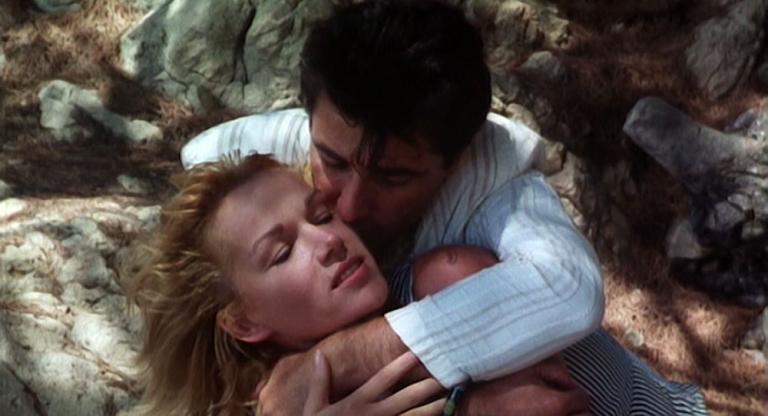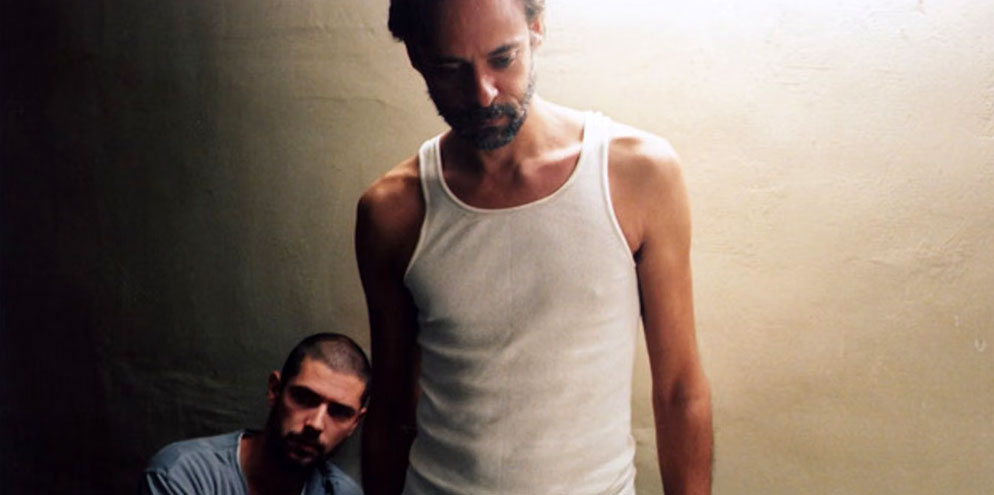
Danielle Arbid’s A Lost Man (2007) opens in Beirut, Lebanon, in 1985, at the epicenter of the Lebanese Civil War. A man later identified as Fouad Saleh (Alexander Siddig) runs breathlessly through the near-empty streets of Beirut. The view is obfuscated as Saleh dodges over what appear to be lifeless bodies and evades gunfire reverberating in the background. It is at this moment that the 27-year-old Saleh disappears from the Barbir Checkpoint in West Beirut. Some 20 years later, the viewer finds Saleh in Northern Syria, among fields of green vegetation, picking malfouf (cabbage). It is Saleh’s first day of work and he is immediately fired after he is accused of being a spy. He flees to the Syrian-Jordanian border in a packed yellow taxicab. When he reaches the border crossing, Saleh follows a woman into the women’s restroom, and is soon thereafter apprehended and detained by border authorities for inappropriate conduct. It is there that he meets Thomas Koré (Melvil Poupaud), a Frenchman who was held for taking photos of the encounter.
Upon their release, Saleh and Koré, communicating in French, agree to split a cheap hotel room in Jabal Amman. From this point onward, the two drift aimlessly throughout Jordan. For Saleh, wandering is a product of his exile and PTSD-related memory loss; for Koré, it is a deliberate pursuit of so-called self-exploration. Initially, Koré tells Saleh that he is a photographer who travels to document the world, but it soon becomes clear that Koré is primarily interested in chronicling his experiences with the sex workers he seeks out during his travels. These engagements raise questions around consent and fetishization—Koré, a voyeur, classifies his proclivities as thrill-seeking, while the impact of his behavior is tangibly unsettling to Saleh and the North African and Levantine women that become the objects of Koré’s desire. Concurrently, Koré’s fascination with the details of Saleh’s elusive past appears to derive more from an inclination toward conquest than from a genuine urge to guide his friend home. The film largely avoids dialogue, as Arbid instead creates dimensionality through nonverbal exchanges. Through these interactions, it becomes evident that Koré and Saleh fundamentally do not understand one another. Frustrated by his inability to access, or possess, certain details about Saleh’s story, Koré independently travels to Beirut for answers. His journey is ultimately successful, as he locates Saleh’s estranged wife (and sleeps with her) and returns Saleh to his family.
At the close of the film, Saleh trails closely behind his young nephews as they walk through the wintry streets of Beirut, passing older men playing games at the park and birds chirping among the foliage. As they stroll, Saleh appears to contemplate the profound grief of having lived two decades in exile. He brings his pace to a slow jog and the sound closes in as we hear the familiar sounds from the day of his disappearance. In Paris, Koré sorts through the photographs of nude women he has printed since his return to France. He dials the phone and asks to speak with Saleh. A voice answers: “He doesn’t live here anymore. Please don’t call again,” and the phone disconnects. Ultimately, the fate of Saleh remains unresolved. Arbid instead points to the relationality—and a lack thereof—between the voyeur and the subject, the colonizer and the colonized, the beneficiary and the exploited.
A Lost Man screens tonight, August 1, at Low Cinema as part of the series “Arab Women in the Arts 2026.”