Chris Shields is a filmmaker and writer based in Los Angeles who often contributes to Screen Slate, Film Comment, Sight & Sound, Reverse Shot, and Film Quarterly. He also writes essays for Vinegar Syndrome and Cinématographe releases. He is a film programmer and a frequent moderator of Q&As at the American Cinematheque in Los Angeles and other venues.
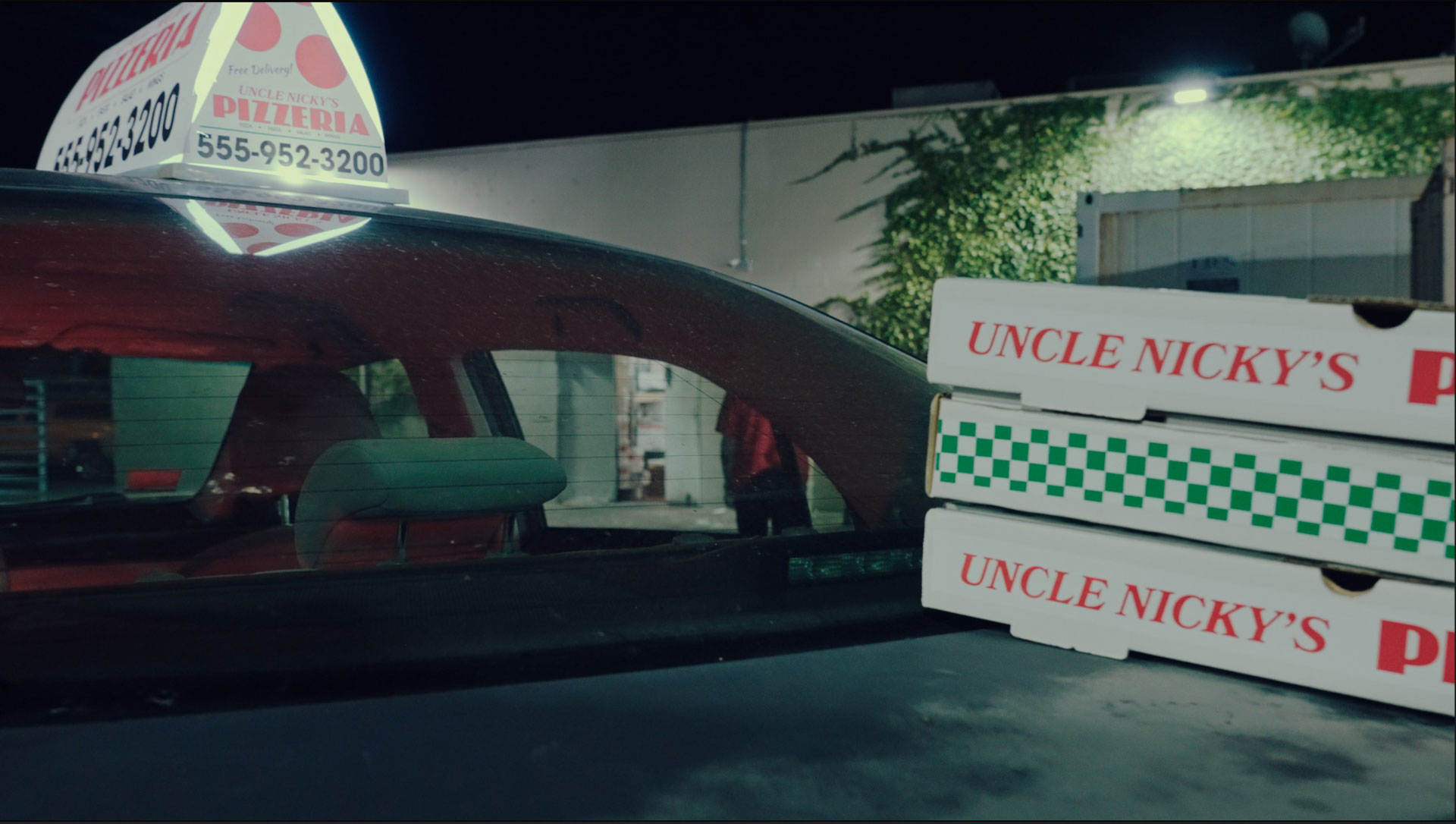
With his new film, Morbid Weekend, Shields makes his narrative feature directorial debut. Set just outside LA, Morbid Weekend is a horror movie of a different sort. Using a range of experimental techniques, it obliquely tells the story of a pizza delivery driver (Greg Diaz) who dies in a car accident while working. He is memorialized and buried but still haunts the living, including his girlfriend (Rosie Wilt). Texting pizza delivery updates and dropping off pies, he watches them, unseen. His melancholic, ghostly stalking replicates the viewing experience of theater, the cinema, and surveillance. Or of just eating in front of the TV.
Shields and I spoke by phone on the eve of Morbid Weekend's New York debut. Our conversation has been edited for length and clarity.
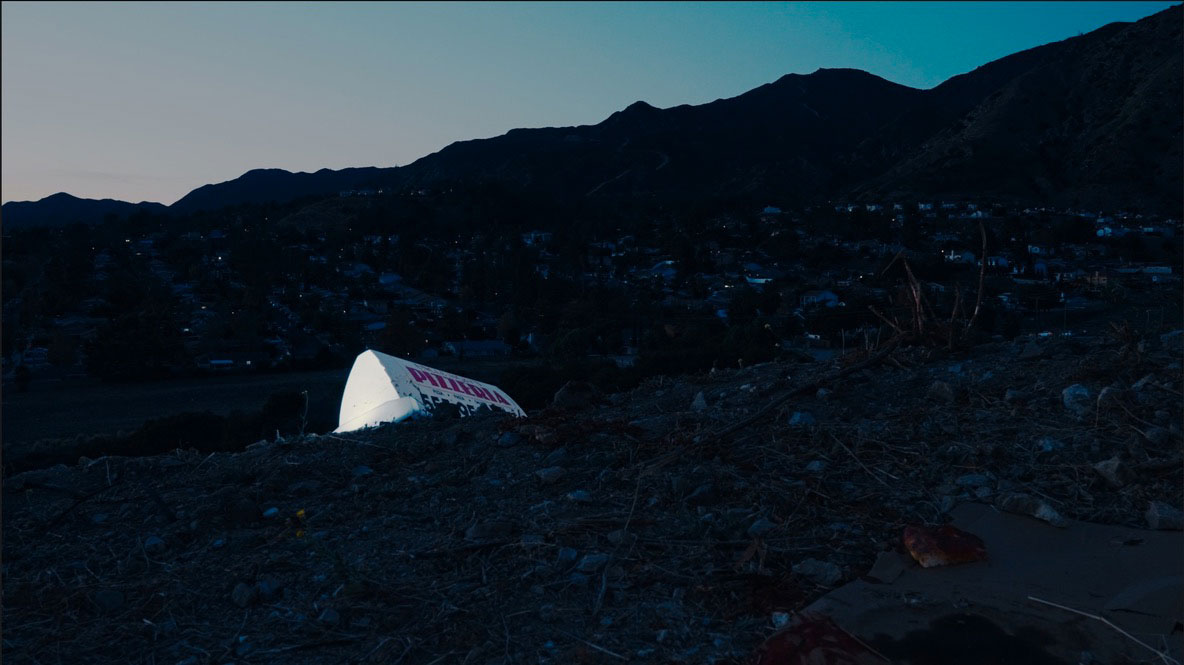
A. S. Hamrah: Your new movie, which is your first feature-length film, though it's a short feature at 69 minutes, is called Morbid Weekend. When I heard the title, it sounded to me like some kind of cross between a Jean Rollin film and The Ghost in the Invisible Bikini. But then I saw it and it's about the ghost of a dead pizza delivery guy who observes people in Southern California going on with their lives at night: photographing their pets, doing aerobics by the pool, practicing with their band in their garage. It's kind of a contemplative look, from the point of view of a dead man, into other people's lives. Do you have some experience with pizza delivery that made you want to make this?
Chris Shields: I worked pizza delivery for several years. I grew up in Central Florida, where I was a pizza delivery guy for a bunch of different places. To me, it's a very emblematic job of a certain kind of scumbag, and if you were punk at that time, you probably delivered pizza. It sucks as a job, but at the same time it's a very contemplative occupation because you're just driving, usually at night. You're listening to music, and there is something cinematic about the experience.
Over the years, I've basically had every low-wage job that somebody could have, but pizza delivery is one that has stayed with me as having something cinematic and poetic about it. You could just drive through rural Florida and be listening to the harshest music, smoking cigarettes, and you're bringing someone's pizza to them. There was a kind of freedom and beauty there, so I was thinking it could be the site of something beautiful. Like what you said about Jean Rollin. Rollin deals in the dumbest subject matter possible—zombies and vampires—but his films are so beautiful. I'm a huge Grapes of Death and Living Dead Girl and Night of the Hunted fan. Those just live in the basement of my brain, so that was something that was there.
ASH: Just as Jean Rollin's films are often quite tied to Paris, Morbid Weekend is tied to the region in which you shot it, which is Southern California, but it's a part of Southern California that wasn't so recognizable to me as someone who doesn't live there. Where are we geographically in your film?
CS: It's the San Gabriel Valley, which is like a suburb outside of what we recognize as Los Angeles. I had some friends who lived there, and my wife Sarah and I would drive out there, and it reminded me of Florida, where I grew up. I love really empty spaces. I feel that my mind is more free in those places. The area was new to me because we had moved to Los Angeles relatively recently from New York City, and so it was novel and kind of spooky, a little haunted, but pastoral. I thought it would give me a certain freedom to work with that landscape
ASH: What towns are in the San Gabriel Valley? How far is this from where you live in Hollywood
CS: Rosemead is one of them. I'm asking my wife, Sarah. Where else?
Sarah Fensom: We also shot in Pasadena, which I don't think is considered San Gabriel Valley.
CS: But was close to that area. It's very much a suburb in its own way. We were, I'd say, 15 or 20 minutes on the highway outside LA. It feels disconnected in a sense.
ASH: I guess this is a good time to mention that both you and your wife, Sarah Fensom, are film critics. Sarah is also in this film and worked on it with you as a producer. She plays the person doing aerobics next to the pool.
CS: Nothing is possible without Sarah because, on the practical level, we're two Italian-Americans who are talking constantly, from the moment we wake up to the moment we go to bed. Once Morbid Weekend became a real possibility, we were just talking about it all the time. She is like the co-author in a very significant way.
So, with her doing aerobics… The people in the film, they're all shot in their spaces. That's where they live, and I really like that because I hate art direction and production design. I wanted the actual world in the film to be as interesting on screen as it is to me. Why fake it? Sarah is actually the only one who is not in a space where she lives but the part is tailored to her because she's obsessed with vintage aerobics videos. We were talking and I asked what's something that would be funny or interesting for you to do?
ASH: Yes, we see her doing aerobics by a pool at night as the pool is cleaned by some kind of automatic pool-cleaning device. You say you are not interested in art direction or production design, but one thing that's clear in this film is that you are interested in wardrobe and makeup.
CS: Yes, very.
ASH: One of the main characters in the film, who is played by Rosie Wilt, who is really excellent in it, I guess is a professional clown like Anne Archer was in Short Cuts?
CS: She is not a professional clown. She is actually a computer engineer...
SF: A software engineer.
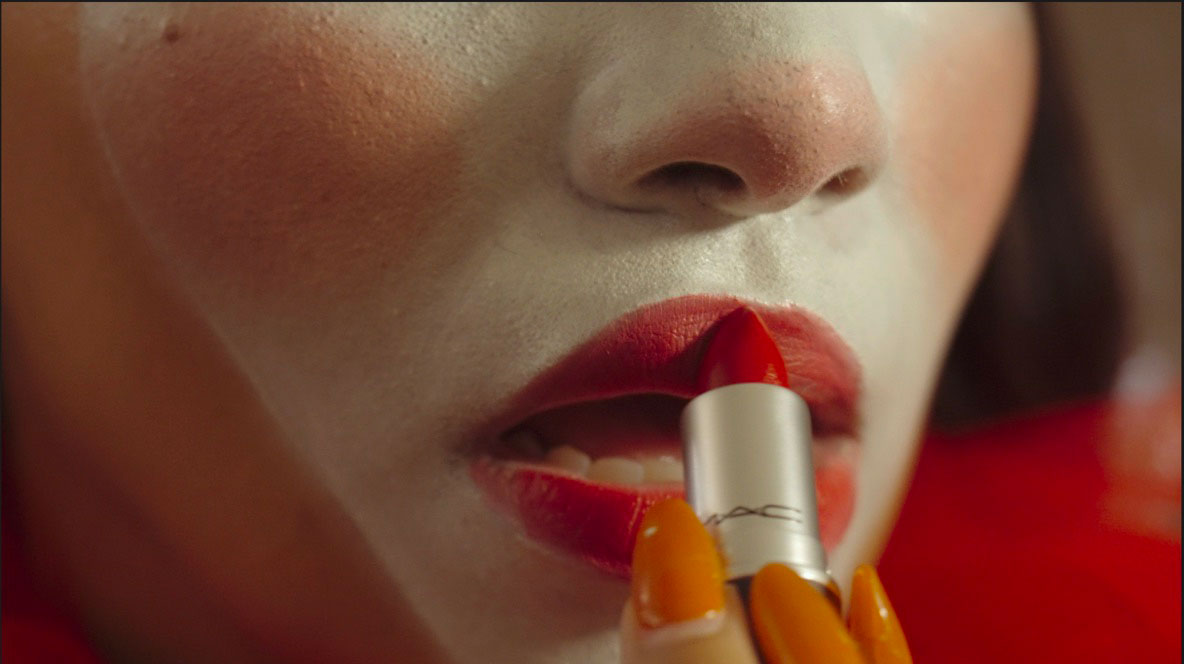
CS: She's a friend we know from New York who goes online when Halloween comes around to find different events and then she designs these incredible looks. Her makeup and her costume were her own. I got the idea for her to do the clown and the other costumes she's in because Sarah and I went to this Rob Zombie, Alice Cooper, and Ministry concert. I love Rob Zombie unapologetically. We had a great time and I never do this, but I looked at Rob Zombie's Instagram after the show and there was this person posting in the comments about how she tailors her looks to honor Sheri Moon, the actor Zombie is married to. I was like, "What is this?" So I went to this person's profile, and they're a cosplayer for metal and horror stuff. I thought it was really interesting, and I liked how elaborate it was. So I thought, "What if Rosie, who's really good at doing these looks, what if that's her form of mourning for her dead boyfriend?"
ASH: She performs various rituals as these characters, or just hangs around her apartment in the outfits.
CS: I wanted to limit it to three things, because I believe in a Ramones form of verse-chorus-bridge. Rosie and I limited her mourning scenes and outfits to three figures: a clown, Kurt Cobain, and Jackie Kennedy.
ASH: That's an odd group, a clown, Kurt Cobain, and Jacqueline Kennedy. Wilt's performance is sometimes just her sitting back in a chair, or playing videogames. The chair shot could serve as the primary image of the film. Then there's that very brief moment where she's playing the videogame and the character in the game starts laughing, like it's laughing at her as a clown. That was very haunted. The film does have a contemplative and funeral sense. We see a funeral in the film and you returned to that graveyard a couple of times.
CS: As far as that videogame moment, that is, again, just working with someone in their house and in their interests. I asked Rosie what are some things that you could do while you're mourning, and she had an old Sega Genesis. I remembered that game Altered Beast where a guy says "Rise from your grave." It's a happy accident. I said play the game and then that moment becomes a transition. As for the funeral stuff, I am a taphophile. I love cemeteries.
ASH: What is this word you used for someone who likes cemeteries? I love cemeteries myself, but I've never heard it.
CS: Taphophile. I learned that word because I was a transcriptionist for years. I worked on the show called Oddities, about an antique shop in New York where it was all morbid stuff. They would say taphophile all the time. Everybody's got to work and even though that job sucked I tried to learn little things from it and I got taphophile.
ASH: Speaking of the scenes of mourning in the film, while Wilt was doing the Jackie Kennedy assassination reenactment it reminded me of Vincent Gallo in Arizona Dream doing the North by Northwest reenactment of the cropdusting scene. I don't know if that's a good thing or a bad thing.
CS: OK, well, as a person I find Gallo pretty despicable, but as an artist, I find him interesting and I'm a really big fan of The Brown Bunny. Maybe, on some level, that informed Morbid Weekend, because that film is his version of Monte Hellman. I like Monte Hellman because though I do find his films boring in a sense, I'm obsessed with boredom. Films like The Brown Bunny, that someone might think are failing, are exciting to me because I want to let my mind wander and my imagination in. I want my time to expand, which is why there's so much driving in my film. I love Tsai Ming-liang and durational cinema, but sometimes I think we shouldn't assume that we're getting more from some of these moments of duration than it seems. I think sometimes it's OK if it's just boring. I think that's something that we have to face. To come back to Monte Hellman, one of the films I gave my cinematographer was Hellman's Silent Night, Deadly Night 3 because it is a boring movie. It's by someone who is the preeminent existential filmmaker in American cinema, but he's doing this piece-of-shit genre movie. That's my movie, that's what I want.
ASH: Well, these aspects of the film that you mention reminded me of David Lynch, Chantal Akerman, Jacques Rivette, and Apichatpong Weerasethakul. Not that it's a film of references at all. But, for some reason, it also made me think of The Living Dead at Manchester Morgue—maybe it was the graveyard.
CS: I love a slow zombie moving across a field, something that's pastoral and boring. The Living Dead at Manchester Morgue is a kind of a sad and boring movie. One of the silliest things I hear people say is that something was three hours long but it didn't feel long. Why wouldn't you want it to feel as long as it is? If we're all just moving toward death and time is the thing we can't stop, why don't you want your experience on earth to feel longer?
ASH: It's a strange combination. It reminds me of that Chantal Akerman quote about how when people told her her movies were too long, she felt happy because she knew she'd robbed them of three hours of their lives.
CS: I don't realize how antagonistic I actually am as a person, because I want to make everybody happy. I think we owe each other a certain level of civility, but with my work there is something where I want to see if you can handle it. Sarah always points that out. She tells me, "You like to fuck with people a little bit." What I'm implicitly telling you is maybe you don't have something better to do with your time, you should watch this. I'm very comfortable with that. What I'm always chasing is that moment in L'avventura where the camera begins to move and you have that moment of authorial presence emerge out of the emptiness.
ASH: It's interesting to mention camera moves because the cinematography in Morbid Weekend is very considered, but you do use the zoom lens at times, and the movie also kind of has a glitch quality at the beginning.
CS: The movie opens and the pacing is a little odd, but as it settles into what it is, it's like an exhale. The zoom was a struggle for me, because I'm very much a believer in one lens. Changing the lens is like changing your glasses.
ASH: Bresson said.
CS: But the film would not exist without my cinematographer Luca Cioci. He was a one-man crew, shooting it. I wanted to have a little leeway for him to do something if there was something he wanted to do. As long as it was motivated for me. And also, he's Italian and who uses the zoom lens better than the Italians? (Maybe Jess Franco.) But as long as it was justified and beautiful, it was fine. If you're getting to make a movie, I think nothing should be taken for granted because the movie doesn't have to exist. So if it is going to exist, make sure everything is meaningful and makes sense to you. I couldn't believe I was zooming in a film, but now I'm really happy with it.
ASH: You and Sarah are both working film critics. How do you see your work as a filmmaker in relation to that?
CS: It's very connected for me. I only really get excited or want to write about a film that kind of speaks to what my philosophy is. A film should structurally and formally be doing something. It should be a little machine that's creating a little magic trick for you. I'm friends with Ernie Gehr, and I love Georges Méliès. As beautiful or poetic or as meaningful as a film can be, in essence you're still always doing a magic trick. I'm looking for that in my film writing. The writing has helped me to explore that. A lot of nonsense has fallen away through my writing as I get closer to things that are the heart of what I'm interested in. On a more practical note, this is a way for me to stay constantly engaged with the medium. If I'm not making a film, I'm writing about a film and it becomes a totalizing thing. You really have to think about what the effect of something is going to be when you're watching so many things and analyzing them. You really bring that to your own work. With Sarah and me, every decision gets interrogated quite a bit, because we've seen the results of things that aren't fought through that much. I'm looking for the peace and the beauty in my films that is hard to find in life. It's a constant, ongoing practice. I think everybody who wants to make films should try to write about them.
Morbid Weekend screens this evening, October 10, and throughout the month at Spectacle.