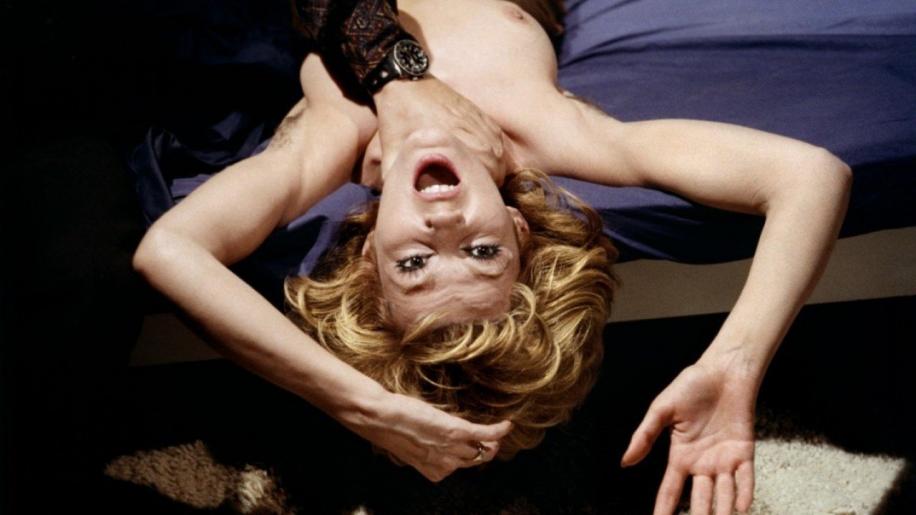
Claude Chabrol’s Just Before Nightfall (1971) fascinates in part because its ultimate aims differ ever so slyly from the suspenseful modes it seems to be channeling moment to moment. When advertising bigwig Charles Masson (Michel Bouquet), hours removed from accidentally killing his best friend’s wife during one of their secretive sadomasochistic afternoons, tosses his evidence-strewn handkerchief down a drain, one senses the stirrings of a Highsmithian exercise in amoral criminal machinations. The initial probe of the murder scene, in which Chabrol emphasizes the fidgety lead detective’s fingers repeatedly drumming a tabletop, perhaps suggests the determined forensic mind that will solve the mystery. The camera’s zoom-in across a train platform at a confidant of the deceased who recognizes Charles sends shivers down the spine, her hard stare poised to crack the case open. But the thrill of such gestures abates as the movie settles into a somber, near-philosophical examination of Charles’s internal reckoning. Over a long series of conversations—about guilt, innocence, courage, madness—Charles seeks the counsel of those closest to him and becomes genuinely mortified when they uniformly implore him, through their own twisted logic, not to turn himself in.
The hysteria of the opening—the fatal, ambiguously presented roleplay and Charles’s ensuing sickly reaction in a dim bar—contrasts with the comfort of Charles’s regular domestic idyll. His wife Hélène (Stéphane Audran)—the kind of carefree person who says, “I don’t like funerals,” at the conclusion of a funeral—looks after their children, taking them on neighborhood motorcycle rides and indulging them in silly games around the house. Hélène babies Charles too, lugging him off to bed after a late round of Scrabble. Charles’s motormouthed mother drops in frequently, showering her son with praise. Meanwhile, Charles makes anguished visits to the new widower, architect François (François Périer), his longtime pal, who designed the Masson property. Each appearance of François’s own austere home startles, its domineering gated entrance perversely at odds with the tree-lined environs.
Throughout, Charles drinks—whiskey, Champagne, laudanum-tinged water before bed—usually throwing back two or three gulps at once, as if starved for oblivion. Bouquet plays him with a tremendous poker face, hiding the character’s dawning agony behind a mask of propriety. Chabrol stages many scenes in extended, snaking takes, the camera beginning on one object, or person, before pivoting to another—as if mimicking the ethical reverberations of Charles’s mind. It might be easy to laugh at this coddled, doughy-faced man as he ruminates on his deeds at a beach house or before a fireplace—and there is indeed something darkly funny about how all his privileged counterparts urge him against assuming moral responsibility. But, there is little escaping the chilling truths about human nature that Chabrol reveals as he charts Charles’s bourgeois purgatory.
Just Before Nightfall screens this evening, February 19, at L'Alliance New York as part of the series “Chabrol! Suspense! Restored!”