The master espionage novelist John le Carré crystallized the tension between intent and result, causality and correlation, on both personal and political terms. The necessity of their murkiness was brought into sharp relief in his 1983 novel The Little Drummer Girl, adapted by Loring Mandel for a 1984 film directed by George Roy Hill. As opposed to the slick and chic takes on other le Carré works, Hill’s Drummer Girl is rough-hewn, craggy, and intense.
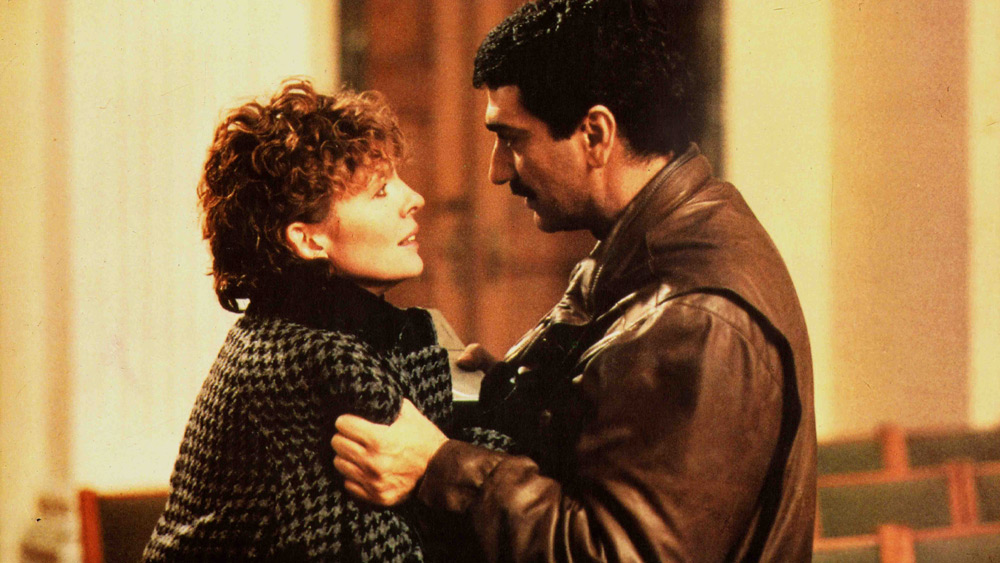
Diane Keaton plays Charlie, an actress with anti-Zionist beliefs and leftist sympathies, who, while vacationing in Greece, is recruited by a handsome Mossad agent (Yorgo Voyagis) posing as Michel, the brother of Palestinian resistance fighter Khalil (Sami Frey), who was actually executed by Israeli intelligence officers. Asking Charlie to infiltrate a Palestinian resistance group under the guise of the late Michel’s girlfriend to wheedle Khalil out of hiding, Mossad agent Kurtz (Klaus Kinski) constructs a narrative for her that Israeli/Palestinian peace and an end to the ceaseless cycle of violence are the team’s goals.
But as much for Kurtz and the other Mossad collaborators as for Charlie, this is but a performance. She reads Khalil’s letters, written by Kurtz, detailing the beauty of the land, the preciousness of their families, the crucial belief that the fight must be done with love. Kurtz and his Mossad cronies fashion themselves an acting troupe upon the geopolitical world stage. And Charlie, playing the role she was offered, follows the narrative diligently, painfully unaware of the dramatic irony Hill and the audience are privy to.
When Charlie, technically working as a double agent, is able to assimilate into the resistance group’s community, is she acting? Or is this what she believes? Is there a difference? She’s trapped between two narratives, and unable/unwilling to disentangle herself from these competing planes of political reality. Ultimately, she is forced to discover their harrowing and heartbreaking costs. The human tragedy, and the scream of history repeating itself, are scrawled across Keaton’s face, alchemical in its potent reactions and ability to convey both assuredness, certitude, and, ultimately, horror.
Politics—which is to say the exchange of power and influence between people, institutions, and nations—are performed, yes. But done so in a context where performance becomes tangible change, even destruction or revolution. For the last 77 years, we’ve watched world leaders perform the care and interest of civilians, while they permit and enable genocide and atrocity as they are live-streamed for an audience across the globe. They are performances in what le Carré terms “the theatre of the real.” And we’re all strapped into the seats, like it or not.
The Little Drummer Girl screens this evening, February 17, at Film at Lincoln Center on 35mm as part of the series “Looking for Mrs. Keaton.”