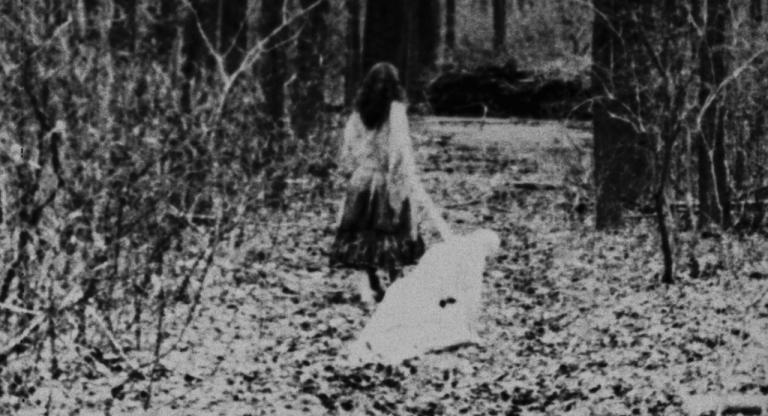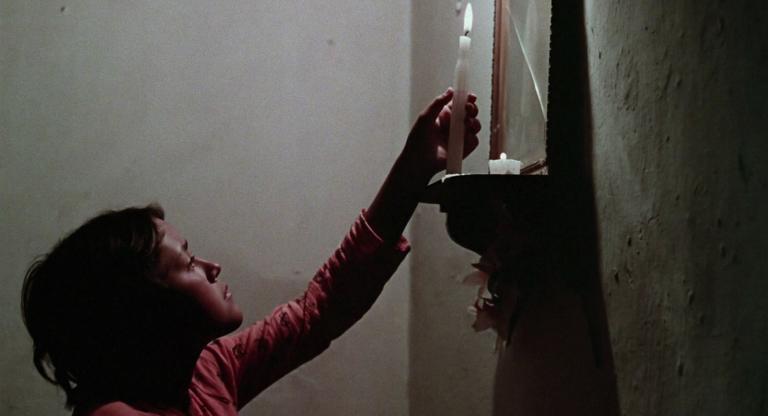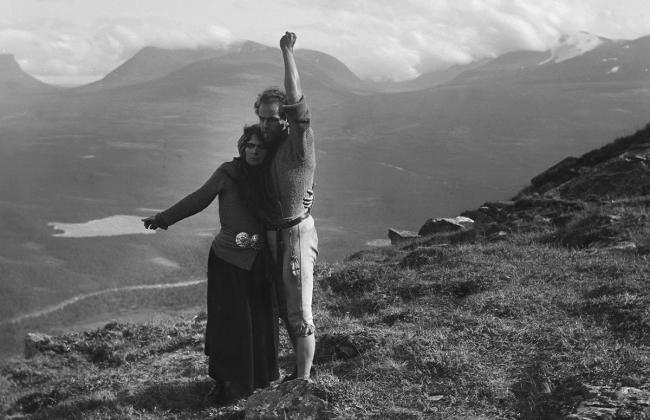
Regular attendees of the Berkeley Art Museum and Pacific Film Archive will likely have noticed their recent focus on Swedish cinema, from retrospectives of Mai Zetterling, Roy Andersson, and Gunvor Nelson, to thematic series featuring classics by Alf Sjöberg, Gustaf Molander, and Ingmar Bergman. This January, BAMPFA will continue this trend with a new series focused on two of Sweden’s most significant silent era auteurs: Victor Sjöström and Mauritz Stiller.
Over two decades, Sjöström and Stiller raised the Swedish film industry from a producer of minor shorts to a major European creative powerhouse by the end of the 1910s, distinct for its epic features shot on-location in the Swedish countryside. Both men moved to Hollywood in the 1920s, where Sjöström directed The Wind (1928), regularly considered one of the last masterpieces of the silent era. Stiller, though less known today, introduced America to an actress who became one of its greatest icons in the 1930s: Greta Garbo.
This retrospective will feature restorations of major works by both men, including new prints of The Outlaw and His Wife (1918) and Erotikon (1920). Ahead of the series, I spoke with Jon Wengström, a senior film curator at the Swedish Film Institute. Mr. Wengström, who also sits on the advisory board for the Nitrate Picture Show and the artistic committee at Il Cinema Ritrovato, will be in Berkeley to introduce the first week of the series and deliver a lecture on Sjöström’s career as an actor and director on January 17.
We met on Zoom to discuss both directors, Garbo, Lillian Gish, and the place of Swedish cinema in the history of silent cinema.
Jonathan Mackris: While people often think of the dominance of Hollywood during and after the silent era, there was actually quite a bit of competition from Europe in the early decades of the 20th century, including from Sweden. I wonder if you could say a bit about the position of Swedish cinema in the 1910s.
Jon Wengström: There were already embryos of an industry in Sweden in the first decade of the 20th century. You could argue that maybe the professional, and bigger scale film industry, started with the creation of Svenska Biografteatern in 1907. They had quite a good network, nationally and internationally. They stepped up their production when they moved their production facility from a small town in the provinces to Stockholm in 1911. Then, they hired three major theater directors to start directing films for them. One was Georg af Klercker, the other was Stiller, and the third was Sjöström.
During the first formative years of these three directors—let's say, 1912 to 1916—the studio turned out something like 25 films a year: two-reelers, three-reelers, et cetera. Some films were slightly longer. Some of them were good, some of them were run-of-the-mill productions. Then, during World War I, Sjöström released A Man There Was [1917]. It's almost an hour in length. It was also slightly different from previous films, as it was almost completely shot on location. The dramatic landscapes were not only a spectacular backdrop to the action, but were also really integrated into the drama. The waves, the sea, and the rocks are as important as the characters. This film became a huge success, which meant that the company changed their production policy. So, instead of making 25 films a year, they would just make five films a year, but each one would spend longer in production and would be more elaborate.
This is when I would say Swedish cinema made an international impact. A Man There Was was exported to more than 40 countries, including the U.S., but also Europe. Every new film got a lot of attention, because they were a bit different from most things you could find from other countries. And, also, because of the individual talents of the directors and the DOPs.
We should also keep in mind that Sweden was neutral during World War I, which meant that Swedish films could be screened in the U.S., in Germany, in France, and also in the UK, whereas German films could not be screened in the U.S. at the time. So, there was an opening in the market, so to speak, which, I would say, lasted until the mid-1920s.
Sweden really had these years—let's say, 1916-17 to ‘24-25—as a prominent filmmaking country. They didn't produce that many films, but almost all of the films they did produce were big, big productions. When you see some of these films today and you compare them with films made in other countries at the same time, they have a kind of psychological depth and sophistication, as well as a kind of low-key acting, which make them stand out if you compare them to American, French, or German films of the period.
JM: Students are often very impressed when I show A Man There Was. Sjöström himself is an incredible performer and, as you say, the location shooting is very striking. I think when many people think of the great Swedish films of this era, whether The Outlaw and His Wife or Sir Arne’s Treasure [Stiller, 1919], the location shooting stands out. French silent films would also be shot on location, but typically they were set in urban environments like Paris, whereas many of the Swedish films I’ve seen from this period feature very striking natural landscapes. Would you say this was a signature feature of Swedish filmmaking at the time?
JW: Yes, I would say so. Not that all the films were these kinds of historical dramas, though. You also have films like Erotikon by Stiller, which is a very sophisticated urban comedy.
JM: Your lecture on January 17 will focus on Victor Sjöström. I don't want to ask you too much, at the risk of spoiling it, but I wonder if you might be able to say a few words about his origins—first as an actor and later as a director.
JW: He began his film career in 1912. When he was hired by Svenska Biografteatern, he immediately started acting in his own films, but also in films directed by others. I think when you see A Man There Was, or The Outlaw and His Wife, or The Phantom Carriage [1921], it's quite amazing that he was so in command of making films at the same time as he was playing the main character. He then, of course, went to Hollywood in 1923 and continued to make films, including his first sound film [A Lady To Love, 1930]. Then, he came back to Sweden. In 1931, he made one more film, and then he continued to act in films directed by others. In the ‘30s, but mainly, I would say, in the mid ‘40s and early ‘50s was when he really did his best performances as an actor in films directed by others.
JM: I think one of my favorites of his performances is in Gustaf Molander’s adaptation of Ordet [1943].
JW: He’s fantastic! I prefer it to the Dreyer film.
JM: Since you brought up his American period, I’m curious about his work with the actress Lillian Gish. The Wind (1928) is probably the most famous of Gish’s silent films beyond her work with D.W. Griffith. From what I understand, she requested Sjöström to direct the film. How did they come to work together?
JW: The first film they made together was The Scarlet Letter, released in 1926. From what I understand, it was Lillian Gish who came to MGM having read the novel [of The Wind], saying we should make a film out of it. Then, as you say, she really wanted Sjöström to direct the film. Apparently they struck up an amazing understanding. In our collection, we have letters between her and Sjöström, which I will also mention and show excerpts from in my lecture. They’re quite moving.
In her letters to him, she recalls what a wonderful time they had together. She really urges him to continue and make sure that he can make his own films, and not be worn down by the system. They kept on corresponding with each other well into the ‘50s. Gish came to Sweden to visit him with her sister Dorothy, and vice versa.
JM: One of the films that isn’t playing in this series is Thomas Graal's Best Film [1917], which, if I’m not mistaken, is the only collaboration between the two men, with Stiller directing and Sjöström acting. What was their relationship like? How did Stiller come to make films in Sweden?
JW: Actually, Sjöström acted in seven of Stiller’s films, and Stiller acted in Sjöström's first film also. They were hired, more or less, at the same time by the studio head, Charles Magnusson, in 1912. So, they knew each other from the beginning, when they both started. They kept a pretty close relationship. Stiller was born in Finland; at the time, Finland was part of Russia. He grew up in a Jewish family. He was also a theater director and had toured in Sweden. So, Sweden was not a strange country for him to come to.
JM: One of my favorite films playing in the series is Ingeborg Holm [1913], the first of Sjöström's masterpieces. I'm very intrigued by the film accompanying it, Stiller’s The Wings [1916], with which I’m not familiar at all. Could you tell me about it?
JW: For quite a long while, it was considered to be a completely lost film. And then, it turned up in the mid ‘80s in an attic in Norway and we started working on it. We made a photochemical duplication, which was not that good. Now we’ve come back to the original nitrate print to make a better digital version.
It's an interesting film. It was Stiller’s 34th film, or something like this. He had made so many films; after this film, he actually took a one-year break from filmmaking. When you see the film today, it's quite obvious that it's a film about a love triangle. There’s an aging male sculptor and a woman from the nobility who wants to help the sculptor. Then, you have Lars Hanson playing the sculptor's young protégé. You can see that there is a kind of homosexual undertone in the relationship between the old man and his young protégé, even though it's not explicitly said. Sometimes, the film is referred to as one of the first gay movies. It's quite moving.
The interesting thing is that the film starts with a prologue where you see Stiller casting the film, with the actors coming for auditions, et cetera. And then, at the end of the film, Stiller and the cast and crew go to a theater to see the final results of the film, which is quite an interesting meta-thing that was not so common in those days.
JM: The German novelist Daniel Kehlmann recently published a fictionalized biography of the German director G.W. Pabst, The Director [2023; trans. 2025]. There was one scene in the book that really bothered me, where Greta Garbo meets with Pabst in Hollywood and credits him with discovering her when they made The Joyless Street [1925]. I remember thinking to myself, “That’s not true! What about Mauritz Stiller?” To correct the record, could you say a bit about Garbo and their relationship while making The Saga of Gösta Berling [1924]?
JW: The Saga of Gösta Berling was a huge production. It was mainly shot in ‘23 and ‘24, and released in ’24 in two parts, with one week in between the first and second part. A bit into the shooting, Stiller hadn't completely cast the film and wanted someone for the role of Elizabeth Dohna, and another young woman for the role of her relative. Stiller turned to [Gustaf] Molander, who was at the time the head of Dramaten, the big theater school to train young actors. He asked Molander, “Do you have two people that I could cast in these roles?” Molander told him, “Yes, you should really hire Greta Gustafsson,” because she was not “Garbo” yet at the time. The other actress was Mona Mårtenson, who also has quite a big part in the film. That’s how Stiller came to find Garbo. He watched their auditions and realized, “Wow, this is really a star in the making.” He cast her more or less completely unknown as one of the main characters in the film. She's not so much in the first part of the film, but she really dominates the second part. Then, she met Pabst.
But, do you know what happened after the Pabst film? Stiller was still in Germany, because he was still doing promotion for Gösta Berling. He signed a deal with a German production company to shoot a film in what was then known as Constantinople, which is nowadays Istanbul. He went to Istanbul to scout locations for the film and when he came back to Germany to finalize the deal with the production company they had gone bust. So, there was no film. Then, he was contacted by MGM to follow Garbo to Hollywood. They actually took the same ocean liner to go to New York and then to Hollywood in ’24.
JM: It’s a shame that he died so young, given how prolific he was in the silent era. It would have been interesting to see how he would have navigated the industry in Hollywood at the time.
JW: His career in Hollywood was very different from the one Sjöström had. He [Stiller] was involved in a few productions, but he was replaced by other directors. There is one film that he made for Paramount in the end, on which he had full director's credits: Hotel Imperial [1927], which he shot with Pola Negri. But after that film, he came back to Sweden, caught pneumonia and died a few months later.
JM: I want to end by asking if there are any of the other titles included in the series we have not mentioned that you’d like to discuss.
JW: They're all very good films, but I have a special feeling for The Outlaw and His Wife. It’s the film Sjöström made after A Man There Was. For me, it’s very dramatic. It has all these components of location shooting and natural elements that are part of the drama. But it's really one of the most moving love stories, I think, from that time in cinema. I also think that the print that will be screened is really nice.
JM: I'm looking forward to revisiting it. I've only seen it once, many years ago.
JW: You should definitely see it then, because I think what was available until 2013/14 was slightly shorter than the version now. And, maybe you only saw it in black-and-white. This is tinted and toned, because we had access to a nitrate print that was found in Brussels. I think it's actually 40 minutes longer now and in color, so you should see it. The print of Erotikon is also very nice. A special print, too, because it’s a black-and-white print that has been tinted the old way, by dyeing in color baths. It will be fun.
“Swedish Silent Cinema: Victor Sjöström & Mauritz Stiller” screens January 16-February 28 at BAMPFA.