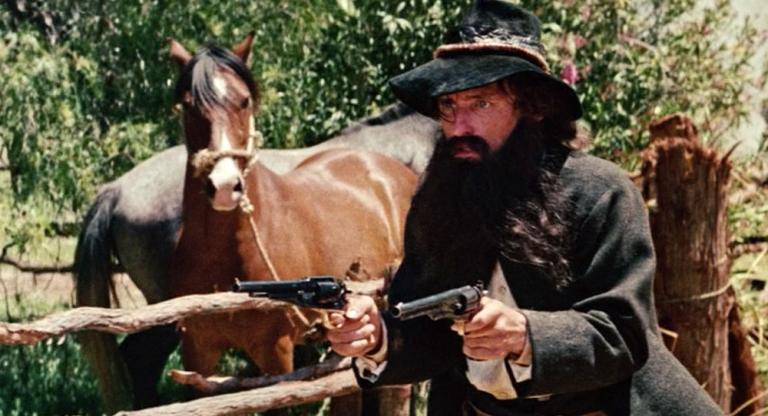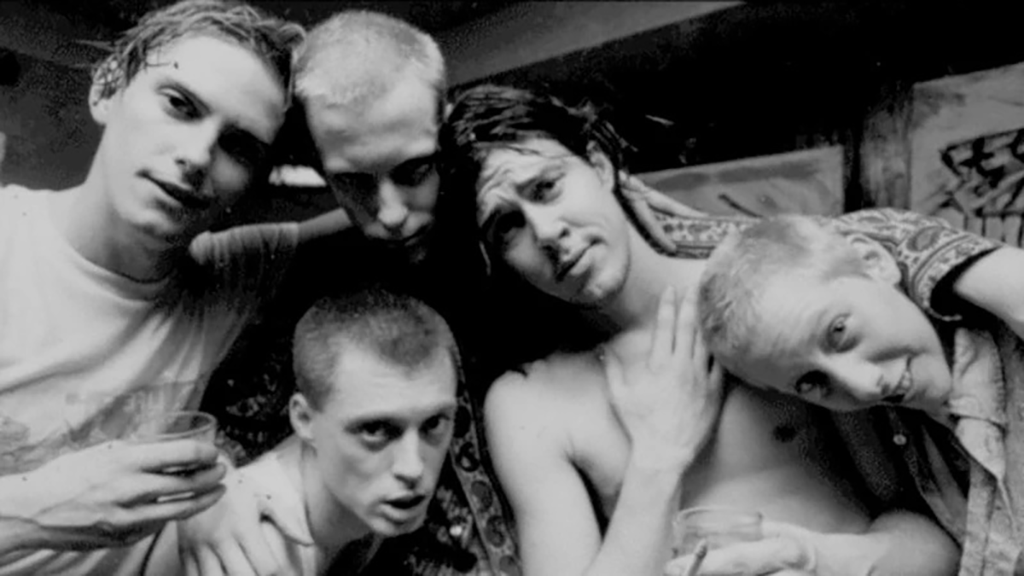
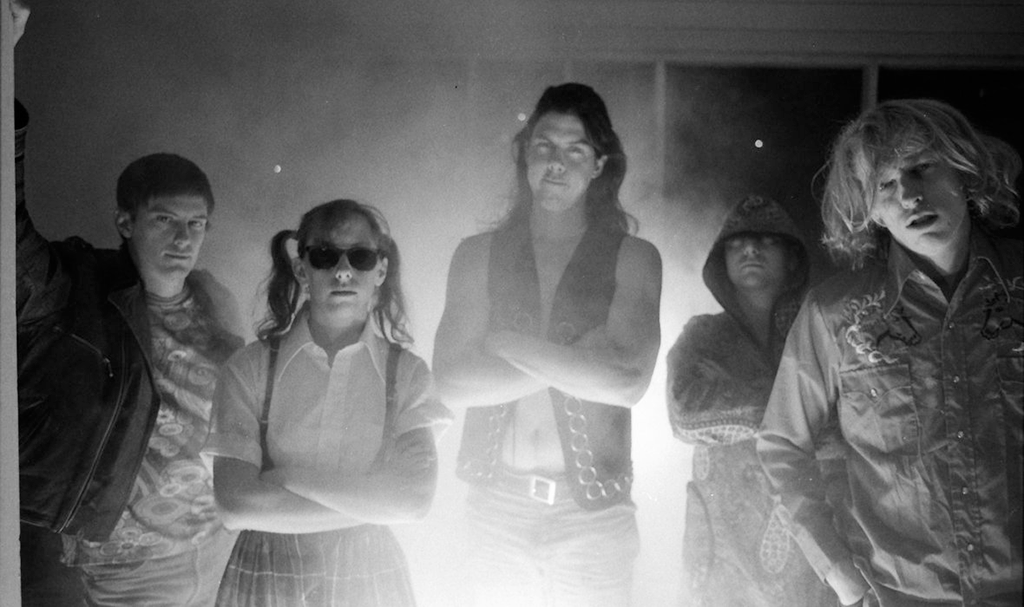
The year when Butthole Surfers founders Paul Leary (guitar) and Gibby Haynes (vocals) both turned 69 is the cosmically perfect time for a documentary about a band that elevated scat, sex, and puke jokes to something approaching fine art to be released. Director Tom Stern’s Butthole Surfers: The Hole Truth and Nothing Butt (2025) assembles a panoply of prestige rock-n-rollers (Ian MacKaye, Dave Grohl, Thurston Moore, Flea); the Surfers themselves (Leary, Haynes, and the tandem drum unit of Teresa Taylor and King Coffey, plus most of the 12 bass players who came and went over the years); and a cast of felt puppets to capture the agonies and ecstasies of the strangest band to ever score a Top 40 hit.
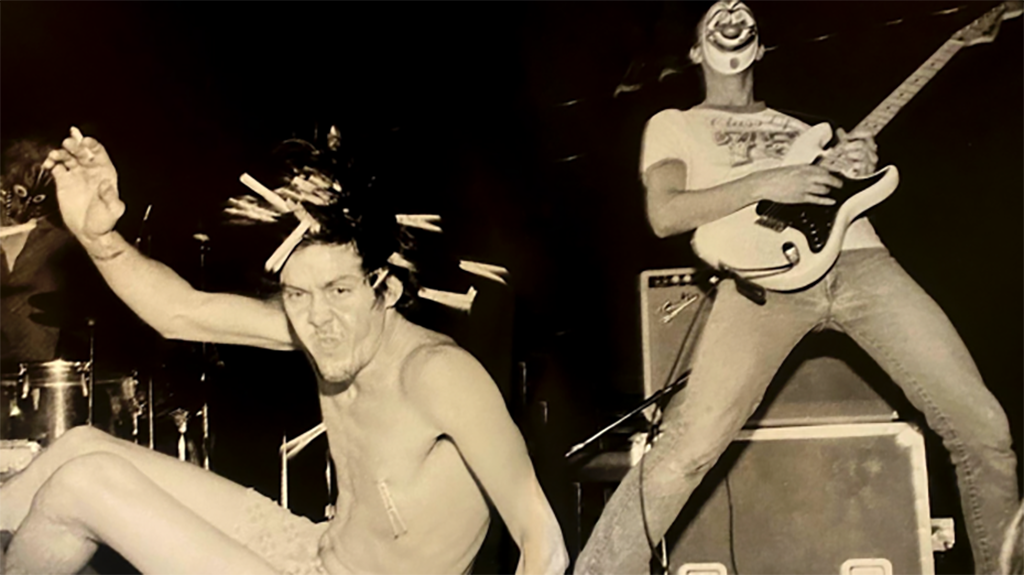
Minivan moms of the 1990s might not stoop to uttering the band’s name then or now, but approach one with the words, “I don’t mind the sun sometimes…” and they’ll gleefully finish the rest of “Pepper” while bopping their heads. But, before their unlikely MTV hit, the band spent the 1980s releasing sui generis psych-rock records while living hand-to-mouth by day and terrifying concertgoers by night with unsanctioned pyrotechnics, penile surgery footage, unrelenting strobe lights, and music that sounded like what battery acid must taste like. What for? Haynes cites Marcel Duchamp’s influence; Leary adds,“I like dumb ideas.” Somehow, Stern wrings unsentimental pathos from the band that once sang, “There’s a time to shit and a time for God / The last shit I took was pretty fuckin’ odd!” At other times, he revels in the mind-melting audiovisual anarchy the group alchemized and somehow survived.
I talked with Stern about what makes a good rock doc, how to provoke sincerity from infamous pranksters, organizing a surfeit of archival material, and using puppet reenactments to fill in the gaps. This conversation has been condensed and edited for clarity.
Patrick Dahl: Do you remember your first encounter with the Butthole Surfers’ music?
Tom Stern: Yeah, I was a college student at NYU in the '80s. Me and my friend Alex Winter, who I was working with at film school, were into the new underground music. We would go out and see the Minutemen and the Meat Puppets, and these exciting new bands from that era. Then, he said, "Oh, there's this new band, the Butthole Surfers, that everybody's talking about.”
The name grabs your attention. We went and checked them out at 8BC, which was a club in the Lower East Side or East Village. They were amazing. It was just such a unique, singular experience—somewhere between rock n’ roll and performance art.
I think the first thing that caught me was the song "Something”, which was on their first EP. It had this high screechy guitar part that really cut through everything, and there were two drummers pounding out these tribal rhythms in a “rubbery groove,” as Flea puts it in the movie. And, they had a bass player who would switch off to sousaphone, which was unexpected in a punk rock band. They just made a big impression. I was hooked right there. I started seeing them every time they came through town, which was a lot.
PD: In the 40 years between then and now, when did the idea of a documentary take shape in your mind?
TS: Back in 2019, another old friend of mine, Alex Halpern, said, “Hey, why don’t you do a Butthole Surfers documentary?” And I was like, “Wow, that makes a lot of sense.” I’d been following them for 40 years and had become friends with them, so I had access. In a way, I’ve been working on it since the ‘80s without realizing it. I shot a show of theirs at CBGB in 1986. Then, me and Alex Halpern made a student film out of it. We sent it to the band and they liked it. It had stuff like Alex running naked through Grand Central Station, sort of Jackass style.
PD: Very Surfers.
TS: Yeah, and I guess they appreciated that. Alex Winter and I did another short film with them shot on Super-8 called Entering Texas [1988].
PD: Was it difficult to get them interested in participating in the documentary?
TS: When I initially asked Paul Leary, he said, "You know, I always resisted a documentary. But if anybody's going to do it, you should be the guy to do it.” He agreed because we’d worked together. They knew that I got what they were trying to do, and I absolutely did. I was a huge fan, but at the same time, I told him, “I’m not going to do a hagiography.” That would be boring and they knew that. Gibby, to his credit, was like, “The movie that makes me look the best is not going to be the best movie.”
PD: That's a perfect segue to my next question. Gibby seems to have been the most difficult interview subject. He always seems ready to perform during your interviews with him, but then the show he puts on comes across as his way of not fully cooperating.
TS: Yes, exactly.
PD: So, what was it like… dealing with him?
TS: The big challenge was getting Gibby to stop performing and just open up and be sincere, and go places that were uncomfortable for him. He doesn’t want to talk about stuff [from his life] that is dark and disturbing. He’s much more comfortable performing and just being funny. I had to gently try to get him to be more sincere. He’s difficult and moody, so you have to be patient more than anything.
To his credit, he was game to just let me keep interviewing him over and over, so I took a volume approach: “I’ll keep interviewing him and, inevitably, the more conversations we have on camera, the better chance I have to get moments that aren’t all the same kind of performative response.” So, I interviewed him like 20 different times over the course of four years. But some of his evasions are kind of memorable. There is a moment where you hear me asking about his drug problems. He seems to consider the question and then walks over to the camera, unplugs the microphone, and then pantomimes a response with no sound.
PD: It’s such a dark moment, but I think it was the hardest I laughed while watching the movie. It’s a great gag, but then there’s a tragic layer on top of it because it reflects his anxiety about engaging with these topics. He’s trying to manage not being fully in control of the interview.
TS: He’s contradictory, because at the same time he’s sort of hiding behind this performative routine; he understands that the best version of the movie isn’t necessarily what he’s giving me. He understands that despite his personal discomfort there is a bigger picture of the movie presenting the whole story.
My challenge was how to get past that discomfort. For instance, the first question I asked was, “What’s your earliest memory?” Just kind of an ice breaker. His response was talking about this traumatic event. [In this segment, Haynes describes being sexually assaulted by his nextdoor neighbor when he was four years old.]
PD: That was from the first interview?
TS: Yes.
PD: That makes that revelation in the film all the more heavy.
TS: Yes. He’s not being performative. He’s being sincere, because somehow that question bypassed the instinct to perform.
PD: Were you aware of what had happened to him when you asked that question?
TS: No, and hardly anybody was. Paul didn't know. He hadn't told anybody except his wife. That kind of became a Rosetta Stone to his psychology, and the reasons why he avoids being sincere and vulnerable.
Long story short, after four years of interviewing him, we did a rough cut. We showed it to some people and everybody had the same feedback, which was, “What’s wrong with Gibby?” We essentially hear from other people talking about him, but we don’t hear Gibby confronted.” I went back and told him that people were saying they need to hear more from him directly about the dark stuff and what troubles him.
And he was like, “Okay, I get it. Let’s go to Dallas.” So we brought him and his old friend Bob Forrest, who’s a professional addiction counselor, to Dallas to visit the site of his childhood trauma. I think that yielded a catharsis where we get past this performative Gibby into a sincere, emotionally vulnerable Gibby. I told him, “I just think we need emotional truth here to make the film complete.”
There’s a lot of emotion in the band’s music and art. There’s an emotional range of calm and horror, but there’s also real emotion. A lot of his lyrics are abstract and poetic, but they come from a real place which, when you know the real story, can really deepen the meaning of the music and the art.

PD: What was the experience like tracking down and organizing all of the archival material?
TS: It was an essential part of the job. We knew we needed that stuff, so we put out the word on social media. We also did a lot of detective work and called a lot of people. The band didn’t have much; they couldn’t help us there. But we called their old friends. Eddie Hardin was one of their best friends from college and he was taking film classes at the time, so he shot all their early rehearsals. We tracked down Super-8 footage of their first show, which was at an art gallery. We also found the sound man at Danceteria who had filmed a show there from the sound booth.
We found some amazing footage from the Pandora Festival in Rotterdam, which was in ‘85. It was an important show because it got them a lot of notoriety in Europe. There’s pretty amazing footage of Gibby stomping around in a dress on stage, but also backstage scenes where he’s putting his penis on a record company representative’s shoulder. He’s on LSD and alcohol, just gone. Pretty incredible footage.
PD: Some of the concert footage is genuinely terrifying. I had read about these shows for many years, but seeing them… It’s mayhem. But then in the film you hear from Kathleen Lynch [a performance artist who toured with the band for years as a dancer and provocateur] who describes performing simulated sex with Gibby onstage at Danceteria as a healing experience. She says that she had been scared of men her whole life and performing with Gibby helped her overcome this fear. But as an audience member, watching them have very convincing simulated sex amid all the chaos was so deeply unsettling.
TS: Yeah, it’s pretty deep. These two people who had early childhood trauma were going through this cathartic performative ritual on stage in front of an audience while this cacophonous music created a soundtrack for their emotional nightmare. Somehow, it all came together in a very powerful way.
PD: One of the more refreshing aspects of the film is that interviewees don’t remember, misremember, or disagree on their shared past. I think a lot of nonfiction filmmaking, especially related to popular culture, smooths out all those rough edges and roots itself in fact and certainty. Can you talk about the way that you seem content with certain events or things remaining unknowable or ambiguous?
TS: There was such a blurring of truth in their lore and mystique. In their golden era, in the 1980s, they would just make stuff up in interviews and create myths and legends. It was a challenge to decipher what was true, and a lot of time they couldn’t remember what was true and that became amusing. They were also doing a lot of mind-altering substances that helped obscure what really happened. I saw the Rashomon aspect of it all and thought it could play to our advantage because it resonates with human experience. Human memory is incredibly unreliable and we all manufacture memories, which then change and morph into different things. It’s universal.
PD: I really resent the fact that a lot of nonfiction filmmaking tries to get around that.
TS: I agree. So that was a decision that I made pretty early on, partly out of necessity, partly because it resonates more truthfully than trying to hammer everything into one story that everybody agrees on.
PD: You go even farther than that when you include very intense criticism from their peers. Steve Albini earnestly calls them “the worst people I’ve ever known” and Ian MacKaye charges them with “screwing people over” by breaking an oral contract with Touch and Go records and then suing them. It goes beyond the usual gentle critiques that bands receive in documentaries. Did you ever consider softening the criticism?
TS: No, I never wanted to do a hagiography. I think hagiographies are very boring and annoying. When I see something like the Led Zeppelin film that came out, Being Led Zeppelin [2025], I know it’s not going to go anywhere dark or uncomfortable because it was produced by the band. That immediately makes it boring, even if there’s great footage. It’s just so much more interesting if you can be honest and talk about stuff that doesn’t make them look good. It’s a complicated band. I wanted a balance where you’ve presented a picture that’s fair and compelling. Albini was pretty harsh, but that’s Albini. [His commentary] says a lot about him as well as the band.There’s not one truth. It’s a tapestry of different perspectives.
PD: In addition to the archival footage, you have a ton of visualizations and reenactments of the band’s history using animation and puppets. I think you captured their kind of psychedelic, scrappy, lo-fi aesthetic using a variety of media. How did you approach and execute those sequences?
TS: Being a filmmaker for a long time, I’ve developed some skills and predilections. I’ve done a lot of stuff with puppetry and I love to do lo-fi special effects. I liked the idea of iconifying them into cartoonish characters using puppets and miniatures. They had turned themselves into sort of cartoons of Texas freaks already, so I thought that approach fit well. It’s a nice facet of an overall picture that includes the deep emotional truth of messy and nuanced human beings.
The Butthole Surfers were such blenders of pop culture absurdity that I felt it suited them to take this everything-but-the-kitchen-sink approach. They’re a psychedelic band and I wanted to pay homage to that. The most powerful experiences I had were at live shows in the ‘80s. It was a surrealistic, dangerous performance art circus. This Dada explosion backed by this miasma of tribal drums and screeching guitars, with Gibby being the ringmaster manipulating his voice with digital delay. They created a really transcendent kind of soundtrack and visual experience. Early on, I said that I wanted to capture that experience on film to make the audience feel something of what it was like to be at a Butthole Surfers concert back then. After seeing the movie, Paul said to me, “When you first told me that, I thought ‘Yeah, good luck!’ But you know what, you really did it.” That was the ultimate compliment.
Butthole Surfers: The Hole Truth and Nothing Butt screens tomorrow, August 28, and throughout the week at Alamo Downtown Brooklyn and Alamo Lower Manhattan. Director Tom Stern and members of the Butthole Surfers will be in attendance at tomorrow’s screening.