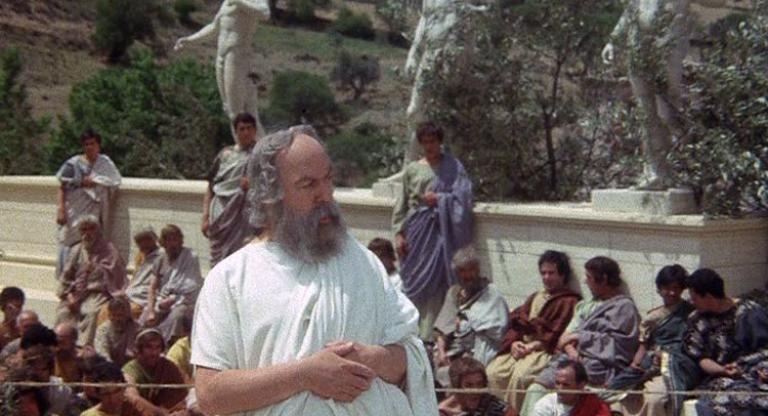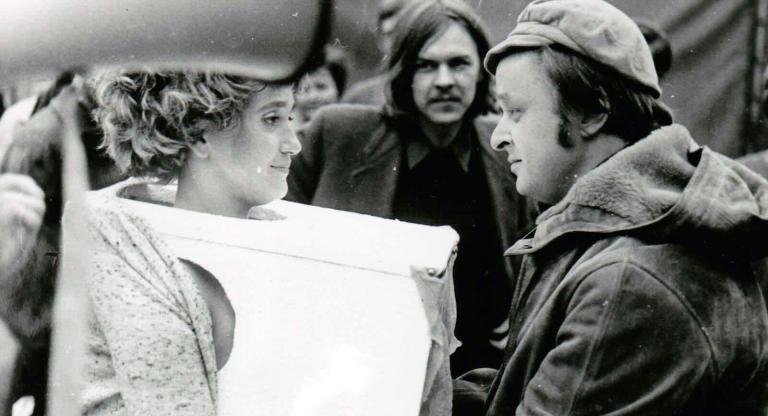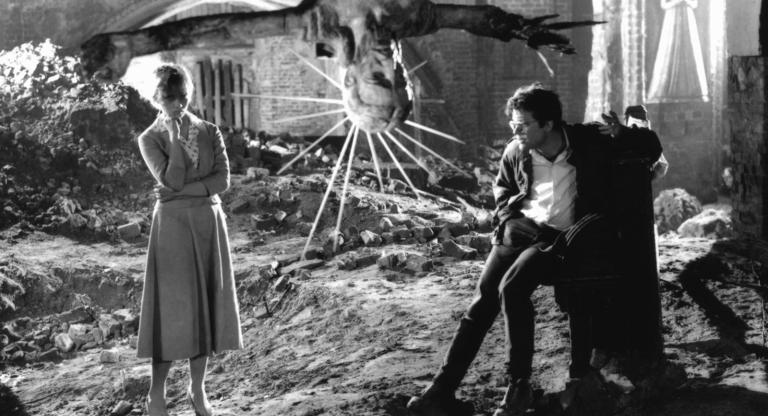
The 37th edition of the French avant-garde film festival FIDMarseille has broken into the mainstream for the first time ever—with attention from publications including Le Monde, The New York Times, and Le Figaro—over the controversy surrounding the French-based Israeli filmmaker Nadav Lapid’s inclusion and subsequent withdrawal as its Head of Jury. Many filmmakers threatened to boycott the festival because of Lapid’s inclusion, and a dozen film workers withdrew their participation in the festival, including Narimane-Mari, Ghassan Salhab, Aude Fourel, and Aïda Kaadan.
After Lapid withdrew from the festival due to the protests, many renowned French filmmakers rallied around him, publishing two letters (here and here) in Le Monde. The letters garnered more than 350 signatures in support of Lapid, including those from high-profile figures such as Jacques Audiard, Mati Diop and Natalie Portman. They argue that Lapid had been discriminated against solely because of his nationality and framed cultural boycott as an “intellectual dead end.” Film Workers for Palestine, allied with PACBI, translated and endorsed a statement by the French collective Palestine Will Save Cinema highlighting Lapid’s funding sources for Yes (2025), which included the Israeli Film Fund. The film was also presented at the 2025 Cannes Film Festival as an Israeli co-production and competed for the Ofir Awards, Israel’s leading film awards, and Lapid has continued to participate in events supported by the Israeli Embassy in France.
The filmmakers who chose to withdraw their works participated in an interview with French publication Emitaï to expand upon their decisions and their discussions with the FID team, with many citing the fact that Lapid was included as a result of a “logic of symmetry,” despite the fact that this year’s edition sought to present a focus on Palestinian and Arab filmmakers. Kaadan enunciated her concerns to the programming team: “Programming my film within a focus on colonization while simultaneously celebrating Nadav Lapid through a book launch amounted to reproducing precisely the power dynamics we are fighting against.”
FIDMarseille’s opening night was met with a protest staged by the counter-festival FID OFF and a speech from the Marseille-based film critic Samy Benammar criticizing FIDMarseille’s disappointing statement, which endorsed the “Cinema is not an Embassy” statement from Le Monde and sought to encourage “dialogue.” FIDMarseille director Tsveta Dobreva followed up with a speech that awkwardly hailed the festival’s goal to “defend cinema.” The question remains: to defend it against what? To witness FIDMarseille make its own disastrous Berlinale-inspired statement is particularly disheartening considering that the core of the festival’s programming has always centered political cinema and has taken pride in its oppositional stance to the red-carpet spectacle of its moneyed sibling from across the Cote d’Azur.
The political stance of FIDMarseille’s programming has not only foregrounded cinema about politics, but a political cinema created through shoe-string budgets, small teams, and horizontal modes of production. While Lapid excoriated the cultural boycott as a violent attack against his existence as a dissident political filmmaker, he remains unable to wiggle his way out of the contradictions of accepting funding from the very state he appears to critique (that is, an apartheid state that is actively funding a genocide). Arielle Angel, Editor-in-Chief of Jewish Currents, identified this contradiction pointedly in their conversation on the On the Nose podcast: “If any Israeli filmmaker can make a film without Israeli funding, at this point, it seems like it’s you.” The Lapid controversy offers a stark vision of the material conditions of current political cinema; that is to say, of funding and distribution networks that are closely intertwined with nation states naturalizing and ossifying their systems of power. In the Emitaï interview, Fatma Chérif also notes that FIDMarseille had been made more financially precarious by the withdrawal of its Creative Europe Media subsidy, alongside reported threats from regional funders over its 2025 focus on Palestinian cinema. Yet much of the subsequent media criticism was redirected towards the boycott rather than the broader institutional pressures to which the festival and its funding were subject.
Last year, FIDMarseille had presented luminous retrospectives on Radu Jude and Chilean duo Carolina Adriazola and José Luis Sepulveda. The latter, whose work has rarely been shown in Europe, champions a punk cinema that often refuses traditional funding avenues that come with strings attached to festival labs, or to a national industry that promotes what they call “concertation cinema” that aligns with the neoliberal logic of Chilean society. Similarly, this year’s focus on the French-Algerian filmmaker Rabah Ameur-Zaïmeche has been a real discovery. Since his handheld-cam debut feature Wesh wesh, qu’est-ce qui se passe (2001), shot in the housing project in Seine-Saint-Denis where he grew up, Ameur-Zaïmeche has been praised in France. (Sadly, his films are still barely distributed internationally.) Ameur-Zaïmeche’s earlier works can be categorized as a form of banlieue social realism, yet he explodes the trappings of this genre (which frequently focuses on the atomized, gruelling realities of the individual against the world) by committing to a form of troupe cinema that often explores the relationship between groups of workers and friends (often portrayed by non-professional local actors) within the specific locales of the workplace mosque, the council-housing courtyard, and the local café. However, he refuses to be pigeonholed as a French filmmaker of “urban issues” by working extensively in Algeria and making outré historical dramas whose subjects range from retellings of the final days of Jesus to the Algerian Civil War.
Ameur-Zaïmeche’s latest feature, Algerian Road (2026, pictured at top), opened the festival and was unfortunately a rather confused genre-bender. What begins as a road film, in which two truckers, Slimane (Slimane Dazi) and Smaïn (Smaïl Ameur-Zaïmeche), are tasked with transporting cargo across the expanses of the Algerian Sahara, abruptly shifts into a spiritual drama after their truck is hijacked and they are rescued by Anna (Liah O’Prey), a young French researcher searching for a lost manuscript with her companion, Sofiane (Sofiane Saidi). Here, genre appears to rhyme with gender, as all of the men in the film belong to the realm of labor, firmly planted in their material realities, while the women in the film have one eye turned to the heavens and are raptured by the mirages offered by the spectacular landscape. These two distinct worldviews constantly clatter against one another, never coalescing to anchor a narrative that steeply falls off into mystical territory. I couldn’t help but wonder if the inclusion of the French actress was the result of French co-production demands (Algerian Road received 78% of its funding from France) resulting in a strange, amalgamated double narrative.
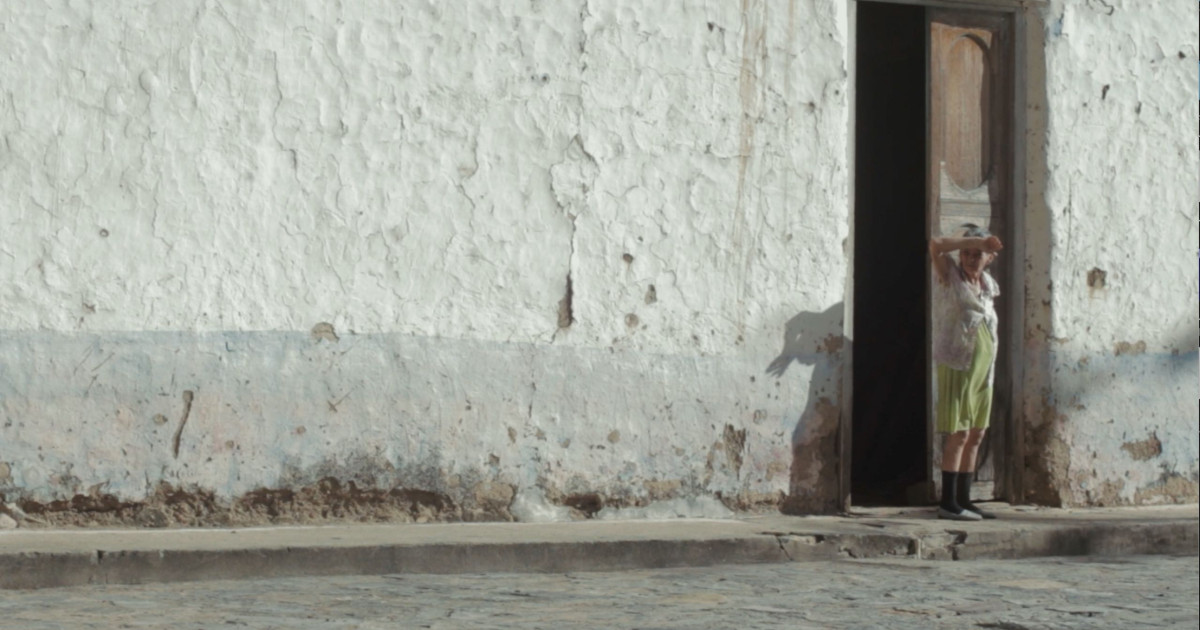
One of the most surprising works I saw as part of the International Competition was Felipe Rúgeles Pineda’s (2026). Accompanied by the filmmaker’s personal voiceover, the film begins as a DV portrait of Jordán, a largely deserted village in the craggy valleys of central Colombia. Shots of mountains, a muddy, fast-flowing river and grazing sheep recur like a refrain between interviews with the few elderly inhabitants who remain in the village and are still traumatized by, and unable to speak directly about, the violent rule of Roque Ferreira, the conservative leader of the paramilitary group Los Chulavitas, which invaded and brutalized Jordán during the 1950s. Halfway through the film, unexplained footage (also shot on DV) from an unfinished B-movie period-drama made in the same village in the 1990s by Javier Gutiérrez (who was unaware of the town’s history) begins to interpolate Pineda’s own images. Bandits on horseback descend on the local church in a stylized bloodbath; mountainous valleys give way to horses carrying body bags; a theatrical tableau of bodies strewn across the church floor is followed by a close-up of the river.
Constantly flitting between past and present, between fiction and documentary, these ouroboric images reveal a landscape inscribed with a terror that remains largely invisible and unspeakable. Pineda appears uneasy about unearthing this violence, as he introduces the extreme gore of Gutiérrez’s fiction as a way to desacralize any attempts at memorialization, as images themselves remain incapable of doing justice to what has been witnessed and endured. His response is to abandon the conventions of the ethnographic essay film—of late, the mode du jour for documenting such histories—and corrupt his own images with the extremity of an unfinished horror film.
One of the most frustrating tendencies in this year’s Competition was the frequency with which films lapsed into didactic grandiosity, diagnosing the dystopian present from a distance rather than confronting the entropic contradictions of present life at a film festival—of watching films, watching the World Cup, engaging in the banal routines of everyday life—as multiple global crises continue to unfold. It’s a disjunction that felt especially difficult to ignore this year, as Marseille’s canicule bore down on the city, portending an increasingly insufferable future.
Although the International Competition winner, Eloy Enciso Cachafeiro’s Todo es Cárcel is an uneven work, it does attempt to register this dystopic sense of simultaneity. The film unfolds through two parallel narratives. On the one hand, it addresses the marginalized history of the concentration camps Dictator Francisco Franco erected in Spain after the Civil War through a series of deeply affecting prison letters exchanged between leftist lovers. On the other, it tells a fictional narrative about Elsa, a documentary filmmaker researching this history for her own film while returning to her late uncle’s countryside home and contending with the trials and tribulations of family inheritance. This venn diagram is tenuously connected by the question of inheritance: how do we inherit history, in both its lower and upper case forms? How can Elsa hope to memorialize a national past while, at the same time, recoiling from the belongings left behind by her own family, who are suggestively connected to this history? To what extent do the compromises and routines of daily life align with, or betray, our political beliefs? Excerpts from the extraordinary letters exchanged between Carmen and Ángel, who were separated after the Nationalist victory in 1939 and imprisoned in these camps, are heard over landscape shots of Elsa’s hometown. Their letters are suffused with disappointment as the realization of their defeat gradually percolates. What struck me most was their surprise at the prospect of defeat—which now, too many of us accept as the inevitable—and how, even in its aftermath, they continued to exhibit a steadfast devotion to their values and actions, even in the face of imprisonment and torture, while imagining a future in which they would find one another again.
At the end of a mostly disappointing edition of the festival, the questions posed by Cachafeiro’s film lingered. On an individual level, how do we take those histories not as petrified historical facts, but as examples from which to rehearse new modes of living, to hold onto hope as a political impetus that precedes all action? And, more directly, how a festival devoted to political cinema might enact its politics with courage in the face of a potential backlash from French society. FIDMarseille has been integral to the festival circuit since its inception in 1989, expanding the horizons of contemporary cinema and often debuting some of the most important burgeoning filmmakers before the likes of Berlin or Cannes. As the film critic Jordan Cronk put it, “At its best, FID can point toward the future.” If there is still a future to be envisioned, one needs more than just the desire to persevere.