As consumer cameras first landed in the United States, brain science was undergoing a technological revolution. In the early 1970s, as the clunky but portable Sony DV-2400 Video Rover was embraced by figures like Nam June Paik and the activist group Videofreex, video equipment was also being purchased en masse by universities, laboratories, government agencies, and corporate research divisions as an efficient, low-cost tool for behavioral observation. Videotape was part of a broad, post-war constellation of innovations including brain sensors, cybernetics, behaviorism, and psychoactive pharmaceuticals that transformed how the mind was understood—a prelude to our current world of algorithmic interfaces and pervasive surveillance. The early days of video art were quite literally a heady time.
Some artists, like Nina Sobell, explored these new vistas of the brain as an artistic medium unto itself. After receiving her MFA in sculpture at Cornell, Sobell moved to Los Angeles and became acquainted with conceptualists like Chris Burden and John Baldessari. When a friend introduced her to electroencephalography (EEG), small electrodes that could measure electrical brain activity, she became fascinated by the potential to incorporate these imaging techniques into artistic scenarios, both as a means of creating visual representations of hidden inner worlds and facilitating psychical connections between participants. BrainWave Drawings (1974-2001) grew into a long-running series, variously taking the form of videos, performances, and interactive installations at museums across the world.
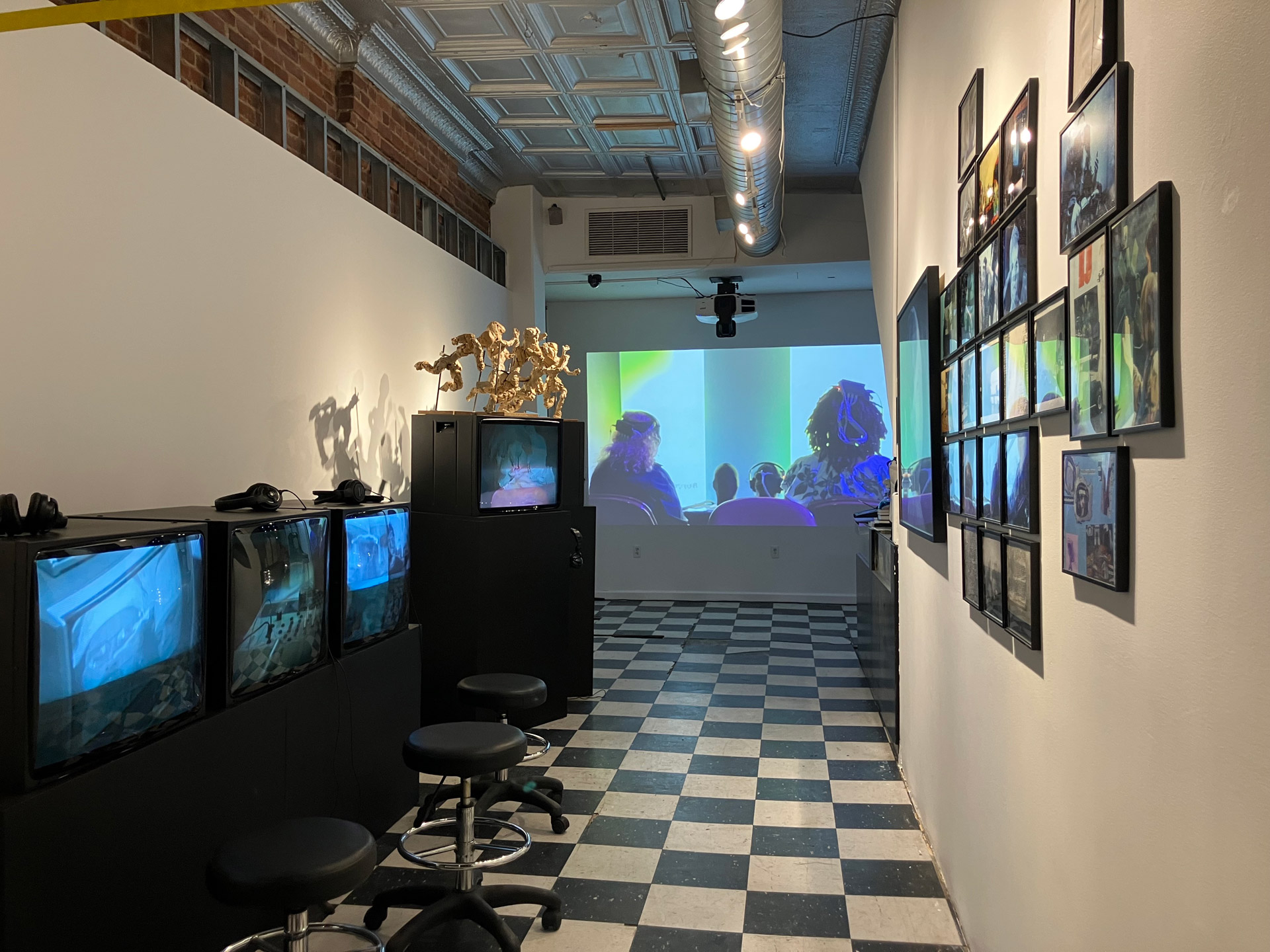
Running through July 26, “Nina Sobell: Proximity Effects” at Various/Artists surveys the artist’s experiments with neurofeedback alongside related forays into porcelain sculpture, transgressive performance-video, and early ‘90s internet interfaces. During its run, viewers will also have the opportunity to witness—and, if they so dare, participate in—live brainwave demonstrations: on June 27 and July 26 at 5 p.m. and 6 p.m., four participants per hour will don EEG headsets in realization of GammaTime (2026), her most recent experiment translating brain activity into strobing geometric color fields and whirring sound.
I chatted with Sobell last month at Various/Artists, near Seward Park, as the show was being installed, tracing the edges of her winding career. This interview has been edited for clarity and flow.
Tyler Maxin: You came to “media” through fine art. We were talking a bit off-mic about some of your early, interactive foam-rubber sculptures from the late ‘60s, early ‘70s. Maybe you could just talk a bit about your initial introduction to electronics and how that fed into your early experiments with video.
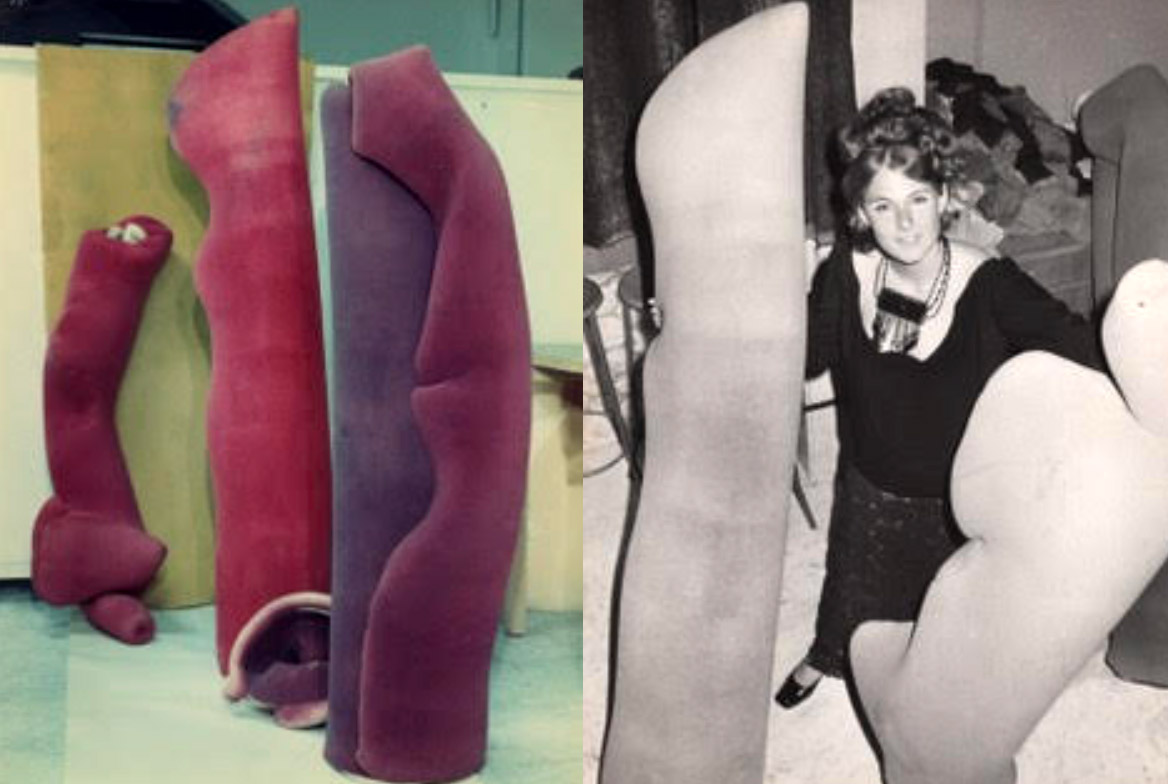
Nina Sobell: I started by using foam rubber as a sculptural medium. I constructed a foam-rubber ceiling in Rome, where I was studying abroad while a student at Tyler School of Fine Art. These were huge, seven-foot tall sculptures that weighed nothing and could be thrown around. I installed one in a double-barrel-vaulted ceiling in Rome and, once it was up, thought, “What about moving it up and down?”
When I returned to Tyler, I found out about Experiments in Art and Technology (EAT). They had a branch at UFP. I began working with an engineer there to put hydraulics into my foam-rubber sculptures to be able to move them remotely. And then, by that time, I was accepted into Cornell and this was put on hold for a moment.
At Cornell, the first thing I made was a foam piece that you could sit in to roll down hills. I had done it at Tyler, but wanted to do it more robustly. This friend that I met at Cornell, Judd Fine, who ended up becoming the chairman of the sculpture department at USC for many years, said, “Why don't we videotape [people rolling down the tubes] in case they fall apart, and we can document the interaction?”
I saw video as a time-based medium. I took a block of time and chunked it out: I videotaped every Tuesday for four weeks, used the fifth Tuesday to edit, and the sixth Tuesday to reconstruct the interaction of the four weeks of time. We created the sixth week from the people who interacted with the works, people who were told about the works through word-of-mouth: they came into the gallery and experienced the four weeks on four monitors. These were the Rockables, the Movable Ceiling, the Cones, and the Balloons. “Disintegration of Objects Within a Sequential Time Period” (1971)—that was the name of the work. So when [the viewers] came out from that time and space, and the physical representation of what they were seeing, they passed by a five-second time-lapse monitor, which brought them into the present time, and then a closed-circuit monitor, which was the end of the show. It was taking time and constructing into “parts.”
TM: What was the reception among your fellow Cornell students at the time?
NS: They were very excited! Because I had put [the sculptures] out anonymously, nobody knew why they were there. The rockable that moved from 180 degrees was outside in the back in this quad space. And then the movable ceiling, the vertical motion, was moved to the A.D. White Museum. Back out in the quad were the four cones, all facing each other, north-east-south-west, with one out to the sunset. And then the following Tuesday was the release of 500 balloons at 6:00 a.m. and 500 balloons at noon. That was the dispersion, the disintegration, and the recreation of those objects within the video structure that I had set up.
TM: Were you aware in this time period of other people making video artwork? Or did it feel like you were making sculpture and interacting with this technology organically?
NS: Organically, but I had met [fellow Cornell student and video artist] Philip Mallory Jones. He was in a different department. I was in the art department, he was in the English department, so we were separated by physical realms, but we had met and got along. We both credit, I'm sure, David Scherer, the librarian at the Art, Architecture and Urban Planning department, who gave us access. He was the crux of it all—the immediate facilitator, the lender of the equipment to Judd, me, Philip.
TM: Where did you first encounter EEG technologies, which became such a core part of your work?
NS: When I was making the Rockables, there was too much torque. Through word-of-mouth, I met a fellow student named Rob Dortignac. We started collaborating on the torque, which he solved by placing lead weights around outside, connected to the external structure. Then he introduced me to his friend, an electronics engineer, and I thought, “I can make the remote-control moveable ceiling!” I brought him into the museum and we came up with a block-and-tackle system.
That was my first encounter with an electronics engineer that I could work with and was inspired by! Then I went out to Los Angeles, to Venice, to visit Judd. John Sturgeon and I went out together. We met William Wegman, John Baldessari, Chris Burden, Paula Sweet. To make a long story short, lo and behold, who comes to visit but Rob Dortignacq, the electronics engineer, and their third friend, a systems engineer at the Phillips Corporation who had developed and performed the first ATM transaction between San Francisco and Los Angeles for Bank of America. His name is Mike Trivich. And, Mike Trivich brought an alpha wave machine with him!
An alpha wave machine is very simple. It would have one electrode on your forehead and one on your ear for ground, and when it gave out a tone, it meant you were emitting “alpha.” Well, I said to him at the time, “What if we were able to see when we were both putting out alpha at the same time.” And he said he had just finished making a Heathkit oscilloscope. We could put one person on the x-axis and one person on the y-axis. When you do that, it forces the parallel lines to make a circular configuration and informs the participants when they’re emitting the same brainwave synchronistically.
Then I thought, “Who wants to sit there and look at a squiggly line?” Let’s bring the person’s ego into it. Let’s have it be a mental and physical portrait of the interaction. So we had two cameras: I had a camera, John Sturgeon had a camera; one on the people and one on the oscilloscope. It was very important for me to teach participants how to control the equipment because this was all new. It was reel-to-reel, and not many people had experience with it. I really wanted to demystify the technology. That was very important for me and still is to this day.
TM: Right, you want people to feel free to bring in their personalities.
NS: In fact, when we do it [at Various/Artists], I'm going to have a guest book for people to sign. I'll introduce people to each other before they participate, and ask them if it's okay to record them making one composite drawing together, one composite symphony together, one composite quartet together.
TM: From your observations, are some people better at the feedback element of EEG? Getting into the rhythm of someone else?
NS: I hesitate to give a status or a comparative, because it is provisional. As far as I’m concerned, it’s giving the public a situation in which they themselves can interpret what they want and how they feel. How they interact together is a precious time in our lives. There’s no testing. After all, science needs to prove; art does not.
I kind of shy away from that naturally. If you're quiet and calm, you will emit alpha or theta. If you're more intense, you'll emit gamma or beta. The only thing is, if you reach gamma-40, a cymbal sound is heard. 40 hz binaural beats and 40 hz gamma lights are part of it all. That’s the only thing to attain or not to attain. If you happen to attain it, you'll get that feedback and if you don't, you won't—and that’s okay.
TM: During your L.A years, you made a number of performance videos—often very funny and immediate, playing with gender and the body. For instance, Hair Comb [1974], an early video in this exhibit, features you and performer Susan Krentzman mimicking each other’s movements, combing your hair. Eventually you put on bald caps and roll around together. Where were these videos coming out of?
NS: When I moved out to Los Angeles, it was after this intense period of object-building and an adherence to my thesis. I was the first in the art department to do my thesis in video, which was a real struggle to accomplish within the administration. Coming out of it, I just kind of cocooned into myself in relation to the video screen.
As for Hair Comb, I wasn’t sure of my own sexuality at that time. I had these motorcycle sounds that were going on naturally outside my door. Susan and I were miming each other, and I was, in a sense, inviting her to participate with me in creating the video and implying sexuality. After I combed my hair, I put Vaseline on my face, rolled over the floor, and gathered a beard from cut hair. Then we went up to each other and said, “One, two, one, two,” which started to sound like “Want to? Want to?” It was an overture! I don’t think I’ve ever explained that to anybody. We were doing it in the mirror to deflect the direct contact and to make the video become a third party, a witness to this overture.
TM: Were you screening these videos publicly?
NS: Yes. Chicken on Foot [1974] was a favorite of John Baldessari, whose class I showed my videos to. He published the magazine Straight Turkey with his CalArts students, one of which said that Hair Comb was their all-time favorite video in one of its articles.
But sometimes they were rejected! Hey! Baby Chicky!! [1978] was censored. Which was ridiculous, because I only meant it playfully. I didn’t mean it sexually at all. I mean, it was very sexual, but it was obviously play.
TM: Could you describe Hey! Baby Chicky!! for the viewers at home?
NS: I unwrap the chicken, I go down on the chicken, and then I dance with the chicken. I hold it up to my breasts and it dances. It’s set to “In the Midnight Hour,” and then it changes to “Baby, You’re Mine.” I cradle the baby chicken and I put it in my purse and walk off. I meant it playfully, so it was a surprise to be censored.

TM: I wanted to talk about the ParkBench project. When did you first become aware of the Internet and when did it occur to you as a site of artistic production?
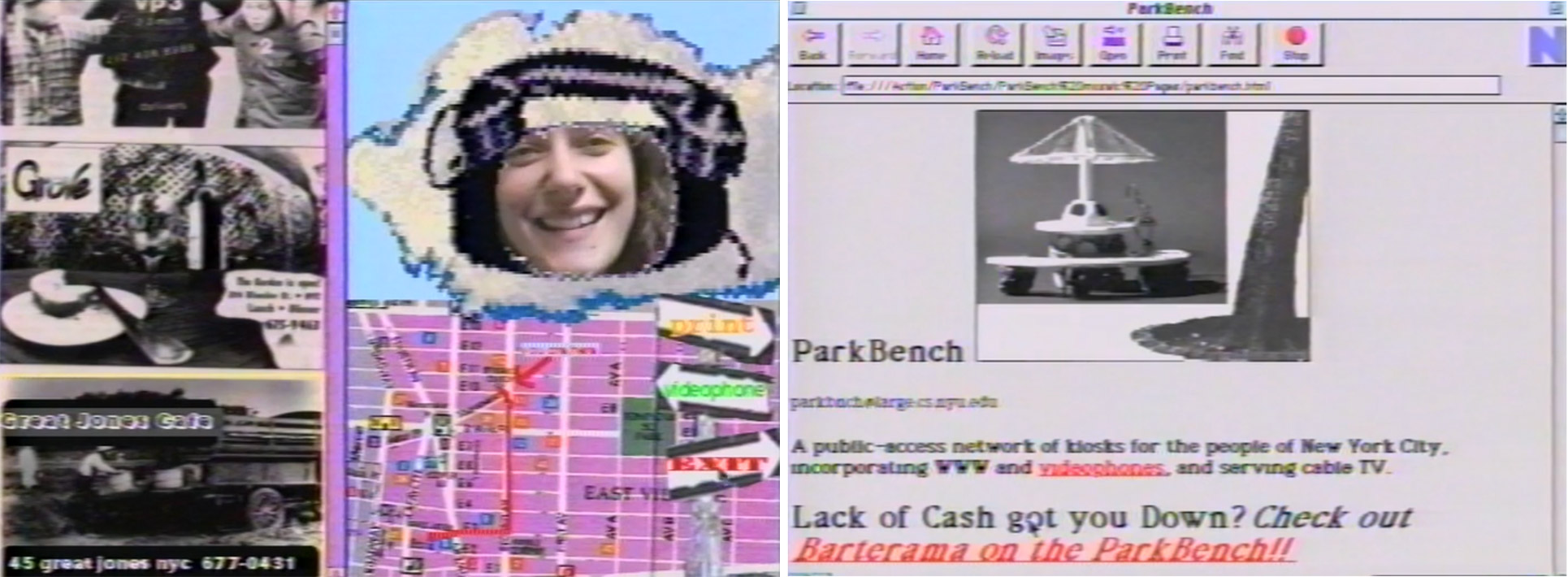
NS: I first was introduced to the Internet by a neighbor in Venice who was working for DARPA. It sat with me and just percolated with me. When I got to New York, [Emily Hartzell and I] proposed to New York University creating kiosks using interactive cameras and closed-circuit cameras. I thought of creating ParkBench to create kiosks in subways to introduce people to the Internet, teach them how to use email, and be a safe space in cyberspace.
We had an interface called City Safari. It gave access to different parts of the city, with a shared whiteboard, and access to restaurants: you could scroll through different numbers, it would stop at different restaurants, and you could make a reservation.
I thought of this because I wanted to institute a program for alternative school kids to be positioned at these kiosks to teach the public how to use the internet. For many people, maybe coming off the subway as they were going home was the only interim time they had in a day to learn how to use e-mail.
TM: How many web kiosks were set up and how long did they run?
NS: There weren’t, because we no sooner got that in motion that I noticed, at NYU’s Center for Advanced Technology where we were invited to be artists-in-residence, this remote-controlled camera. I was able to use it to do the first live web performances between different parts of the world. I took a bare armature and when they clicked on the right side of the monitor, I put clay on the right side of the monitor; when they clicked on the bottom, I put clay on the bottom. It was an interactive sculpture! Ken Goldberg, who teaches at UC Berkeley, called it the first remote-controlled sculpture. [Emily Hartzell and I] developed other things. We did the first internet cooking show with Naoko Tanese, a microbiologist. We did 30 different performances with her!
TM: Were there people in the early commercial internet that were interested in what you were doing?
NS: Yes! In fact, Emily developed “Barterama,” which was for trading services for free on the web. It was this whole interface and it actually worked. People coming in and trading their services for lithographs or cooking. eBay contacted us! eBay ate it up. They ate it up and spit it out.
TM: In this exhibition, how will ParkBench be displayed?
NS: Scott [Kiernan] and a friend of his are going to reconstruct a monitor to make it interactive. We’ll have City Safari be the interface that bridges the gap. I haven’t told Emily yet, but I’m excited to tell her!
The séances will be in it! The séances were another evolution after the ParkBench interfaces. We—Emily Hartzell, Sonya Allin, Jesse Gilbert, Naoko Tanese; they were really the heart of ParkBench, along with me—were invited in 1998 to take ParkBench to the Walter Philips Gallery at the Banff Centre in Alberta, Canada, to do a show. Sonya devised an app called “Dadadodo”: you would enter a story without words, and after three stories, it collated them into one continuous sentence.
The following week, representing each person by their IP address and with a yellow dot, we formed a virtual space between New York and Banff. We connected brainwave output between New York and Banff. We gave “meditations” out every five minutes. People on the web or in the gallery at Banff could write in the answers to these meditations, which were then read live to the audience in the gallery. These are still active and visible on the web! With server push animation, because we didn’t subscribe to any third-party software. We did it through programming!
TM: Throughout the exhibition, you’ll do a handful of GammaTime performances. These are live brainwave performances with a group of four participants. Could you talk about that project?
NS: I had been developing, for eight years, between 2000 and 2008, something called BrainChat, the first internet communication tool between brainwaves. I stopped developing BrainChat for a number of reasons. Lo and behold, Mike Trivich surfaces again in 2023, after all these years, and sends me an article about how 40hz gamma light and 40hz binaural beats stimulate your cerebrospinal fluid that goes up to your brain to wash it of the plaque that causes Alzheimer’s and dementia. It inspires and stimulates higher cognition, creativity, and concentration.
I thought, “Is there anything out there that lets a person know when they themselves are emitting 40hz gamma?” Mike didn’t think so, and I said, “Well, Mike, here we go again!” I was totally inspired and contacted my friends Victoria Keddie and Scott Kiernan. I asked them if they knew of someone who would work with me on developing an EEG component. They both said, hands down, Ed Bear is your person. Ed is an engineer extraordinaire: a magician, musician, artist, programmer, a one-stop shop.
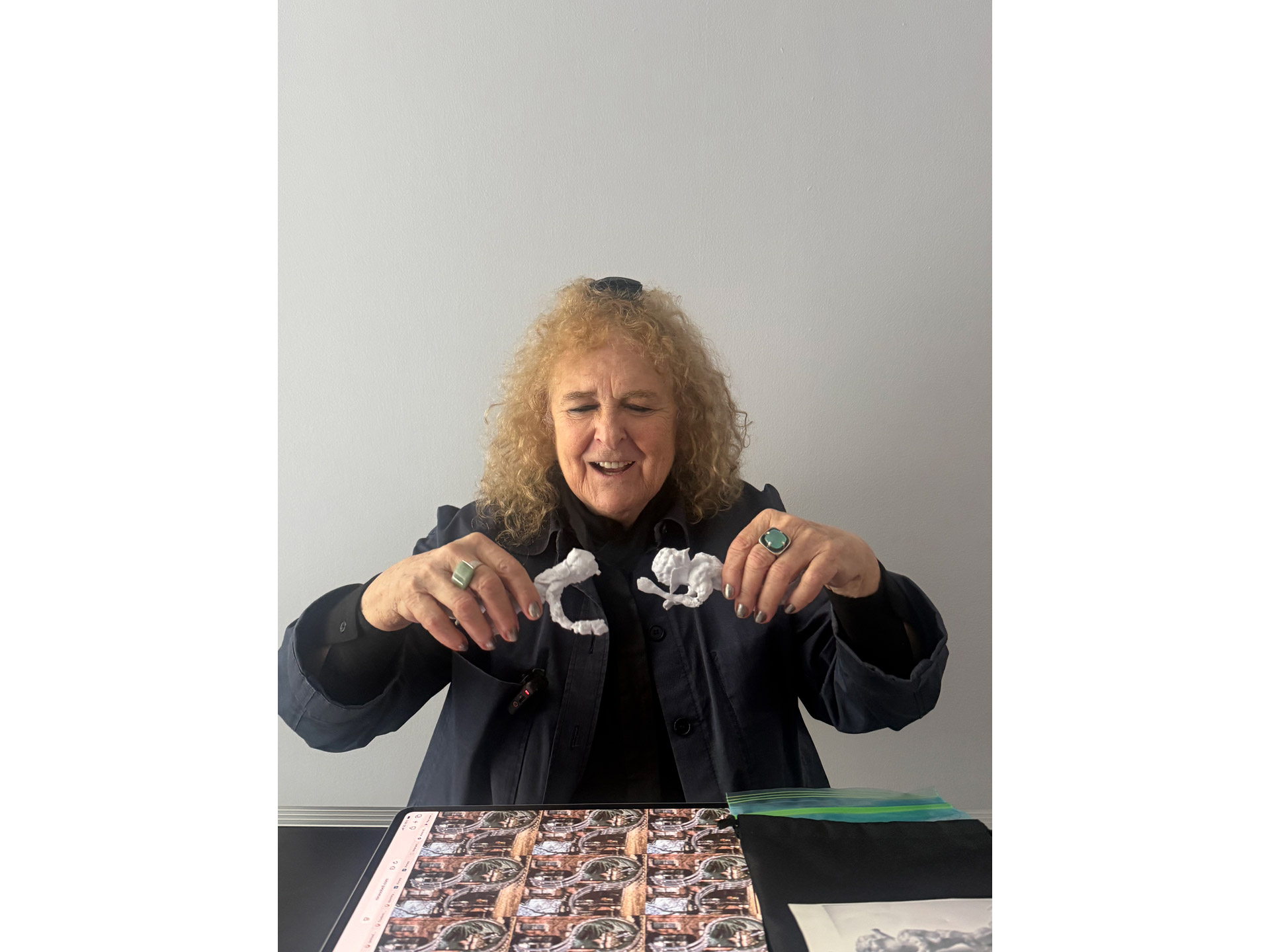
It’s been magical. I love every second of GammaTime, because it is always evolving. Now we have the likes of these creatures. I figured, people need something to hold, to connect themselves to the brain images on screen. Each participant will get a sculpture in a numbered bag. Although nothing happens on screen [when you interact with them]; only your brainwaves affect the speed and the color of yours on the projection. By holding them, it’s meant to form a perceptual loop between physical and mental actions.
Nina Sobell | Proximity Effects is on view through July 26 at Various/Artists.