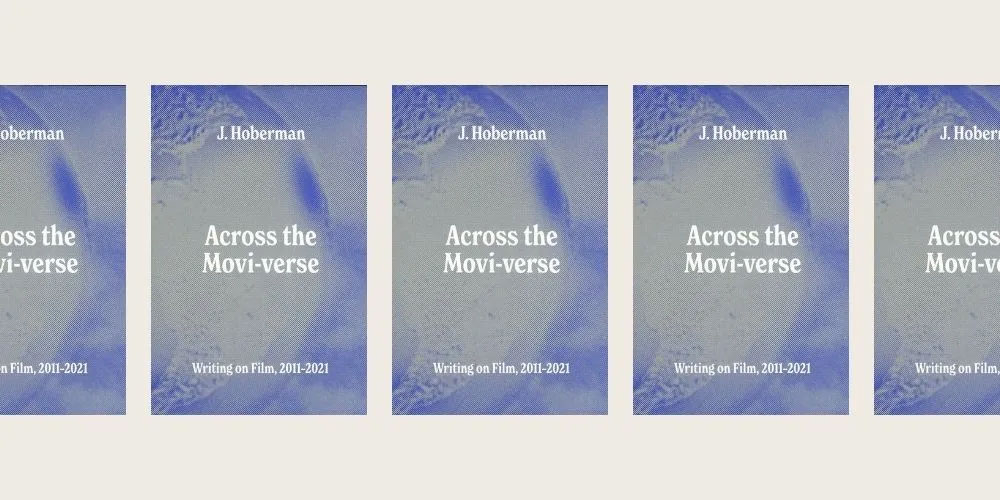
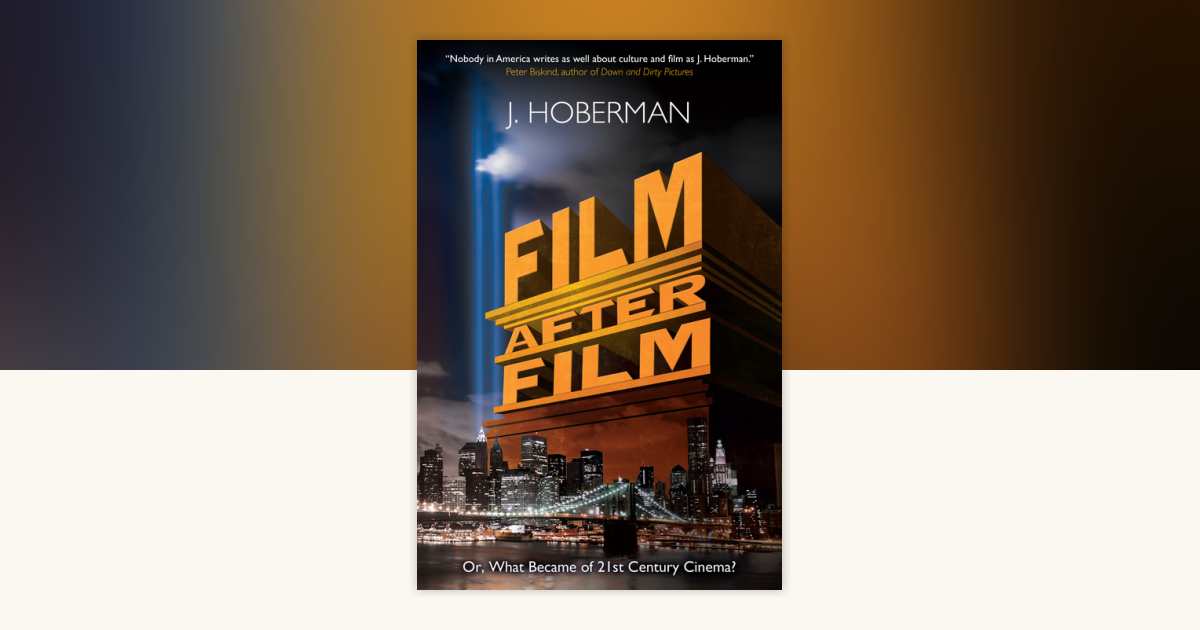
“After My De-Voice,” the introduction of J. Hoberman’s new collection of film criticism Across the Movi-Verse (2026), takes us back to the first week of 2012, when the venerable alternative weekly The Village Voice, well into its terminal decline, laid off their senior film critic (and union steward). A regular contributor since 1977, and full-time staffer since the 1980s, Hoberman was thrust into the brave new world of freelance, balancing the necessity of making a living with the abiding interests he had been free to pursue, with greater or lesser interference, for 30-odd years.
Hoberman had a beat at the Voice—he began covering the downtown avant-garde film scene, and returned, as much as the release cycle would allow, to related, crypto-autobiographical subjects that included Cold War politics, postwar Pop, subculture and counterculture, mass communication, and Jewish-American life and politics—and a style, based on a time-consuming, research-intensive historical approach which is wildly cost-inefficient for a writer who doesn’t have health insurance through work.
His new book, published by The Film Desk, begins with several pieces, many originally published in Film Comment in the middle of the Obama years, that revisit the beginnings of his foundations as a critic and the beginnings of his time at the Voice. It also collects book reviews, retrospectives, obituaries, and a very tightly curated selection of essays about new releases, taking the reader through Donald Trump’s first election, the Covid-19 pandemic (via a piece for the Jewish magazine Tablet on plague imagery, xenophobia, and 1922’s Nosferatu), and the emergence of second-screen content.
I Zoomed with Hoberman last week to talk about his career and what he’s watching these days, two topics that, as every freelance film critic knows, are actually the same.
Mark Asch: The introduction, which is the most recent piece of writing in the book, is about the difference between being staff and freelance. I remember you saying once, in an interview or talk, something like, “Some weeks it’s a struggle to have an opinion.” Not everyone is vocationally reactive, like Pauline Kael. Is that feeling something you remember?
J. Hoberman: I do remember saying something like that. What I was getting at was that, even though I had a tremendous amount of freedom at the Voice, the available films are not always equally interesting. And, I had an obligation as the senior critic or lead critic to cover things which I might not really have wanted to.
I think I also said that after I lost my job, the best thing about it was that I would never have to look at another Spider-Man film again.
MA: That’s quite sad coming from you, because you’re a contemporary of Peter Parker, right? You’re both from Queens. You’re about the same age.
JH: There’s no doubt that Marvel comics were a remarkable development in the mid-60s when they appeared. I was, as a Queens kid, totally with the idea of a superhero from Forest Hills, and did enjoy the attitude [of Spider-Man], but I was more taken with [Steve] Ditko’s other comic, Doctor Strange. I got more interested in underground comics once they appeared, but I followed [Jack] Kirby.
MA: In the piece in the book about Manny Farber, from 2010, you wrote, “The 750-word weekly film review is a form of journalism. Gathered together, short pieces written over a period of months and years become a chronicle of an individual sensibility.” In 2012, you also characterize Siegfried Kracauer as “a nonacademic intellectual” who had to do a lot of piecework, and say that, despite being friends with [Walter] Benjamin and [Theodor] Adorno, that his work was “essentially journalistic.” These pieces were written immediately before and after the end of your time at the Voice, and they echo what you say in the intro about you seeing your work as a form of journalism. Was that true consistently for the Voice decades?
JH: It’s not like I had a job anywhere, prior to the Voice. I had written some things for, you know, National Screw, Monster Times, Crawdaddy, the New York Ace, the Berkeley Barb. A fairly motley bunch of publications. But the Voice offered me a regular spot, which I turned into a beat.
[Arts editor] Richard Goldstein had done a film supplement and had wanted an overview of avant-garde film. So I did that. He liked me. Jonas [Mekas] had left in ‘74, so he had been gone for like three years, but [Goldstein] understood historically that the Voice had covered avant-garde film. He suggested that I do that.
Initially, I was able to generate my own assignments. The Whitney had film shows, MoMA had Cineprobes, there was the precursor to Anthology, the Film Makers’ Cinematheque, the Millennium, a bunch of venues where I could cover things. So I would suggest that, assign myself this, maybe every other week, and they gave me more space because I never missed a deadline. I delivered clean copy. I was a very reliable writer; I was not a temperament. So, I was able to expand my purview. And there were things which neither [Andrew] Sarris nor Tom Allen had the slightest bit of interest in covering—sometimes to my utter amazement. I was so excited when Celine and Julie Go Boating [1974] got a commercial opening and these guys didn't care.
MA: Something in your Eraserhead [1977] and Killer of Sheep [1978] piece that gives me a real pang of recognition is about the expectation that you're the young person who is ostensibly on the cutting edge, but you're in the wrong scene to actually flag something new as major. [As Hoberman wrote in one of the first-person Film Comment pieces republished in the book, he led his inaugural Village Voice column with Jon Jost’s Angel City, with a few words on Eraserhead as the second feature; he likewise writes of his regrets in using his entire word count on a Miklós Janscó retrospective the week that the Whitney played Killer of Sheep.] Did it feel like things moved slower, that there was more time to consider work across multiple weeks or issues, to observe a phenomenon as it emerged? Or was it the nature of that early, marginal beat that things would come and go very fast?
JH: I adjusted to the rhythm of a weekly. The thing that was the biggest breakthrough for me was when I did an entire feature on Super-8 punk films; that unfolded over a couple of months, looking at these films, talking to filmmakers.
I had another thing like that with [Hans-Jurgen] Syberberg’s Hitler, because I had seen a very early screening of that, on hard chairs at the Goethe House. I was hyper-prepared when it was about to open on a larger market. Jeanne Dielman [1975] is another example. I’d actually written about it two or three times before, but when it got a run, I knew that I could do something with that.
MA: I’ll get out of the ‘70s in a second, but it is kind of amazing to me that your first two Voice columns as a regular contributor were Eraserhead and News from Home [1976].
JH: Yeah! The thing is, Eraserhead was totally unexpected. I had never heard of David Lynch. I just went to the Cinema Village on a Friday or Saturday night. It was almost totally empty, there were like 10 people in the audience. But News From Home I had heard about, at least. Jackie Raynal showed me that in her apartment. That was something that I was psyched to do. In my allegiance to the preexisting avant-garde I put this Brakhage film first, The Governor [1977], which is not uninteresting… I didn’t lead with News From Home, which, journalistically, would have been much more important.
MA: News from Home, the 52nd greatest film of all time, a film on both our Sight & Sound ballots. What was Akerman’s stature at that point?
JH: She’d been in New York and people knew her. I knew her cinematographer, Babette Mangolte. There was this colossal word of mouth coming from some circles in Europe about Jeanne Dielman, starting in ‘75. I was completely knocked out by News from Home; if I had been more experienced, I would have known how to position it. It’s a New York film, it should have been a huge deal in the Village Voice. But Stan Brakhage was somebody I covered a lot in those early days and was still the most complicated and in some ways radical figure in American avant-garde film…
MA: In book reviews republished in Across the Movi-Verse, you talk about Farber’s and Kracauer’s and Buñuel’s and Godard’s teaching and speaking and editing and distribution gigs. There’s an awareness that even geniuses still have to work, and how the need for money shapes the output and ambition of even visionary artists.
It's interesting to think about a critic, on a journalistic beat, who can still put together a substantial body of work despite the contingencies of having to write for money. So, I guess I should ask you about how you put this book together—it has thematic chapters and a fairly satisfying flow, despite being a collection of journalistic piecework. You are still a reasonably prolific freelancer, but you were pretty selective about what ended up in the book, right?
JH: I tinkered with it quite a bit. It comes out of being very protective of these pieces. I was told by my original publisher, Temple University Press, which put out two anthologies [of my criticism], that these anthologies just didn’t work anymore. But I had done all this stuff in the decade after leaving the Voice that I wanted to put between covers somehow. Just having [them] out there in cyberspace didn’t seem real to me. I suggested it to Jake Perlin [of The Film Desk] and I was glad that they went for it.
But if you ask how I did it [i.e., created a body of work as a freelancer], basically, I, again, lucked into this sinecure which, although it was brief, was substantial. When Dave Kehr left [The New York] Times, they, almost with an air of desperation, asked me, would I like his job [as the weekly DVD columnist]. Are you kidding? I mean, this was, in a way, the easiest job I ever had, and it was like $1,000 a column. That was the bridge for me between the Voice and Social Security.
You know, I don’t think I have to elaborate on the misery of being—it’s one thing to be a freelance writer when you’re 25 or 30. It’s another thing when you’re in your 50s, late 50s, to be doing that, you know? I was able to sell pieces, I was able, for a while, to sell things to Harper’s, and so on; the money was good, but it’s not like you can live on that.
MA: It’s funny, if you said, it’s one thing to freelance when you’re 25, it’s another thing to freelance when you’re in your 50s to a young person who’s freelancing, they’d say, yeah: it’s worse when you’re younger, because you know you have to do it for 40 more years instead of 10.
JH: [Laughs] If that’s what it is, although, you know—
MA: Yeah, I know, there’s always law school. But it also does change. It’s gotten worse for all of us since 2012. Has it gotten worse for you, in the time you’ve been freelancing?
JH: Sure, I think it’s bad for everybody. I used to enjoy teaching what I considered practical film criticism. I taught it three times, and some seminars at other places, but I taught it intermittently at NYU. The last time I taught it was 2008, and that’s when I realized: I was teaching this as if, and I was hoping that, my students would be able to go out and get jobs. That’s what I thought it was, the first two times I taught it. By 2008, there were some people in the class who were able to make careers, but the field had severely contracted by then, so I didn’t want to teach it anymore. I didn't want to teach it as a hypothetical thing, I wanted it to be practical.
MA: In terms of the curation of this book, it’s necessarily a portrait of the times from about 2012 up to about midway through the Biden administration. Were you thinking about putting in pieces that you felt would have the most retrospective historical value, or that you were proudest of, or that made a portrait of your interests?
JH: All of those, but the heart of the book, the things that I really wanted in there before anything else, were a series of pieces that I did for Gavin Smith at Film Comment. There were maybe half a dozen of those in there. And some longer pieces that I did for ArtForum, mainly for Don McMahon. And, as I say in the book, these were things that weren’t pegged. I just got interested in something, and these editors were generous enough to give me space, and also with a minimum of interference. So I was living off my capital, in a way, having been a quasi-famous film critic.
Then there were other things that I did that I was pleased with and that I wanted to include. Although, I’m not sure what the staying value of 12 Years a Slave [2013] is now. Or No. I don’t know whether those films seem as important now as they did then, but maybe that will change. I really liked that piece about The Godfather, which I had written for Harper’s and they turned it down. I was very grateful to Tablet for running it—I enjoyed writing for them, but then the political gulf was too wide for me to bridge.
MA: So, I did have a question about that. You wrote for Tablet, you did good work for them. You haven’t written anything new for them in the last three years. I was curious how intentional that was.
JH: I had always had deep disagreements with what I perceived as their editorial stance. But if I wanted to write about Diane Arbus, I could do that; if I wanted to write about Todd Haynes, I could do that. I did do some things that were critical. There was a documentary, The Settlers [2017], which I wrote about, and I didn’t get any pushback. I think they liked having me there, some other voice. But then after October 7, they wanted me to write something, be involved in something about Carlos the Jackal, and I wanted to see how things developed. Their politics just got more and more extreme.
Listen, I never grew up believing in “America, right or wrong,” and I certainly did not believe in Israel, let alone Benjamin Netanyahu, right or wrong. I just could not be associated with that. Too much of a Voice writer, in the end.
MA: Based on the stuff that's being published on there now, you got out at the right time.
JH: I dread thinking what they're going to accuse NAZA of—being created by AI?
MA: Something I found myself thinking a lot about when reading this book is what constitutes the “marginal.” In your piece about Eraserhead and Killer of Sheep you write that “new ideas in motion pictures typically arrive from the so-called margins.” This is a theme of the book as it relates to your professional history and many of your abiding interests, so it does lead me to ask about your current cultural consumption. Some of the more recent pieces in the book are about what you call “vernacular video,” after Peter Snowdon. You’re clearly interested in work that metabolizes an instant archive being created on TikTok and Instagram Reels and YouTube—is that something you feel like you have to work backwards into when you’re dealing with work that engages with it? Does it feel natural to engage with that stuff?
JH: I teach one seminar a year at Columbia and for the past six or seven years, the subject has been documentary activism. There’s also a book I’m working on for Fireflies on this Chinese documentary, Disorder, which came out in 2009. Documentary is much more what I think about, these days. I really do think there's a documentary avant-garde. In China, there definitely was, although it ended in 2011—right when I lost my job at the Voice, Xi came to power and just terminated this whole unofficial culture. It’s really kind of shocking.
The two things that are in the book, Shooting and Storming of the U.S. Capitol [2021] by Jayden X, and the French documentary Monopoly of Violence [2020], had a certain sense of immediacy that I wanted. That’s where a lot of my thinking is, in terms of what’s happening or what’s interesting to me in film right now. This is something the New York Film Festival has been good on for the past few years, in the Currents section: avant-garde documentaries. Obviously I don’t like everything that I see there, but I like the tendency. These are things which accept the world that we’re dealing with now.
Once in a while, there’s something that I like. Coyote vs. Acme, or I don’t know if one could consider the latest Alex Cox film to be a Hollywood movie. There’s a few big-budget things, Sinners [2025], but basically I don’t have much interest in that. The same thing is true to a large degree of foreign art films. There were some that I saw in the New York Film Festival that I like, but they're not as interesting to me as documentaries that are trying to map out cyberspace or whatever, this new arena. I wrote about the digital turn years ago, although the book came out in 2011, and I still think there was something that profoundly changed in the nature of motion pictures. I guess these vernacular videos are “marginal,” although I have a student who told me he was doing his PhD thesis on vernacular video. So, I guess it’s not that marginal at this point.
Probably I’m crankier in a way. I had this conversation last night with my wife — I amassed this wonderful DVD collection, thanks to the New York Times. And so I put on something like Ride the Pink Horse [1947], and I get so much more out of this ancient Hollywood movie than anything that they produce now. And I’m not saying I think that it’s better, it’s just where my head is at.
In that Eraserhead/Killer of Sheep piece from Film Comment, you ask, rhetorically, “Who’s to say that comparably original works are not now being produced at the margins? But in order to find them one would have to hack through the jungle of student films, amateur movies, fan sites, and, as proposed by Howard Hampton in this journal's July/August issue, YouTube—or worse.” That “or worse” we now know as Twitch streams, Discord servers, online fandoms. For myself and my colleagues, I think we’d like to believe that it’s possible to write about contemporary mass communication without our attention being totally captured by it, but I’m not sure it’s true.
JH: Look, we're all products of our particular moment in time. Manny Farber said this amazing thing to Jonathan Rosenbaum: he said, in essence, that he was like a young person during the Depression, and he never got over it.
I could never keep up with stuff. I still get The Nation—although I find I like it much less now that it's a monthly, I liked it much better when it was every other week—and somebody’s writing about some independent filmmaker from the West coast who made a communist crime movie. I’m reading the thing and I’m saying, “Why don’t I know about this?” I don’t know about it because I’m not functioning on the edge of these things. I’m much more of a termite, following my own particular path.
That was both the curse and the blessing of being a weekly critic. I was obligated to know about everything. And I prided myself on it. That’s how I felt I could keep my job.
MA: To continue thinking about the new or marginal, in your quickly written response to the first time Trump was elected in 2016, you wrote that “the candidate most adroit in deploying new communications technology has pretty much always prevailed… Donald Trump, a long established television personality, was defined by Twitter. The next new media will perhaps be some form of virtual reality.” I think, 10 years on, we can say, virtual reality, AI slop, close enough, we count that. The major development that immediately follows the historical period covered in this book is generative AI. I’m curious if that’s something you would ever write about, or if there's anything you’ve seen that has used it that you feel is at all valuable.
JH: I had a back-and-forth with Radu Jude in Film Comment which was largely about AI. I found Dracula [2025] fascinating and horrible. It really was the most disturbing film I had seen in a while, but I think this guy is great. This even goes back further into the digital turn and CGI: how can you believe what you’ve seen? The truth claim that cinema once had, and photography, no matter how complicated—it’s been completely overthrown. That is of interest to me.
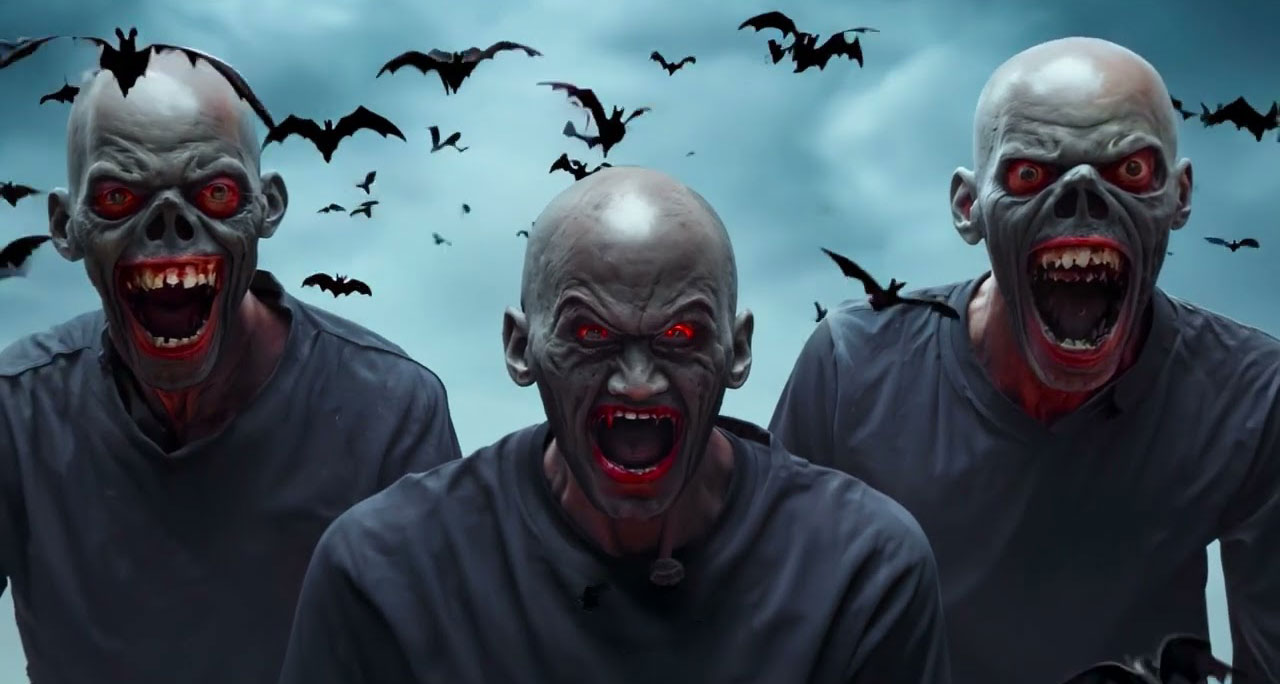
I did go to see that film in Tribeca, the so-called first AI feature. To me, it looked like a video game. I was more curious about the research. I would like to know, well, what did you use? What did you tell it? Where did it find? I think the guy made it in two weeks. It certainly works as a film. It seems to have dropped without a trace, even though they were hyping it, so it didn’t disturb people on the level of Jude’s Dracula, which I think really made people crazy.
I mentioned this to Jude, that it occurred to me that the people who love Pauline Kael can have her back: they can ask AI to write a review of whatever they want in her style and it will do it. If that’s what you want, you can have that. So as an experiment, I asked AI to write a review in my style and it was terrible. Didn’t get it at all. I was really disappointed.
MA: When I interviewed you for The Film Stage last year we talked a little bit about Sinners, which was the main takeaway from that interview for a lot of people who read it. So now I imagine the voices of my friends in the back of my head saying, “Ask him if he’s seen Primetime,” “Ask him if he’s seen Chronovisor,” “Ask him if he’s seen WTO/99.” Would you ever Substack?
JH: People ask me that—it’s too much. I feel like it’s worse than working for a magazine. Jonathan Rosenbaum gets something up every frigging day, but I couldn’t. There’s only been two things that I ever wrote directly online and they’re both in the book.
MA: I will do one more “Ask him if he’s seen…” Because you write, in your 2013 piece about seeing movies under the influence of marijuana, that “Godard’s 1967 Two or Three Things I Know About Her […] required no pharmaceutical enhancement to be my most powerful cinematic experience since my mother took me, age three, to see The Greatest Show on Earth.” I had not known that you shared that formative moviegoing experience with Steven Spielberg.
JH: I know, it’s bizarre.
MA: So what did you think of The Fablemans?
Loathed it. Actually, “loathed” is too strong. I just thought it was like The Feeblemans. Even the title is so stupid—it reminds me, in Paris there’s a chain of bagel places called Bagelstein. I mean, give me a break, man, like call it “Horowitz’s Bagels.” Michelle Williams is an actress who I really like and was treated horribly. I don’t like Spielberg as a rule, but I don’t hate everything with the same passion. I couldn’t stand that.
The thing is, I wish people would tell me about things. I’m an old guy, you know? The best thing about teaching, from my perspective, is that you hang out with younger people. The only reason I saw Joker [2019] was because I was doing my book tour for the Reagan ‘80s book, and enough people said “What’d you think about it?” to me that I went out to see it and was very glad that people directed me to it. There was the thing that people were talking about, Eddington [2025], which didn’t really work for me—kind of a plague on both houses critique—but I was glad that I saw it.
MA: This interview is running concurrently with the films maudit screenings of Southland Tales and Peeping Tom at Museum of the Moving Image. I almost asked if it was too late to swap in Digger, but your piece in the book, published in 2021, asks, in an era of social media, whether there’s still any such thing as a film maudit, inasmuch as any failed film has its champions amid the infinitude of digital film culture and it can feel like there’s no narrative to counter.
All this leads me to ask whether cinema itself is also more marginal. There are, in the book, references to a number of pieces about the death of cinephilia. You allude to the peak of theatrical moviegoing in 1946; to Sontag in the mid-70s mourning the ‘60s golden age of filmgoing… All of these deaths of cinema, at a certain point, it just makes me think that I used to be younger. The New York Film Festival isn’t a matter of life and death for me now, like it was in my 20s, but also it’s harder to get tickets these days.
JH: It is interesting how successful it is. I see that as a good thing. I only had one bad day when I was there, with Fred Camper’s Suicide Note followed by the Carlos Reygadas film. That was enough to send me home depressed.
Death of cinema pieces—for me, the key piece was written by Rudolf Arnheim in 1931 or ‘32, when all these people were mourning the death of cinema because sound had come in, and he, in essence, says, you’re right. It’s something else now; accept it.
I think that that’s the truth. I may not like what movies have become. I do believe that, in some senses, movies as a mass cultural form have been overwhelmed by video games. People who go to Lincoln Center—it’s a minority taste. It’s not as rarefied as opera, but it’s closer to that than to big concerts.
One can accept that. The problem is that everybody has this narcissistic sense of what they think is really important. You have to give that up when you get to a certain age, because you can’t see everything, you can’t do everything. There’s books that you read when you were young that you might even want to read again. (If you’re still able to read, which not everybody is.) You just have to dig in and defend or explicate what seems to be worth defending. The audience is so wide at this point that there are bound to be people who are on the same wavelength, but it’s not necessarily going to get you on — I don’t know, what do people want to be on? Do they want to be on NPR? What is the big fantasy that people have, in terms of reaching an audience?
It’s maybe unfair for me to say that, because I had this incredible lucky break where I had a readership, not because of me so much, but because of the journal for which I worked — and those things don't exist anymore. And that is tragic. But, you know, there's no more network TV, either.
See Also