Earlier this April, the Arsenal Filminstitut opened its new theater in Berlin, having spent a little over a year without a physical venue. To commemorate the opening, Arsenal’s artistic director Stefanie Schulte Strathaus published an article considering the role that cultural institutes can play in politically-polarized times. “The question,” she writes, “of whether cinema is a place of intervention or merely representation has continued to follow the Arsenal to this very day. It arises again and again under changing conditions—in the face of global crises, social polarization, and growing expectations for cultural institutions to take a stand. Cinema remains a place of negotiation, not a neutral space, but a social situation in which the archive, the present, and the public sphere come together.” These comments acquire particular meaning in Germany, where the institutional backlash against Palestinian activism has been among the most aggressive in Europe. This question of what the archive can or ought to be is one which has driven Strathaus’s scholarly and archival work for decades, motivating her longstanding collaborations with archives internationally and particularly within the Third World.
Strathaus, who stands on the Executive Committee of the International Federation of Film Archives (FIAF) and previously served for two decades on the selection committee for the Berlinale Forum, will be at BAMPFA this week to deliver the annual Mosse Lecture. Additionally, she brings to Berkeley a week’s worth of programming showcasing the range of Arsenal’s work, from its origins alongside the radical student movement in the 1960s—origins, one may note, it shares with BAMPFA—to its diverse restoration work and collaborations with film archives worldwide. Thursday evening, she shares with us two restorations completed by the Cimatheque – Alternative Film Centre in Cairo, alongside a series of home movies depicting Egyptian city life in the ‘70s.
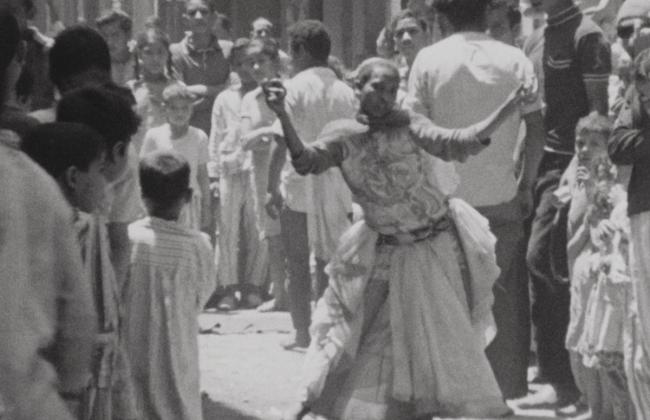
Opening Thursday’s program is Sad Song of Touha (1972), a documentary about street performers in Cairo directed by Atteyat Al-Abnoudy, the first Egyptian woman documentarian. Al-Abnoudy, who came of age as a filmmaker in the post-Nasser period and amidst the radicalism of liberation movements throughout the Middle East, considered her work as a rejoinder to bourgeois, establishment cinema in Egypt. Of this film, she remarked, “the poor people and the working class are not on the screen, when they have the right to be.” Accompanying her film is the restoration of the Sudanese filmmaker Hussein Shariffe’s The Dislocation of Amber (1975), a lyrical survey of the port city of Suakin. One of the striking things this pairing brings out is how both filmmakers rework the techniques traditionally associated with European avant-garde filmmakers in the 1920s such as Jean Vigo, Henri Storck, Dziga Vertov, Alberto Cavalcanti, and Joris Ivens, who similarly grappled with the problem of how to present the uneven effects of commercial capitalism on social life. As for Shariffe’s film, comparing this new version with the prior extant copy available online serves as a reminder of just how transformative a great restoration can be and the crucial role archives play.
Collaborations with Cairo’s Cinematheque screens Thursday at BAMPFA, with an introduction by Stefanie Schulte Strathaus, as part of a series she has programmed, Modes of Archivism.