Fascism is notoriously difficult to define in precise terms. Does every dictator intent on glorifying war and persecuting the opposition qualify, or are other components necessary? To answer this, it might be helpful to look at its origins, specifically the first time the nascent ideology was put into practice: the occupation of Fiume by the Italian poet Gabriele D’Annunzio in 1919. One of the most outlandish sieges in modern history was also one of the most impactful, as many of the tactics D’Annunzio implemented ended up inspiring his friend Benito Mussolini and becoming trademarks of fascist regimes.
The bizarre saga started at the end of World War I, when both the Kingdoms of Italy and that of the Serbs, Croats, and Slovenes (later Yugoslavia) claimed Fiume, a city populated by Italians and South Slavs. Although both kingdoms eventually agreed to make Fiume an independent city-state, D’Annunzio, still riding high from his recent transformation from famed poet to war hero (as well as cocaine), gathered troops and annexed the city on Italy’s behalf. In the many months that followed, Italy tried to get D’Annunzio to come to his senses, but he and his zealots defiantly declared war on Italy, adopting the slogan, “Fiume o morte!” (Fiume or death!) Eventually, their death wish was granted when the Italian army was forced to fight D’Annunzio’s in a five-day battle to end the siege.
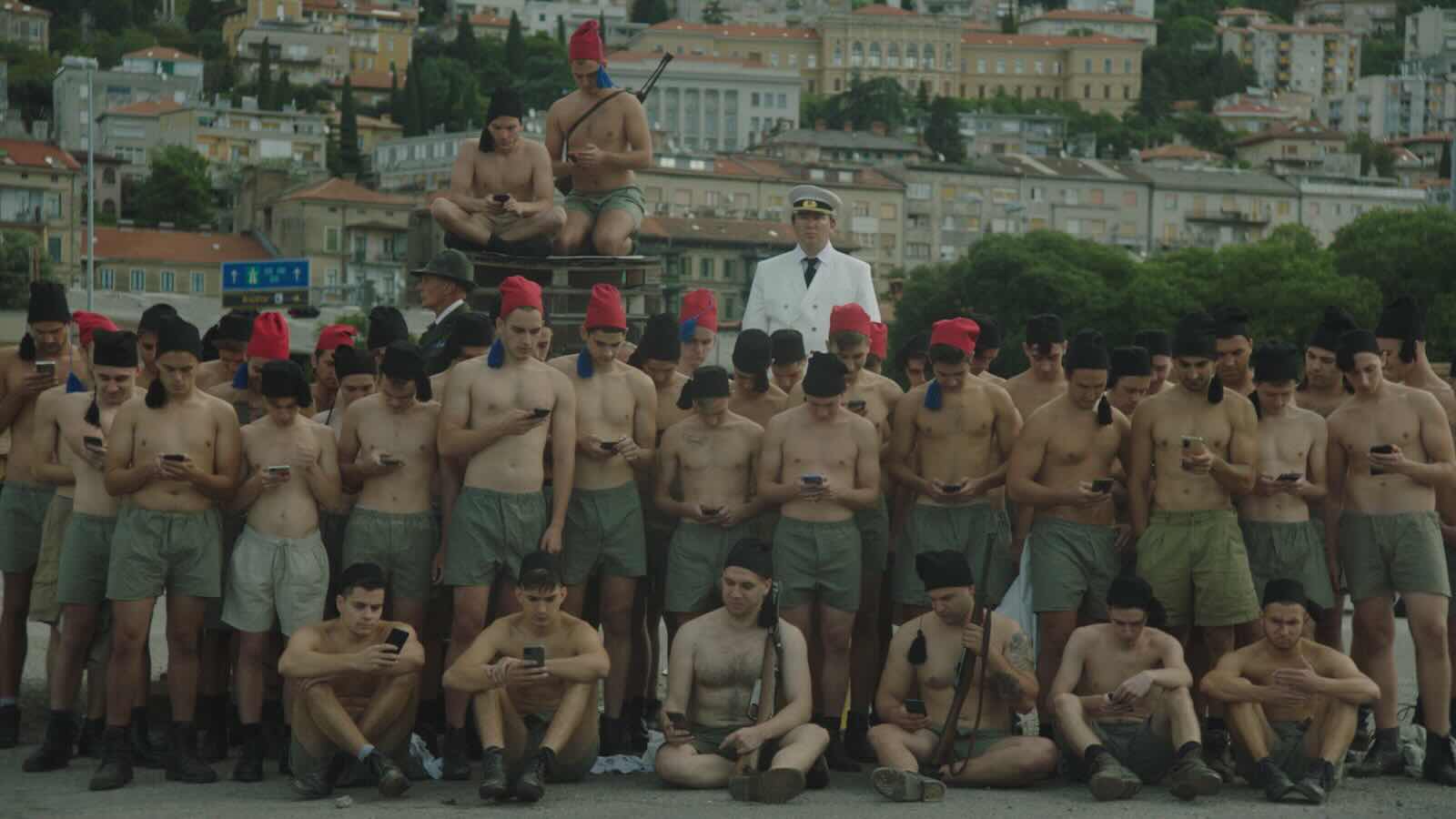
Capturing both the absurdity and tragedy of this prescient episode, the documentary Fiume o Morte! (2025) manages to hit both notes simultaneously in every frame, as it flips back and forth between the numerous photographs of the occupation and their modern reinterpretations. While the simple yet surreal contrast between the former Fiume and present-day Rijeka (as it is now known) is enough to make the documentary visually arresting and refreshingly daring, it’s the inventiveness at the film’s core that infuses it with warmth and adds to its depth. Rijeka is filmmaker Igor Bezinović’s hometown, and it is this personal touch (in one of the opening shots, he points out his former high school) that radiates throughout the film, as he shares the retelling of the siege with other locals, cleverly realizing that the most fitting tribute to this fascist ordeal is a democratic one.
This tactic is especially effective in depicting D’Annunzio, whose character is played by seven different non-actors. It reduces the self-proclaimed Duce to nothing more than a ridiculous figurehead whose only defining characteristics are that he’s middle-aged and bald. The film deftly illustrates how fascism was an idiotic nightmare from the start—showcasing details that will make viewers shudder with recognition, such as D’Annunzio’s claim of “election irregularities,” or how the song “Youth” was his soldiers’ anthem—but it’s the poetic justice of seeing ordinary residents reclaim their city's history that is its most compelling feature. It proves, once more, that history is written by the victors. In this case, the people of Rijeka.
Fiume o Morte! runs April 10-15 at Metrograph. Director Igor Bezinović will be in attendance for a series of Q&As on April 10 and 11.