How is it that I have not heard about a single movie my godmother watched on Amazon Prime this year? Part of this has to do with the fact that we live in different countries, but the main reason is that I don’t go looking for movies on Prime. I go to the theater, I go to recondite websites, and I browse YouTube. I have more or less, and for worse, severed myself from popular media. At the same time, popular media has become so alienating that it’s hard to maintain a real relationship with it. Even weirder still is that there’s this ambient feeling that those weird films I’ve dedicated my life to are increasing in popularity.
There are new theaters popping up across the country (look at Partizanfilm in Vermont) and the world (here in Mexico, Miko Revereza and Carolina Fusilier inaugurated Cinema Antena in Oaxaca). Younger people are attending repertory cinemas in New York and everyone loves Mikey and Nicky, Mouchette, and All About Lily Chou-Chou—at least according to Letterboxd. The state of cinephilia seems like it’s in a good place, but the state of cinema writ-large does not. All of this year’s tent-pole films were declared financial flops. Warner Bros. has capitulated to larger market forces. AI divisions are popping up at major studios. As Kent Jones argued almost a decade ago, what is left of cinema has become marginal.
This transition raises new issues. Negatives include the increasing presence of PR-talk in criticism and the eventization of all movies big and small. Both produce a culture in which films cannot be assessed or viewed through reasonable lenses, as every new release is charged with the expectation of saving cinema or the accusation of destroying it. But, on the positive side of things, there appears to be a new contingent of well-informed, tech-savvy critics and programmers who managed to familiarize themselves with the filmographies of once-marginal directors like Straub-Huillet and João César Monteiro, and who are directing people to the artists they hold dear through loving tributes and well-researched essays, as opposed to hype-talk and fawning writing. At this moment in time, perhaps that level of dedication can make the marginal not quite mainstream, but of increasing importance to conversations surrounding cinema history and its future.
What is collected below represents some of my own encounters with films that made me think about where the medium can go and where it hasn’t been before. Also, a few frustrations with new films and filmgoing experiences, as well as some simple praise for those theaters and programmers who preserve New York’s film culture.
January
Peter Watkins passed away on October 30, 2025. Earlier in the year, New York audiences were able to catch an anniversary run of his last completed film, 2000’s La Commune (Paris, 1871) at Anthology Film Archives. Two months later, even more devoted cinephiles were able to watch 1987’s The Journey at Spectacle. Both of these screenings preceded his death. Thus, when he died, locals, or at least peers, felt a true loss, having engaged with his films throughout the year. Watkins was a true maverick who never compromised his formal ambition or political beliefs. I believe, in part, that this is the reason his loss felt so heavy now, when comparable artists are far and few between. Hopefully more people around the world are awarded the opportunity to watch and read more of his work.
February
As tiresome as the surplus of hybrid films (docufiction, experimental docs, post-fiction, et cetera) at festivals has become, I cannot deny that this year’s edition of Doc Fortnight hosted the most exciting new films of the year. Among these I count Alexander Horwath’s Henry Fonda for President, Jessica Sarah Rinland’s Collective Monologue, Seth and Peter Scriver’s Endless Cookie, Julian Castronovo’s Debut, and Hernán Rosselli’s Something Old, Something New, Something Borrowed. These were all personal films made, as far as I can tell, on humble budgets. Each toyed with film form in unique and unprecedented ways. But wilder still, all of these unconventional works managed to secure U.S. distribution with the exception of Rosselli’s film. Perhaps that can be amended, perhaps not. Either way, it seems that the glut of doc-fic hybrids that has populated the last decade or so of arthouse cinema is finally giving rise to more than just one gem a year.
March
March belonged to La Clef Revival and their New York roadshow. The collective, which banded together to purchase Cinema La Clef in Paris, came to New York to raise the necessary funds to repair their theater. As part of their fundraising efforts, they presented a series of films in cinemas across the city. I attended two of these shows: Guy Gilles’s Earth Light (1970) at Anthology Film Archives and Rabah Ameur-Zaïmeche’s Dernier maquis (2008) at Spectacle. Both films proved tremendous, and it surprised me that neither had screened in New York. Herein lies a reminder that we owe much to those strong-willed groups of cinephiles scattered across the world, who often work over-time and without recompense, because their tenacious research and adventurous spirit reveals what has been omitted from the canon. Cinema La Clef will reopen on January 14, 2026.
April
There were few new films at New Directors/New Films.
May
Sarah Maldoror and Miguel Littin. These were, fittingly, the key figures of May. Maldoror was the subject of a retrospective at the Museum of Modern Art and Littin the focus of a single screening at Light Industry. Like Watkins, both filmmakers’ careers reflect an ironclad commitment to art and politics. Though I caught a mere three screenings from the Maldoror retrospective, each film included in said screenings demonstrated the Guadeloupean-French director’s restless curiosity as a filmmaker, as well as her lifelong commitment to detailing the lives of kindred artists across the world. Her filmography represents a bottomless well of wonders and I regret not making more time for her this year.
On the other hand, Light Industry’s presentation of Littin’s The Jackal of Nahueltoro (1969) jump-started my ongoing mission to watch all of his films. (Thankfully, most of them have been digitized and made available online thanks to Chile’s National Cinematheque.) I have yet to be disappointed.
June
Again, MoMA. This time: Andy Warhol’s Blue Movie (1969). Half of it is tinted blue, the other half orange. All of it is perfect, plus I’m certain it proved a major influence on Ira Sachs’s Peter Hujar’s Day, which I just so happened to enjoy a great deal. History works in waves and it seems that the fruits of yore are resurfacing in the films of now. Sachs recaptures the breeziness of this Warhol flick, and Louise Weard appears to have revived the anarchy of the late artist’s clique in her own Castration Movie, a mammoth of modern-day filmmaking that upholds a quality I hold dear in filmmakers: brazenness.
July
I am ashamed that while I spent most of my formative years in Mexico, I did not delve into its cinematic history until very recently. But, this is a sad fact for most of us third-worlders now stationed in the States; in discussing Lino Brocka with fellow contributor Mick Gaw, he remarked that it was not until moving to New York from the Philippines that he encountered his work. (In all fairness, Mexico does have a robust film preservation tradition, and an interest in disseminating classic cinema, but much of this is concentrated in the capital or cities like Guadalajara and Morelia as opposed to the small state where I hail from: Chiapas.) So, whenever films from Mexico land in New York, I make an effort to watch them. This was the case when MoMA organized their tribute to María Félix this summer.
Félix is the Mexican movie star par excellence. Her name invokes the Golden Age melodrama in much the same way Dolores del Río does, although her demeanor shares more in common with actresses like Marlene Dietrich and Louise Brooks. She was a powerhouse performer whose off-screen behavior enhanced her on-screen magnetism. Her character alone necessitated being filmed, and the added glamor that made her so distinctive justifies the existence of the camera. This became evident in the three films I caught of hers at MoMA: Doña Bárbara, Tizoc, and Doña Diabla. The last of these bears special mention. It starts with Félix firing off a gunshot under the cover of night and then details how she earned the nickname “Ms. Devil.” She’s framed as the Devil and owns it. All one can do is admire her marvelous misdeeds.
August
I was in London for a week in August and caught a showing of Five Easy Pieces on 35mm at The Prince Charles Cinema. Talking through the trailers with my friend, an older British gentleman tapped me on the shoulder and said something along the lines of, “Please, this is a movie theater.” That pettiness that passes off at etiquette exists on both sides of the pond.
September
I’ve never been a regular at IFC, but every time I’ve been in recent years has been quite special. That’s where I first saw Celine and Julie Go Boating and that’s also where I caught Kiyoshi Kurosawa’s Cloud this year. In September, I attended a 10 p.m. showing of John Woo’s The Killer. A few months before that, I saw Jia Zhangke’s Platform on 35mm there. The former was part of an expansive Hong Kong Cinema Classics series and the latter part of a robust retrospective dedicated to the Chinese filmmaker. All of this to say, those screenings weren’t lone incidents and IFC is killing it.
October
Over the last year, New York programmers and audiences have demonstrated a predilection for Portuguese cinema. This has manifested itself chiefly between MoMA and Metrograph. The zenith of this obsession came to be MoMA’s tribute to João César Monteiro in October, which brought together his life’s work, much of which was presented on 35mm. Where do we go from here? Perhaps the answer lies in Narrow Margin’s next issue, which will be in part dedicated to Rita Azevedo Gomes.
November
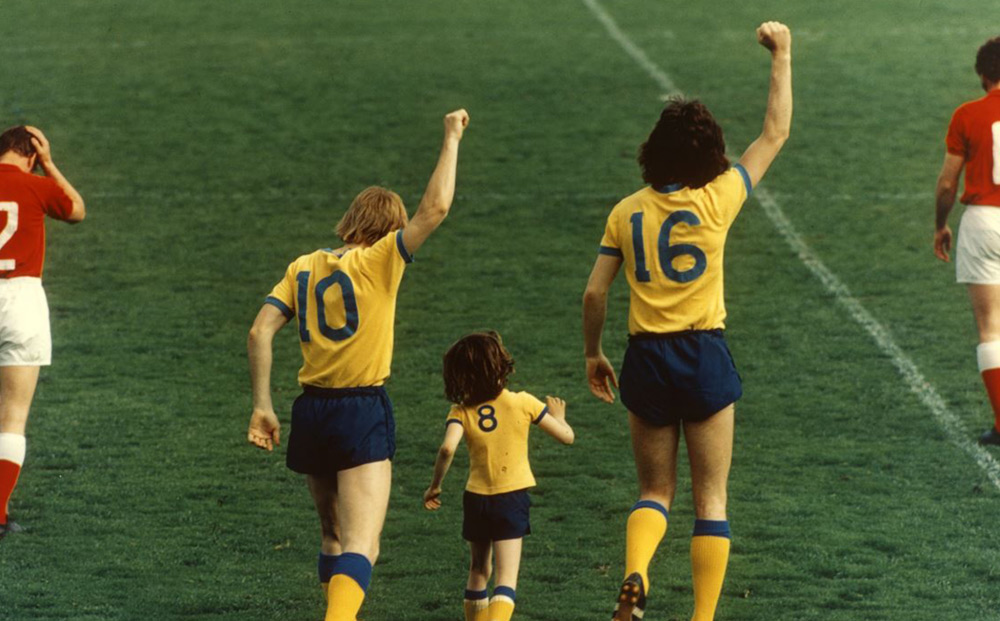
At 11 a.m. on November 9, I attended a screening of Bo Widerberg’s Stubby (pictured at top). The film is about a seven-year-old football prodigy who gets recruited to Sweden’s national team. It is a hilarious and educational fable with a hidden melodramatic dimension. Halfway through the film, Stubby is attacked by fans for not signing autographs and acting like a diva; but, as he tells one of his teammates, the truth is that he still hasn’t learned how to sign his name and is too embarrassed to tell anyone. The scene stings and it’s the closest I’ve come to crying at the movies in years. Also in attendance was Jake Perlin, who claimed Stubby represented the “rep event of the year.”
Up at L’Alliance New York, Perlin and his colleagues put on a retrospective that might also be deemed the “rep event of the year.” It was their yearlong tribute to Yannick Bellon, a French filmmaker who worked outside the establishment and made films tackling perennial issues of social life: love, divorce, queerness, assault, gentrification, loss. Her work remains underseen, but Perlin and his colleague Chloe Dheu’s efforts offered a corrective that might, one day, make Bellon’s films more known.
December
There is only so much blue one person can take. This is how I felt after watching Avatar: Fire and Ash at an empty multiplex in Southern Mexico. The rep experience offers endless, ephemeral experiences that make one think; the multiplex experience instead offers bloated, mindless variations on the same thing. None of this is new and my concern, above all, is personal. It has to do with the fact that I’ve sought refuge in repertory cinema, in part because I cannot tolerate what’s out there right now. These are, to invoke the title of one of A.S. Hamrah’s latest books, End Times. But, rather than hide them out, as I have done, we must confront them head on. It is difficult to write something intelligent, critical, and worthwhile about films like Avatar or Avengers: Doomsday, but it must be done. Otherwise, we’re done for.
Feedback Loop is a column by Nicolas Pedrero-Setzer reflecting on each month of repertory filmgoing in New York City.