A week ago, Letterboxd sent me an automated email stating that I’d already watched 52 films this year. I was surprised about this for a number of reasons. First, because I was unaware that Letterboxd was tracking my viewing statistics so habitually since my account is still linked to the email I used in high school and rarely check these days. (I also refuse to upgrade my account out of stinginess and, well, because I don’t believe in giving more time and money to social media platforms that consume so much of mine and other people’s attention.) Second, because I had promised myself I’d watch less movies after feeling like I’d shirked so many of life’s other joys when Letterboxd sent me my Year-in-Review in December. Although the numbers of films I had apparently watched paled in comparison to those of other critic friends, they made me look like even more of a freak when compared to the modest stats my more well-adjusted friends were sharing. And lastly, because much of my viewing this month has taken place indoors on my laptop due to the chilly weather, sudden apartment repairs that have necessitated my staying home more than usual, and the fact that I tend to work from behind a computer. It’s this last point that informs my writing today. Though it seems I have been watching a fair amount of films this month, the only ones that have stuck in my head are those I saw in theaters. Sure, the point is obvious to all readers of Screen Slate, but I think it bears repeating at a moment when the gap between a film’s theatrical window and its streaming availability has become smaller than ever, and when just about every film seems like it’s one YouTube, Internet Archive, or Ok.Ru search away.
To avoid the obvious and perhaps trite sentimentalism that has buoyed so many writers’ calls to keep theatrical viewing alive (here, I include my own past writing on the subject), I will not list the many merits of filmgoing. Instead, I’d like to focus on what defines that oft-unmentioned, entirely unavoidable, and absolutely necessary practice of watching screeners that makes up most of my life as a critic-cum-programmer. As an aside on the magic of IRL-movie-watching, all I will say is that I cannot imagine any experience at the movies this year surpassing the treat that was viewing Lino Brocka’s Macho Dancer (1988) with a full house at the Museum of Modern Art’s Titus 1 as part of this year’s edition of “To Save and Project.”
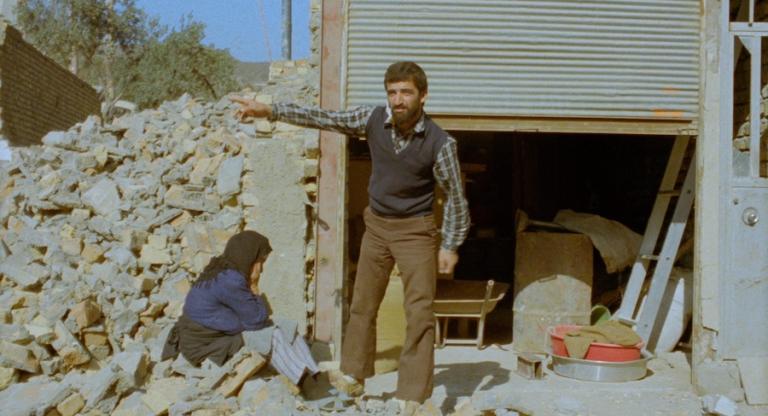
The flipside to that magical experience was tasking myself with watching Ciro Durán’s La Paga (1962) and Jomí García Ascot’s On the Empty Balcony (1961) on the same 15” laptop screen on which I am typing these words. Both films are treasures, and I wrote about them for the site, but they are also slow, lyrical, sumptuous visual experiences. All of these aspects were warped on my laptop. The slowness, with my added pausing for glasses of water, became exaggerated, and the films’ lyricism impacted because they were no longer operating on their own time but my own. Diminished to a tiny screen, it goes without saying that the films' visual punch also suffered. Yet, through training in such watching, I worked to latch onto each film’s images, rhythms, and provocations. Knowing their rarity and the virtual inaccessibility of these restorations, I reminded myself of the great privilege that watching such films at home represents, and the respect that writing about these works necessitated so that more people would seek them out. Yet my writing on these films avoided any of this contextual baggage, in part because it would have proven distracting from the points I was trying to make, but also because I form part of the generation that implicitly understands they are watching films in subpar conditions while pretending to write about them as though this were not the case.
I have had screeners expire on me. I have taken multiple hours to watch a 90-minute film. I have watched film files without subtitles and others where the frame-rate appears to be worsening in real time. I believe all of these experiences are part and parcel of being a cinephile today. I have also watched (and shown) red or scratched-up prints. I assume other filmgoers, critics, and programmers before me did too. And, that it was even more difficult to access bad prints of magnificent films a decade or more ago than it is to find bad copies of most films on the Internet nowadays. Though I have complained about the setbacks of watching Vimeo screeners, it is undoubtedly part of the job and a silly thing to gripe about within the grand scheme of things. Though imperfect, they make my work possible, because I cannot run off to a press screening at 11 am on a weekday, or to a festival in a far-flung city. Screeners, YouTube videos, bad prints, and subpar DVDs all serve the same function for the programmer and critic today. They are more or less research tools. And it is for this reason that the experience they impart on the viewer is dissimilar from that which the cinema does. The latter commands attention, while the former demands it.
The reason I can only properly recall five out of the 52 films I watched over the last few weeks relates to this difference. Logic should dictate that if I was focusing my attention on films I was watching online, I would be able to remember them with greater clarity. Yet, like so much in life, it is that which appears unexpected, and before which one appears smaller, that leaves the greatest imprint on memory. So, because I was forcing my brain on those little movies on my computer, it seems I have exhausted their meaning in my mind, whereas because I surrendered my body to larger films that were exerting their entirety on me, they have stuck in my head. These are different conditions of viewing, and ones all people who watch movies to murderous effect alternate between even though they do not state so in writing, or are awarded the wordcount to discuss it.
In this age of media agglomeration, I have become convinced that is not sufficient for a film critic or programmer to discover an artist or unearth a film (if that was ever even the case), but it is their duty to recover a film from the slop-heavy digital swamp where all art—good or bad—is drowning and confer upon it dignity in the form of a write-up that goes beyond summarizing its vibes or a screening that treats it like a passing fad. That is the only chance films still have to cast a real impression on people. Otherwise, the art survives in degraded form: as Vimeo links, ripped files, and numbers on a bi-weekly Letterboxd email.
Feedback Loop is a column by Nicolas Pedrero-Setzer reflecting on each month of repertory filmgoing in New York City.