Ramón Rivera Moret’s Everything Seemed Possible (2025) derives its title from an essay by Arcadio Díaz Quiñones in which he describes Puerto Rico during its relentless modernization campaign in the 1950s: “Everything seemed possible, new, a frontier. They vaccinated us, they educated us, moved us. The past was misery, another world, another century, another planet; we needed it less and less and we had to discard it forever.”
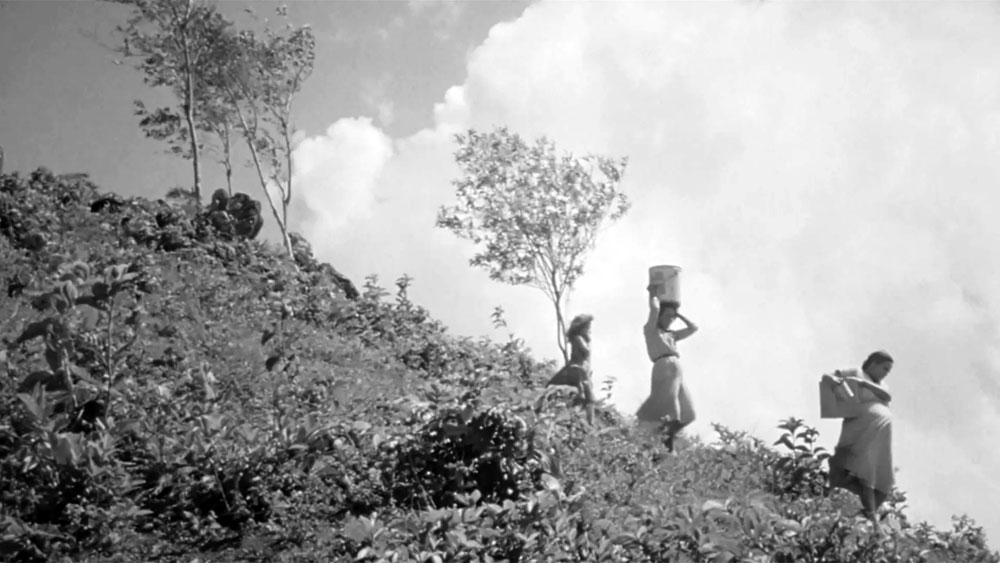
The campaign’s architect was Luis Muñoz Marín, a journalist and socialist in his youth, who was elected governor in Puerto Rico’s first democratic contest in 1948 after 50 years of American rule. Muñoz Marín introduced a national program of urbanization and industrialization that included the construction of roads, subdivisions, and factories, as well as the widespread distribution of consumer goods. He also created the Division of Community Education (DIVEDCO), which employed artists and writers to make films, in collaboration with rural communities, about a variety of social and economic problems that the changing country faced.
In Everything Seemed Possible, DIVEDCO’s films are used to examine this period of radical transformation, and are interpreted as a sacred social and artistic experiment in and of themselves. In one DIVEDCO film called El Puente (1951), a rural community is afflicted by a river that regularly floods the town. During a dramatic thunderstorm, a young boy nearly drowns trying to swim across it. This sequence uses an Eisensteinian montage of rapid cuts that generates the feeling of panic induced by the flood. In the storm’s wake, the townspeople organize a meeting and gather together to build a bridge across the river by hand.
Other films produced by DIVEDCO reckon with the murkier outcomes of “progress.” In El Santero (1956)—shot by Rivera Moret’s great uncle, the cinematographer Gabriel Tirado—a rural artisan known for carving wooden saints can no longer find a buyer for his creations. In a heartrending sequence, the artisan sees a factory where icons are mass produced and decides to give his saints away to the Museum of Anthropology, History, and Art. Rivera Moret quotes a letter his grandmother wrote to a newspaper editor about a proposed coal plant in her hometown of Carrizal: “it is progress that will turn [Carrizal] into a cemetery.”
Toward the end of Everything Seemed Possible, Rivera Moret introduces Paco Collet, a former community organizer with DIVEDCO. As Collet paws the fruit of his sugar apple tree, 50 years after DIVEDCO’s dissolution, we hear him speaking in voiceover. One of the principles of a democratic life for him and his fellow organizers, he says, was that “the solution to a problem is not more important than the way in which the problem is solved.” For those seeking true progress, in Puerto Rico and elsewhere, this is a principle best remembered.
Everything Seemed Possible screens this evening, June 10, at BAM as part of the series “Everything Seemed Possible + Shorts Films of the Puerto Rican Film Unit.” Director Ramón Rivera Moret will be in attendance for a Q&A.